Representative End User Clients







Representative Automation Clients







Representative Software Clients









KEYWORDS: Industrial Ethernet Switches, Cybersecurity, Network and Security Convergence
Industrial Ethernet switch buyers must navigate a complex landscape of technical features, certifications, and market dynamics. Escalating cyber threats have recently made cybersecurity and network manageability top priorities. By prioritizing integrated security, centralized management, and compatibility with both IT and OT environments, buyers can position themselves for success in a challenging and dynamic market. In response, modern industrial ethernet (IE) switches increasingly feature centralized policy enforcement, integrated security protocols, and unified management interfaces.
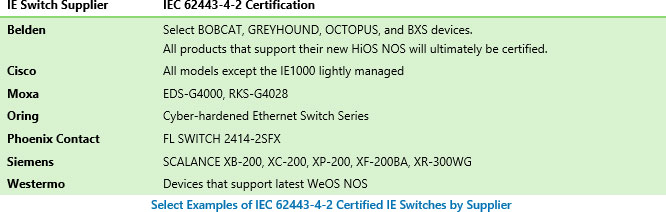
The proliferation of connected devices in industrial environments is amplifying the potential attack surface, making it critical to minimize vulnerabilities through network segmentation, access control, and integrated threat detection. Escalating cyber threats and compliance with current and emerging cyber regulations and certifications, including the Cyber Resilience Act (CRA) and the European Network and Information Security directive (NIS2), have made integrated cybersecurity and network manageability top priorities for industrial buyers. Modern devices increasingly support built-in security mechanisms as well as centralized policy enforcement, integrated security protocols, and unified management interfaces while protecting critical systems against evolving digital threats. IEC 62443-4-2 certification is emerging as a foundational requirement, while embedded firewalls and standard authentication mechanisms are increasingly mandated. IT/OT convergence further requires IE switches to support both enterprise and industrial requirements, enabling consistent oversight and compliance across diverse environments.
The trend toward embedding firewalls within industrial Ethernet switches is increasingly prominent as IT/OT convergence intensifies and demand grows for robust, scalable cyber defenses in operational environments. This shift is driven by both regulatory requirements and industry best practices as organizations seek to bolster cyber defenses amid rising threats and an expanding attack surface.
Firewall capabilities embedded in IE switches enable granular policy enforcement and real-time monitoring without the cost and complexity of deploying separate security appliances for each network segment. Regulatory pressures, such as the EU's Cyber Resilience Act, further incentivize vendors to deliver switches that are certified for technical security requirements, ensuring compliance and customer confidence in markets where cyber standards are becoming mandatory.
Major vendors are integrating advanced security features directly into their switch portfolios. Leading provider Cisco, for example, has integrated its Cyber Vision capabilities for continuous visibility, anomaly detection, and network segmentation throughout its Industrial IoT portfolio. This approach streamlines security deployments by turning switches into active security sensors, eliminating the need for standalone appliances and supporting frameworks like Zero Trust and Defense-in-Depth.
Security is likewise a top priority for Belden and their Hirschmann brand of IE switches. Their newer switches are compatible with their nextgen HiOS network operating system that includes advanced cybersecurity features such as IEEE 802.1x port-based access control, varying privilege levels, configurable password policies, security status monitoring, and audit trails. Similarly, companies like Phoenix Contact and Westermo are embedding firewall capabilities and secure communication protocols into their managed switches to address growing threat landscapes and regulatory requirements.
ARC Advisory Group clients can view the complete report at the ARC Client Portal.
Contact Us if you would like to speak with the author.
Obtain more ARC In-depth Research Market Analysis.