Representative End User Clients







Representative Automation Clients







Representative Software Clients









Digital transformation is reshaping industries at an unprecedented pace—from “precision profiling” in retail to “one-stop government services” in public administration, and from “robots replacing human labor” on factory floors to “digital twins” for cloud-based collaboration. The annual Year in Infrastructure (YII) Going Digital Awards showcase cutting-edge applications of digital technologies such as AI, cloud platforms, and digital twins.
This year, Bentley YII 2025 received nearly 250 projects from 47 countries and regions. An independent jury, including ARC Advisory Group, selected winners across 12 categories and 18 Founder’s Honor Awards. Projects from China won four awards: Baosteel Engineering & Technology Group (Energy Production category), China Energy Engineering Group Guangxi Electric Power Design Institute (Energy Delivery category), PowerChina Henan Electric Power Survey & Design Institute (Founder’s Honor Award), and Shanghai Investigation, Design & Research Institute (Founder’s Honor Award). These four projects will be introduced one by one in this four-part series.
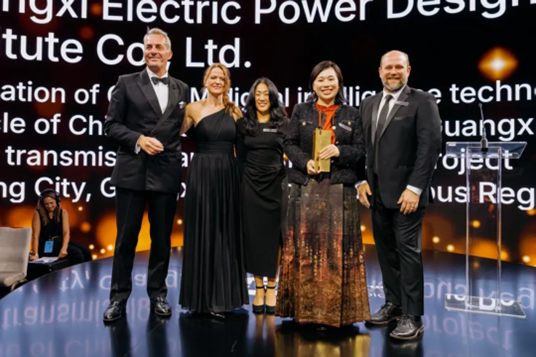
China Energy Engineering Group Guangxi Electric Power Design Institute, founded in 1958, has always been deeply engaged in the energy and power sector and related engineering fields. It has developed into a national, Class-A comprehensive engineering company uniquely integrating survey and design for hydropower, thermal power, and power grid projects. The Engineering Digital Center of Guangxi Electric Power Design Institute has established a digital survey and design framework, forming an integrated solution based on the UAV remote sensing + Bentley + HydroStation + supmapGIS platform. This solution has expanded digital BIM application scenarios into hydropower, thermal power, power grid, construction, and smart agricultural distribution network businesses.
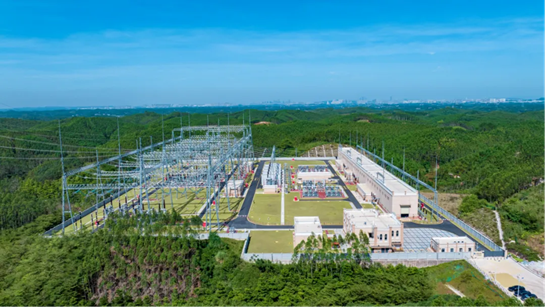
The award-winning project is in Nanning City, Guangxi Zhuang Autonomous Region, China. Implementing the "Strong Capital" strategy, the project meets the rapidly growing load demand of Nanning's Wuxiang New District, the China (Guangxi) Pilot Free Trade Zone Nanning Area, and the ASEAN Information Harbor. It simultaneously optimizes the grid structure of the Nanning power grid, improves power supply reliability, advances the construction of a world-class smart grid in Nanning, and helps build a comprehensive energy big data service platform.
The project is situated in the hilly terrain of the southeastern Nanning Basin, characterized by numerous stratigraphic types, diverse properties, uneven distribution, complex geological profiles, and high environmental protection requirements. China Energy Engineering Group Guangxi Electric Power Design Institute applied GIS + BIM technologies throughout the entire lifecycle, starting from the feasibility study stage and establishing a complete digital management system covering planning, construction, operation, maintenance, and decommissioning.
Utilized the ProjectWise collaborative platform to enable real-time, seamless communication and parallel collaborative design among various upstream and downstream disciplines, improving design efficiency and quality.
Integrated finite element analysis software to unify models and data formats, reducing repetitive modeling work and enhancing computational analysis efficiency.
Used OpenRoads to generate high-precision 3D terrain models, rapidly calculate earthwork cut and fill volumes, and provide reliable data support for rational site selection and layout planning.
Built a GIS platform, imported models, and achieved interactive integration of model data with geographic information data. This integrated multi-dimensional data such as ecological protection redlines, farmland, and cultural relics, enabling large-scale scene visualization and data query functions.
Regarding operations, Zhirong Huang, Chief Engineer of Project Design, stated:
"Leveraging digital technology, we’ve integrated data from the computer monitoring system, video surveillance system, online fire monitoring, and other systems at the substation. Operators can now monitor the entire station’s operational status via a single screen. Delivered in the lightweight GIM format, the project ensures data integrity and transmission efficiency, offering full-lifecycle data support for operations and maintenance. Most notably, it’s equipped with robot dogs for intelligent inspections, paired with drone-based patrols—truly achieving a green, intelligent, and efficient power grid."
Design time reduced by 10 percent and verification time reduced by 15 percent.
Construction period and engineering quantities reduced by 5 percent.
Steel consumption reduced by 10 percent.
Collision-related change orders reduced by 91.8 percent.
Optimized the spatial hierarchical layout of equipment bays, effectively saving construction land.
Achieved lossless delivery of model achievements in other 3D platforms and in systems such as construction and project acceptance systems.
This project fully demonstrates the value of “BIM+” technology, shifting from experience-based judgment to data-driven decision-making and construction pre-simulation, and from passive error correction to active prevention. During the operation and maintenance phase, it enables a shift from “periodic maintenance” to “precise intervention,” making the substation a “monitorable” and “controllable” smart grid node.
Summary
Upon commissioning, this project forms a “four-pillar” structure with the three existing 500 kV substations. It not only meets the load demand of Nanning and surrounding areas during the 14th Five-Year Plan period but also implements the national West-East Power Transmission energy strategy, further strengthening Guangxi’s role as an energy transmission hub. In this project, China Energy Engineering Group Guangxi Electric Power Design Institute applied digital tools throughout the entire project lifecycle—from planning and construction to operation—transitioning from conceptual innovation to practical application. It has created a model of deep integration between digital technology and power engineering, characterized by “intelligent construction and smart operation and maintenance.” By leveraging technological innovation to solve regional engineering challenges and establishing an industry benchmark with full lifecycle digital services, it provides a replicable solution for the digital transformation of the power industry.