Representative End User Clients







Representative Automation Clients







Representative Software Clients








KEYWORDS: Embedded AI, Machine Learning (ML), Edge AI, Generative AI, Large Language Models (LLM), Agentic AI
Industrial-grade AI isn’t just any AI. It’s the kind that’s been through the industrial wringer and comes out ready for the factory floor, clipboard in hand and safety boots on. As coined and discussed during this year’s ARC European Industry Forum in Spain, industrial-grade AI must be robust, explainable, reliable, and able to survive not only real-time applications, time-series data and edge deployments, but also the scrutiny of every engineer in the plant.
It’s not enough to be smart; the experts at the AI sessions underlined, industrial-grade AI must be... well, it wasn’t easy to define. Session members came up with an abbreviation all could agree on and even joke about. Industrial AI must be USSR: Understandable, Safe, Secure, and Reliable.
Expectation management is crucial in industrial AI projects. Overpromising can undermine credibility, while clear communication fosters collaboration, phased implementation, and sustainable return on investment.
In a twist of history, the USSR is back, but this time, it’s not about geopolitics, it’s about making sure your industrial AI doesn’t start a five-year plan for downtime. If your AI solutions can explain themselves, keep your data safe, survive a cyberattack, and still show up for work on Monday, congratulations, you may have industrial-grade AI. Let's put the winking to one side for now. The above definition is not accurate enough for the OT world, even though it’s catchy, so let’s go with this one:
Industrial-grade AI refers to artificial intelligence systems engineered for deployment in industrial environments, including real-time specific applications. Industrial-grade AI requirements include:
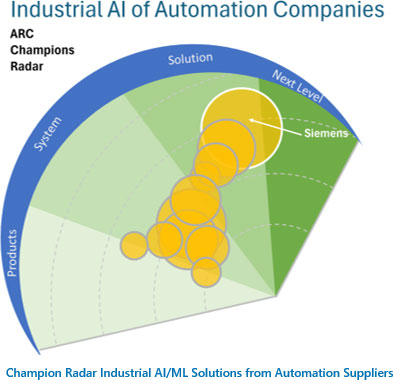 The champions radar chart is constructed using ARC’s established methodology and the scoring logic from the assessment. The horizontal axis represents the breadth of each company’s industrial AI portfolio, encompassing hardware, software, and services. The vertical axis reflects solution capability and future readiness, indicating the maturity and integration of industrial AI offerings. The bubble size corresponds to an indexed measure of CapEx in industrial AI for 2024.
The Champions Radar for Industrial AI Offerings and Solutions reveals a diverse landscape of automation companies, each contributing unique strengths and approaches to the development and deployment of industrial AI. The radar visualization, based on ARC’s methodology and the 2024 assessment, highlights not only the breadth and maturity of each company’s portfolio, but also the dynamic nature of the market—where innovation, integration, and adaptability remain ongoing priorities.
Siemens demonstrates a broad and mature approach to industrial artificial intelligence, with strengths in discrete and hybrid industries such as automotive, electronics, and machinery. The company’s portfolio includes AI-enabled hardware, advanced software platforms, and integrated solutions tailored to complex production environments. Siemens applies industrial-grade AI to support predictive maintenance, quality assurance, and process optimization, with a focus on flexibility, explainability, and edge deployment.
In hybrid sectors like food & beverage and pharmaceuticals, Siemens enables adaptive control and compliance monitoring. The company also maintains a presence in process industries, offering AI-driven optimization and asset performance solutions, though its most pronounced impact remains in discrete and hybrid domains. AI capabilities are delivered through platforms such as Xcelerator, which support real-time data processing and machine learning both at the edge and in the cloud. These platforms enable scalable deployment across engineering and operations.
While Siemens also applies AI in smart infrastructure and mobility, for building automation and transport system maintenance, its industrial AI strategy is primarily focused on manufacturing and production. There is ongoing potential to expand copilot/ agent-based use cases, particularly in process verticals, as customer needs evolve and new technologies emerge.
In a market with ever faster and shorter technology cycles and rising user expectations, reusable deployment patterns, rising agentic assistance along engineering and operations, and cross-domain data flows continue to gain importance. So, valuable data is key, as well as clear goals of what to achieve and to keep everything in line with industrial standards, laws and regulations, especially regarding safety, security and reliability.
Expectation management is essential for industrial-grade AI projects because these initiatives often involve complex technologies, long implementation cycles, and significant organizational change. For automation companies, setting realistic expectations helps avoid over-promising capabilities that current technology cannot deliver, which can damage credibility and customer trust. Clear communication about limitations, integration challenges, and the time required to achieve measurable results ensures that customers understand the true value proposition rather than expecting instant transformation.
For customers, managing expectations is equally critical to prevent frustration and misaligned investments. Industrial-grade AI is not a plug-and-play solution; it requires high-quality data, domain expertise, and iterative optimization to deliver reliable outcomes. Unrealistic assumptions about cost savings or performance gains can lead to project abandonment or strained vendor relationships. By aligning expectations early, both sides create a foundation for collaboration, phased implementation, and continuous improvement, ultimately increasing the likelihood of long-term success and sustainable ROI.
Industrial data fabrics are rapidly becoming the essential foundation for scalable industrial-grade AI and digital transformation in manufacturing and process industries. According to ARC’s latest research report, a well-architected data fabric enables organizations to unify and contextualize operational data from disparate sources, breaking down silos between OT, IT, and engineering systems. This unified approach accelerates time-to-insight, improves operational agility, and supports real-time decision making, which is vital for predictive maintenance, quality control, and process optimization. For automation suppliers, investing in data fabric platforms allows them to offer customers robust, open, and extensible solutions that avoid vendor lock-in and support vertical-specific applications.
End users benefit from improved data governance, faster ROI, and the ability to meet sustainability and ESG reporting requirements. Machine builders gain a competitive edge by enabling their equipment to seamlessly integrate into customers’ digital ecosystems, supporting autonomous operations and advanced analytics.
ARC’s report highlights that the market is experiencing high growth potential, driven by the need for efficiency, resilience, and the strategic imperative to scale industrial-grade AI across the enterprise. For all stakeholders, understanding and leveraging industrial data fabrics is crucial for future competitiveness and innovation. Get in touch with us or directly with the author Colin Masson, ARCs global industrial AI expert.
Data quality and data sharing are fundamental pillars for successful industrial-grade AI projects. High-quality data ensures that algorithms can deliver accurate predictions, optimize processes, and support reliable decision making in complex industrial environments. Poor or inconsistent data can lead to flawed models, operational inefficiencies, and increased risk, undermining the value of AI investments.
Equally important is data sharing between stakeholders. Industrial-grade AI thrives on diverse datasets from machines, production lines, and supply chains. When automation companies and customers collaborate to share relevant data securely, it enables holistic insights and advanced analytics that single data silos cannot provide. This collaboration accelerates innovation, improves scalability, and maximizes return on investment.
Without robust data quality and transparent sharing practices, even the most advanced AI solutions cannot reach their full potential. For automation providers, it means delivering trustworthy systems; for customers, it means unlocking efficiency, sustainability, and competitive advantage.
Industrial edge AI is rapidly transforming how intelligence is deployed in manufacturing and automation. By moving industrial-grade AI processing from the cloud to the edge—closer to machines and data sources—companies can achieve real-time decision making, reduce latency, and address critical concerns around bandwidth and data security. For automation suppliers, embracing industrial edge AI is essential to remain competitive, as customers increasingly demand solutions that deliver measurable value, such as improved quality, reduced downtime, and optimized supply chains. Machine builders and end users benefit from enhanced autonomy, predictive maintenance, and the ability to process vast amounts of machine data directly on-site, enabling faster responses and greater operational efficiency. The ARC research report provides a comprehensive analysis of the industrial edge AI market, highlighting growth opportunities, key challenges, and the evolving ecosystem of hardware, software, and services.
Despite the growing interest in generative AI, large language models (LLM) continue to face critical limitations, most notably, their tendency to produce hallucinations and factual errors. These shortcomings have contributed to a significant gap between expectations and outcomes in industrial applications. A recent study by MIT’s NANDA Initiative revealed that around 90 percent of companies conducting AI pilot projects reported little or no return on investment.
In industrial environments, where reliability, precision, and domain expertise are paramount, generic AI tools often fall short. Industrial-grade AI must be engineered to solve specific operational challenges, such as predictive maintenance, process optimization, or quality control, where accuracy and integration with existing systems are non-negotiable.
Unlike consumer-facing applications, industrial use cases demand measurable improvements in productivity, safety, and cost efficiency. Specialized AI systems, trained on domain-specific data and tailored to interface with legacy infrastructure (e.g., PLC, SCADA), are far better suited to deliver these outcomes. They reduce the risk of errors, enhance decision making, and ensure compliance with regulatory standards.
Focus is also placed on companies offering ready-to-deploy (“out-of-the-box”) AI solutions. However, it is important to note that many end users also pursue in-house initiatives - investing in AI technologies, training proprietary models, and independently integrating artificial intelligence into their production processes. To realize the full potential of AI in industry, the focus must shift from general-purpose models to narrow, purpose-built solutions. These systems offer the precision, transparency, and contextual awareness required to generate real value in complex industrial settings.
ARC Advisory Group clients can view the complete report at the ARC Client Portal.
Contact Us if you would like to speak with the author.
Obtain more ARC In-depth Research Market Analysis.