Representative End User Clients







Representative Automation Clients







Representative Software Clients








In today's rapidly evolving scientific landscape, laboratories have moved beyond their traditional image of instrument-filled rooms. They are now data-driven ecosystems where efficiency, compliance, and innovation are central. At the heart of this transformation lies the Lab Information Management System (LIMS)—a digital platform that enables labs to manage samples, workflows, regulatory requirements, and large volumes of data.

LIMS platforms have evolved from basic data-tracking tools into automation-driven systems that support research, diagnostics, and industrial quality control globally. Modern laboratories generate large datasets, from genomics research to IoT-enabled instruments, requiring tools that can handle this complexity efficiently.
Explosion of Laboratory Data: The volume of information generated in contemporary labs requires structured data management approaches. LIMS provides a framework to manage everything from sample metadata to instrument outputs.
Regulatory Compliance: With stringent regulations in industries such as pharmaceuticals, food safety, and environmental testing, LIMS supports audit trails, data integrity, and standardized reporting, simplifying compliance and audit readiness.
Automation and Efficiency: Integration with robotics and cloud platforms has been associated with a 10–25 percent reduction in reagent usage and improvements in throughput. This automation reduces manual errors and accelerates laboratory processes.
Collaboration and Remote Access: Cloud-based LIMS solutions enable real-time collaboration, remote lab management, and global data sharing, supporting distributed teams and cross-border projects.
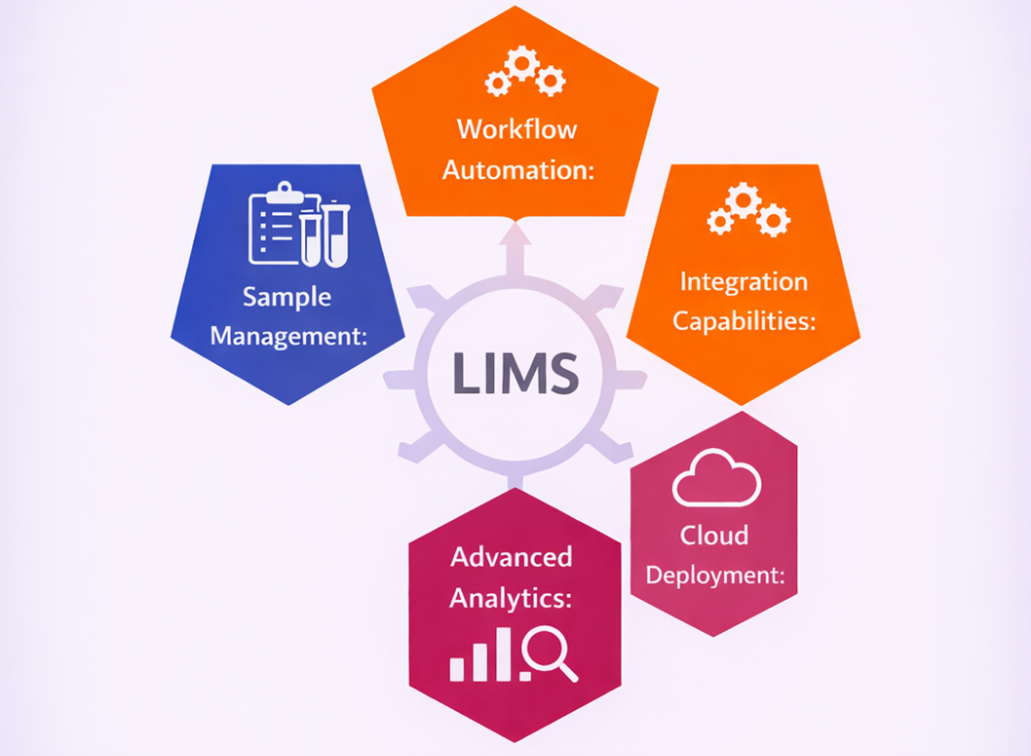
Sample Management: Traceability from collection to disposal ensures each sample's lifecycle is recorded and accessible.
Workflow Automation: Automated handling of repetitive tasks streamlines operations and improves productivity.
Integration Capabilities: Connectivity with analytical instruments, Electronic Lab Notebooks (ELNs), ERP, and hospital systems supports unified data flows.
Cloud Deployment: The dominance of cloud-based platforms provides scalability, cost-effectiveness, and accessibility.
Advanced Analytics: AI-powered analytics support trend identification, outcome prediction, and process optimization, turning data into actionable insights.
AI-Driven “Smart LIMS”: Artificial intelligence and machine learning are enabling more predictive systems that support decision-making.
LIMS as an Integration Hub: Acting as an orchestration layer, modern LIMS connects multiple systems and workflows for coordinated laboratory operations.
Cloud-First Adoption: The shift to cloud LIMS is becoming standard, offering scalability and reduced infrastructure requirements.
Interoperability and Open Systems: Laboratories increasingly require systems that integrate with diverse tools and platforms.
“Lights-Out” Laboratories: Automation is enabling labs to operate with minimal human intervention, supporting more autonomous environments.
Cybersecurity and Data Integrity: As digitalization increases, safeguarding scientific data is a growing priority, with LIMS playing a central role.
Enhanced data accuracy and integrity.
Quicker turnaround times for experiments and analyses.
Reduced operational costs.
Improved compliance and audit readiness.
More informed decision-making supported by analytics.
Looking ahead, Lab Information Management Systems are expected to evolve further. Deeper AI integration, real-time IoT-enabled lab ecosystems, blockchain for data integrity, and expansion into personalized medicine and precision diagnostics are emerging areas of development. By 2035, LIMS is likely to function not only as a supporting tool but as a core infrastructure for data-driven laboratories.
LIMS is increasingly important for laboratories seeking to maintain efficiency, compliance, and data-driven operations. Organizations investing in modern LIMS are positioning themselves for a future where speed, accuracy, and analytics will influence outcomes in both science and industry. As a core digital system, LIMS will continue to shape the next phase of laboratory operations.