Representative End User Clients







Representative Automation Clients







Representative Software Clients








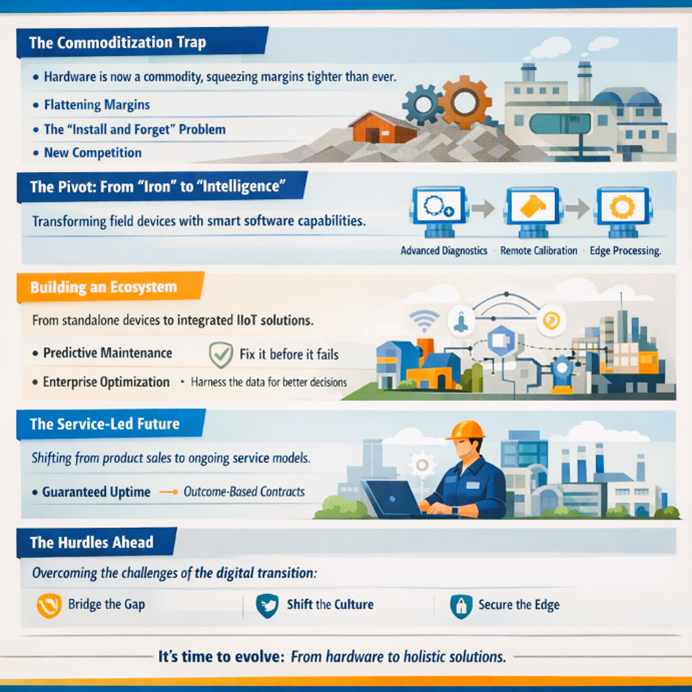
For decades, the standard for a good field device was simple: it had to be accurate, tough, and reliable. Whether it was a pressure transmitter or a flowmeter, if it held up in harsh conditions and delivered a steady signal, it was a winner.
But the industry has changed. Today, those same devices are caught in a pricing vice. As the technology has matured, the hardware itself has become a commodity. When every major vendor offers near-identical performance, the "differentiator" stops being the stainless steel housing and starts being the price tag. For many suppliers, the era of relying solely on one-off hardware sales is hitting a wall.
We are seeing a clear pattern across instrumentation:
Flattening Margins: As hardware becomes interchangeable, buyers naturally gravitate toward the lowest price.
The "Install and Forget" Problem: Because these devices are built to be incredibly durable, replacement cycles are stretching out, making it harder to grow revenue through hardware alone.
New Competition: Low-cost manufacturers are closing the performance gap, making it difficult for premium players to justify their traditional price points.
To break out of this cycle, leading suppliers are redefining what a "device" actually is. We are moving toward a model where the physical hardware is just the host for a much more valuable software layer.
Think of it this way: the hardware is the sensor, but the software is the utility. By embedding diagnostics, remote calibration, and edge processing capabilities, suppliers can now turn a static instrument into a dynamic asset that improves the longer it stays in the field.
The real shift is not just adding an app to a sensor; it’s about moving from selling standalone products to becoming a vital part of a plant’s digital ecosystem.
When a device acts as a data node for an Industrial IoT network, it stops being just a measuring tool and starts being a contributor to:
Predictive Maintenance: Moving from "fix it when it breaks" to "fix it before it fails."
Enterprise Optimization: Tying individual instrument data into broader asset performance management systems.
Perhaps the most significant change is the move from a product-centric approach to a service-oriented one. Instead of a large, one-time capital expenditure, companies are beginning to prefer an operational model where they pay for the outcome, such as guaranteed measurement uptime or continuous monitoring, rather than the physical box.
This transition from one-off sales to long-term service relationships is a win-win. It gives suppliers a steady stream of recurring revenue, and it gives the customer a partner who is incentivized to keep the equipment running optimally.
Of course, this transition is not simple. We are asking industrial teams to:
Bridge the Gap: Making modern software communicate with 20-year-old legacy infrastructure.
Shift the Culture: Moving internal teams from "hardware engineering" mindsets to "software/analytics" mindsets.
Secure the Edge: Protecting connected devices from the growing risk of industrial cyber threats.
The reality for instrumentation suppliers is stark: hardware will always be the foundation, but it is no longer the ceiling. The value, the differentiation, and the growth potential lie in the layers of software and services we wrap around that hardware.
The industry is moving toward a model of continuous, outcome-based value. For those willing to evolve their business models, this is not a threat—it is an opportunity to build deeper, more resilient partnerships with the customers they serve.