Representative End User Clients







Representative Automation Clients







Representative Software Clients








Smart flowmeters have become a critical component of modern process industries. With built-in diagnostics, digital communication, remote configuration, and integration into DCS, SCADA, and Industrial IoT platforms, these devices go far beyond simple flow measurement. However, as flowmeters become smarter and more connected, they are also becoming more exposed to cybersecurity risks.
For plant operators and automation engineers, the question is no longer whether flow data can be compromised—but how vulnerable the flow measurement layer really is.
Traditionally, flowmeters were isolated instruments with limited external connectivity. Today's smart flowmeters routinely support digital protocols such as HART-IP, Modbus TCP, PROFINET, Ethernet/IP, WirelessHART, and cloud-connected Industrial IoT gateways.
This connectivity makes flowmeters attractive targets for cyber adversaries for several key reasons:
Access to Critical Process Data: flow rates, totalized volumes, and custody transfer information.
Potential influence on process control, safety systems, and production efficiency.
Gateway into OT networks, especially when devices are poorly segmented from corporate IT.
High Trust Level: field instruments are rarely monitored with the same rigor as servers or PLCs.
Compromising a flowmeter may not immediately shut down a plant—but it can quietly distort data, disrupt optimization strategies, or undermine compliance and safety over an extended period.
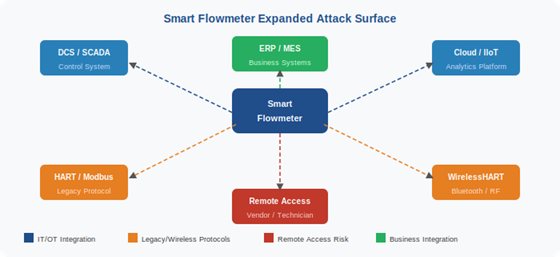
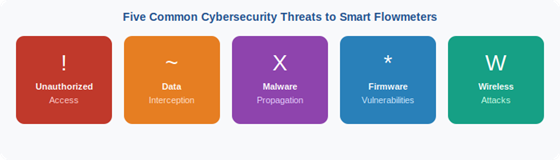
Smart flowmeters support remote access for calibration and diagnostics. Weak authentication or unchanged default credentials allow attackers to modify measurement ranges, disable alarms, or erase historical data without detection.
Impact: Even small parameter changes can cause billing errors, undetected product losses, or regulatory non-compliance—often going unnoticed for months.
Flow data sent over Ethernet or wireless protocols without encryption can be intercepted and manipulated. Attackers can inject false flow readings, alter custody transfer records, or leak sensitive production data.
Impact: In oil and gas, chemicals, and water utilities, manipulated flow data can lead to major financial losses, safety violations, and regulatory penalties.
Flowmeters sharing a network with PLCs or HMIs can serve as malware entry points. Exploited firmware vulnerabilities allow attackers to move laterally across the OT network and disrupt communications.
Impact: A single compromised flowmeter on an unsegmented network can become the starting point for a plant-wide ransomware attack.
Flowmeter firmware often goes years without updates due to incomplete asset inventories and the need for maintenance shutdowns. Attackers actively scan industrial networks for known, unpatched CVEs (Common Vulnerabilities and Exposures) on field devices.
Impact: Outdated firmware in custody transfer or safety-critical loops can expose operators to financial liability and regulatory penalties.
Wireless flowmeters add installation flexibility but open new attack surfaces—eavesdropping, unauthorized pairing, and signal spoofing are all possible when encryption and key management are weak.
Impact: In water utilities and remote pipelines, corrupted wireless flow data can silently distort operational decisions for extended periods before detection.
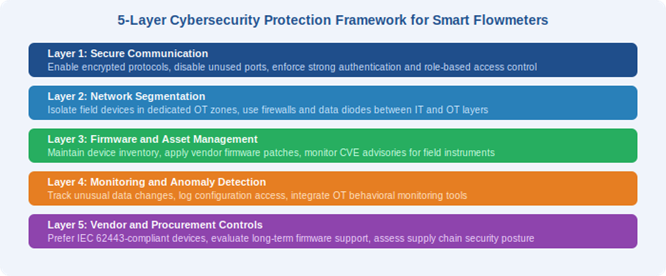
Smart flowmeters deliver immense operational value—but that value depends entirely on data integrity and trust. Treating flowmeters as inherently safe simply because they are field instruments is no longer viable in a connected industrial environment. Cybersecurity now begins at the sensor level: if your flowmeters are smart, connected, and critical to operations, they deserve the same protection as any other OT asset in your plant. The flow of data from your flowmeters is as critical as the flow of fluid through your pipes—protecting both is no longer optional, it is an operational and regulatory imperative.