Representative End User Clients







Representative Automation Clients







Representative Software Clients








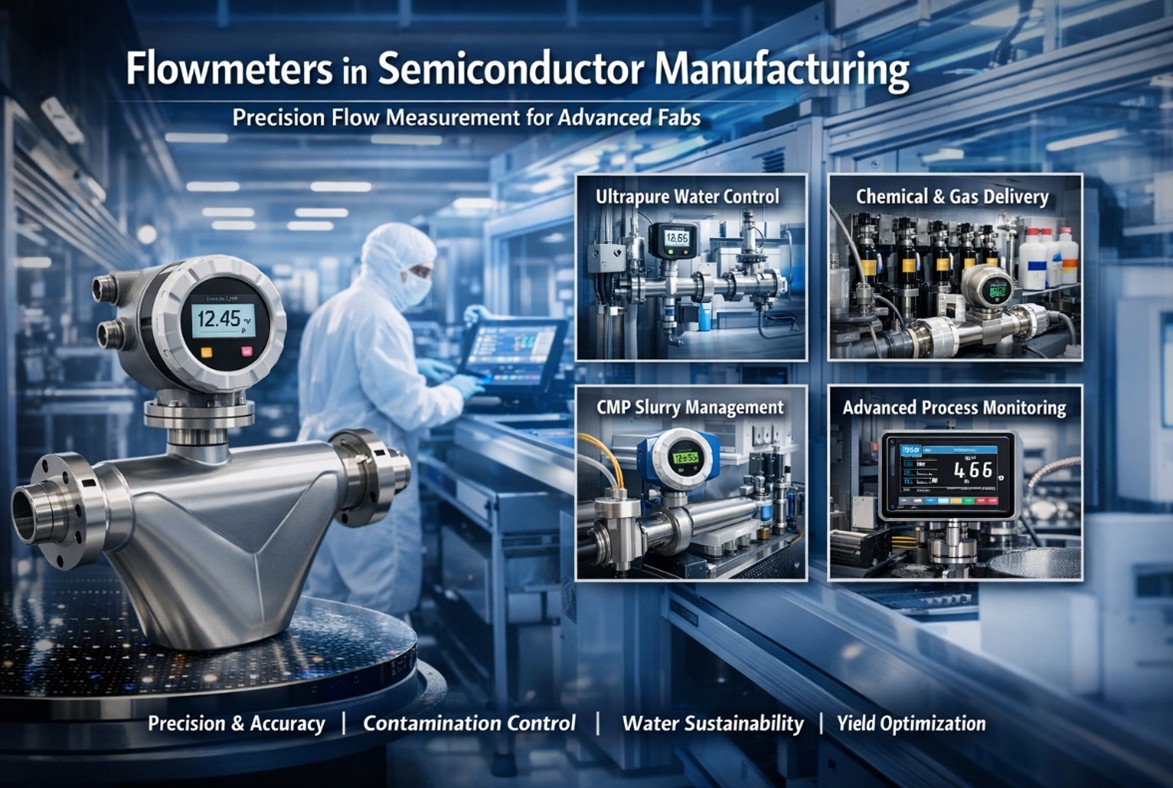
The semiconductor industry is entering an unprecedented phase of expansion and technological complexity. Driven by AI computing, electric vehicles, advanced packaging, and sub-5 nm process nodes, semiconductor fabrication facilities (fabs) are becoming larger, more automated, and more sensitive to process variation. In this environment, precision flow measurement—once viewed primarily as a utility/support function—is rapidly emerging as a strategic enabler of yield, reliability, and sustainability.
Flowmeters play a critical role across semiconductor fabs, from chemical delivery and ultrapure water systems to slurry handling and waste treatment. As fabs strive for tighter process control and higher throughput, the importance of accurate, repeatable, and contamination-free flow measurement has never been greater.
Semiconductor manufacturing involves hundreds of tightly controlled process steps, many of which rely on the precise delivery of liquids and gases. Even minor deviations in flow rate can impact film thickness, etch uniformity, cleaning effectiveness, or chemical concentration—ultimately affecting wafer yield and device performance.
Key fab processes that depend on accurate flow measurement include:
Chemical mechanical planarization (CMP).
Wet etching and cleaning.
Chemical vapor deposition (CVD) and atomic layer deposition (ALD).
Electroplating and surface finishing.
Specialty gas and chemical distribution.
Ultrapure water (UPW) generation, distribution, and recycling.
As process nodes continue to shrink, semiconductor manufacturers are placing greater emphasis on measurement stability, repeatability, and sensor reliability, elevating flowmeters from basic instruments to mission-critical process assets.
Ultrapure water is one of the most heavily consumed resources in semiconductor manufacturing, used extensively for wafer cleaning, rinsing, and cooling. With the number of process steps increasing at advanced nodes—and new fabs being built in water-stressed regions—water management has become a top operational and environmental, social, and governance (ESG) concern.
This has led to:
Increased deployment of flowmeters for real-time water usage tracking.
Greater focus on leak detection and loss prevention.
Expansion of water recycling and reuse systems.
Integration of flow data into digital water management platforms.
In this context, reliable flow measurement is essential not only for process control but also for helping fabs reduce water per wafer, optimize operating costs, and meet sustainability targets.
Semiconductor processes require ultra-high purity (UHP) chemicals and gases, where contamination at parts-per-billion levels can cause costly yield losses. Flowmeters used in these applications must meet stringent requirements for:
Clean internal geometries.
Low surface roughness.
Minimal dead volume.
Material compatibility with aggressive or reactive fluids.
Chemical Delivery Units (CDUs) and bulk specialty gas systems increasingly rely on high-accuracy mass and volumetric flowmeters to ensure stable, repeatable delivery to process tools. As fabs scale up production and move toward higher degrees of automation, flow measurement accuracy directly influences both product quality and fab uptime.
Rather than a one-size-fits-all approach, semiconductor fabs deploy multiple flow measurement technologies depending on the application and process criticality.
Current trends include:
Coriolis flowmeters for high-precision chemical and slurry measurement where mass accuracy is paramount.
Ultrasonic flowmeters for contamination-sensitive and ultrapure liquid applications.
Thermal mass flowmeters for ultra-high purity gas delivery.
Magnetic flowmeters for conductive liquids and facility water systems where conductivity is adequate (note: true UPW/DI water is often unsuitable for mag meters due to very low conductivity).
Differential pressure (DP) flowmeters for clean utilities and general-purpose services where robustness and proven measurement principles are preferred.
Vortex flowmeters for utility flows (e.g., certain gases/steam/plant utilities) where a durable, established technology fits the service conditions.
Miniaturized and low-flow sensors designed for point-of-use measurement.
In parallel, flowmeters are increasingly integrated with digital communication, diagnostics, and analytics, enabling predictive maintenance, remote monitoring, and better integration with fab control systems.
The global push for semiconductor manufacturing self-sufficiency—supported by government incentives and massive capital investment—is driving construction of new fabs worldwide. Each greenfield fab represents thousands of flow measurement points across process tools, utility distribution, and environmental systems.
This expansion is translating into:
Growing demand for semiconductor-qualified flowmeters.
Higher expectations for long-term stability and service life.
Increased collaboration between instrument suppliers, tool OEMs, and fab operators.
Greater standardization around cleanliness and performance specifications.
As fabs aim to ramp quickly while maintaining yield, flowmeters are increasingly evaluated not just on purchase cost, but on lifecycle performance and contribution to overall equipment effectiveness (OEE).
Flowmeters in semiconductor manufacturing are no longer passive devices providing basic measurements. They are evolving into critical process intelligence nodes that support:
Tight process tolerances.
Yield protection.
Resource efficiency.
Digital fab initiatives.
Sustainable manufacturing goals.
This shift explains why flow measurement is gaining visibility in industry discussions, technical publications, and supplier roadmaps. For fabs operating at the cutting edge of technology, precision flow control is now a competitive necessity.
As semiconductor manufacturing continues to grow in scale and complexity, flowmeters are emerging as unsung enablers of efficiency, quality, and sustainability. From ultrapure water systems to ultra-high purity chemical delivery, accurate and reliable flow measurement underpins some of the most critical operations inside a fab.
With ongoing investments in advanced nodes, AI chips, and new fabrication facilities, the role of flowmeters will only become more prominent—making them a timely and highly relevant topic for industry discussion today.