Representative End User Clients







Representative Automation Clients







Representative Software Clients








As the process industries face mounting pressure to accelerate time-to-market while reducing waste, pharmaceutical giants are turning to advanced digital strategies. Operating 26 global manufacturing sites in 16 countries with a total of 94,300 employees as of 2024, AstraZeneca (AZ) is navigating this challenge by heavily investing in digital modeling and artificial intelligence.

In his February 2026 presentation at the ARC Forum, Magnus Nydén detailed the company's evolution from traditional physical experimentation to an adaptive, AI-agent-driven future.
Here are the key takeaways for process industry and industrial automation professionals.

While AZ's ultimate "north star" is the development of a patient digital twin of the human body, its immediate operational gains are being realized through process digital twins. AZ defines a process digital twin as a physics-informed, integrated model of manufacturing processes and products that evolves with new data to virtually represent important cause-and-effect relationships.
The shift from traditional to predictive workflows delivers striking efficiency gains across the product lifecycle:
Material and Lead Time Reduction: Traditional workflows rely heavily on the physical design of experiments and process trials on manufacturing equipment, which can consume up to 25 kg of material. In contrast, AZ’s predictive digital workflow utilizes historical data and Continuous Direct Compression (CDC) for tablet digital twin simulations to predict impacts on product attributes. This method requires only about 0.1 kg of material. Ultimately, this leads to significant lead time and waste reduction for new product launches.
Uninterrupted Optimization: Digital twins allow AZ to conduct process troubleshooting and optimization without interrupting the actual physical supply. This continuous monitoring ensures greater lifecycle robustness.
Physical Cost Savings: As an example of continuous process troubleshooting, AZ evaluated a new type of screen for roller compaction. Prior to the change, screens were replaced and disposed of after each batch. After the change, the same screen could be used for over 1.5 years with no replacements. This saved approximately $120,000 USD and prevented roughly 416 screens from being disposed of in 2023 alone, while also reducing batch changeover time by about two hours.
To simulate complex continuous manufacturing processes, AZ integrates individual unit models across development using the Siemens gPROMS simulation environment.
However, running high-fidelity mechanistic models in real time for process control is computationally heavy. To solve this, AZ uses its offline hybrid gPROMS models to train surrogate dynamic AI/Machine Learning models. This approach functions as a "Soft Sensor," estimating states and providing continuous updates on process parameters where online measurements aren't available. By utilizing these surrogate models, AZ has achieved massive computational speed-ups ranging from 450x to 3000x, allowing the mechanistic digital twin models to keep pace with real-time operations.
The most disruptive element of AZ's roadmap is the deployment of Generative AI and autonomous agents.
AZ is democratizing complex data analysis by building chatbots using Microsoft Copilot Studio. These tools are widely usable by non-specialists and allow scientists to use natural language queries across multiple sources (such as European Public Assessment Reports (EPAR)) to combine information semantically. AZ feeds these massive EPAR PDFs directly into Microsoft Copilot Studio. For example, scientists can query the agent to rapidly compile a table of historical tablet formulations made using continuous manufacturing or bilayer tablet technology.
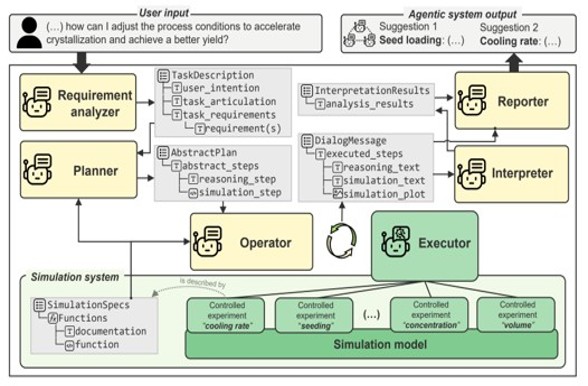
Moving beyond simple chatbots, AZ is pioneering "Agentic Modelling and Simulation" using platforms like Quaísr. In this framework, a Business Process Agent evaluates risks and orchestrates a flow through the drug development value chain.
Virtual agents automatically perform activities traditionally undertaken by scientists, checking that all required data is available and requesting missing data.
Specific "Manager Agents" oversee discrete operations like crystallization, material selection, and CDC tableting.
These agents execute a continuous loop: running a 1st principles model, training a surrogate neural network model, deploying advanced process control on the real process, and feeding data back into the database.
The human scientist remains in the loop, reviewing the top solutions provided by the Business Process Agent, deciding on a way forward, and returning feedback for continuous improvement.
AstraZeneca's trajectory highlights a fundamental shift in industrial automation. Yesterday's operations were defined by fragmented, manual, batch-based physical experiments. Today, the industry has transitioned to web-based applications offering standardized, integrated, and continuous capabilities.
Tomorrow's operations—spearheaded by the integration of Small Language Models (SLMs) with agency and digital twins—will be AI-agent-based. This "Birth of AIDA" (Artificial Intelligence Development Agents) promises a future that is fully automated, democratized, self-service, and highly adaptive. Essentially, AIDA acts as a virtual counterpart to the human scientific team. It orchestrates the complex development flow—from the raw Active Pharmaceutical Ingredient (API) to the final coated tablet—while keeping human scientists in the loop for critical reviews, strategic decisions, and continuous improvement.