Representative End User Clients







Representative Automation Clients







Representative Software Clients








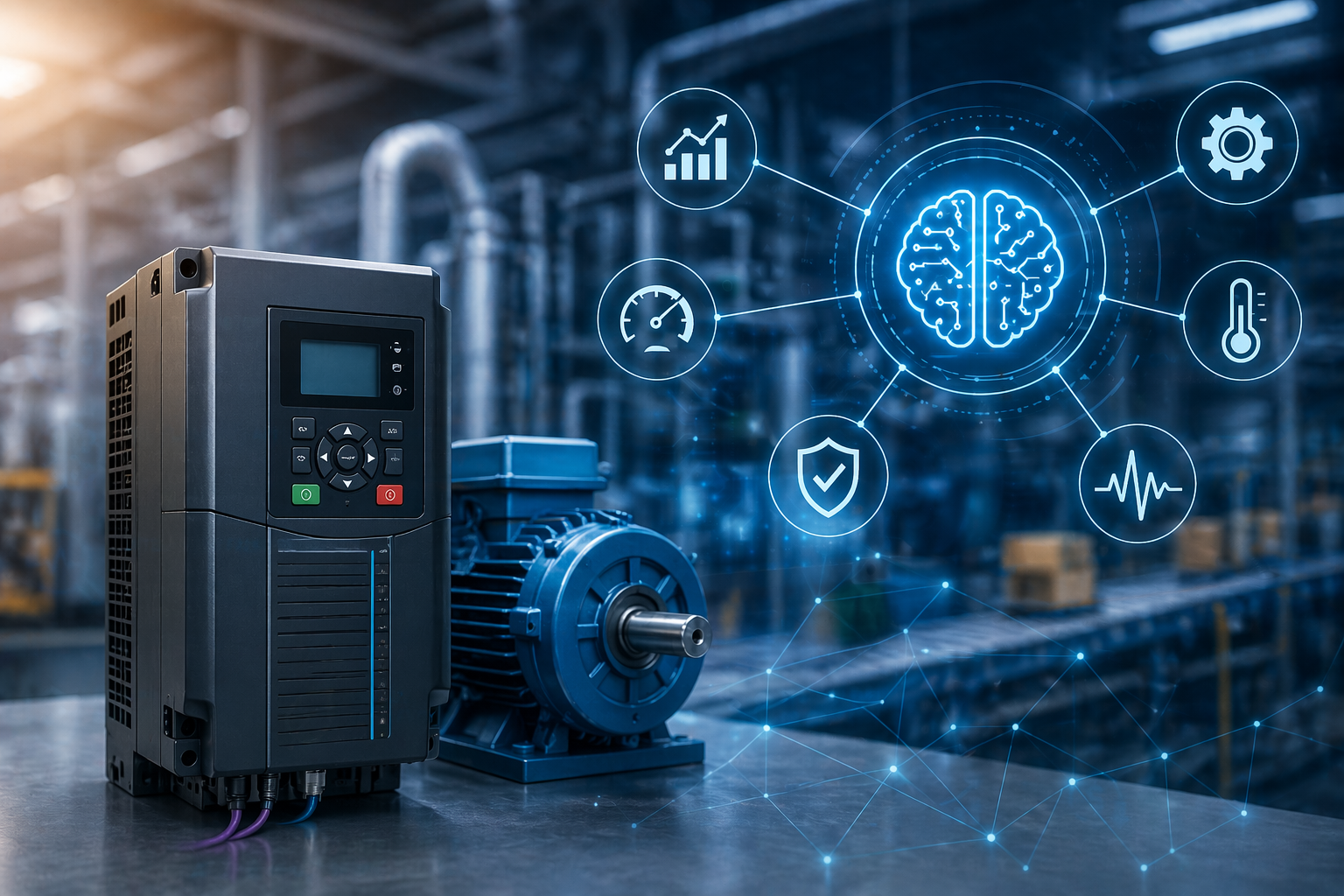
AC drive technology has undergone a profound transformation over the past three decades. What began as a solution for basic speed control and energy savings has evolved into a critical intelligence layer within modern industrial systems. Early generations of drives focused on variable frequency control, protection, and efficiency. As digital signal processors, advanced power semiconductors, and communication protocols matured, drives became more precise, connected, and application-aware.
Today, the industry stands at another inflection point: the integration of artificial intelligence (AI) into AC drive functionality. This shift is redefining how drives operate, how they are maintained, and how value is delivered to end users.
AI is moving beyond cloud-based analytics and embedding itself directly into the drive’s firmware. This integration is transforming three core functions:
Real-time Motor Control Optimization: AI continuously tunes control parameters based on load dynamics, motor condition, and operating environment, improving torque response, stability, and efficiency beyond static tuning methods.
Self-learning Application Behavior: Drives can recognize usage patterns—such as pumping, conveying, or HVAC duty cycles—and automatically adapt control strategies without manual intervention.
Intelligent Fault Detection: Instead of reacting to threshold-based alarms, AI models detect subtle deviations in current, voltage, temperature, and vibration signatures, identifying developing issues well before failure occurs.
This marks a shift from rule-based control to data-driven decision-making directly at the drive level.
From an analyst’s perspective, AI has enhanced AC drive performance across four critical dimensions:
Reliability and Uptime: Predictive diagnostics allow drives to estimate component health—such as capacitors, power modules, and motors—enabling condition-based maintenance and reducing unplanned downtime.
Energy Efficiency: AI-driven load profiling and adaptive flux control minimize energy consumption under partial load and variable operating conditions, delivering efficiency gains that conventional control methods cannot consistently achieve.
Ease of Use and Commissioning: Self-commissioning and auto-tuning functions, powered by AI, reduce setup time and dependence on drive experts, addressing the growing skills gap in industrial automation.
System-level Optimization: Drives increasingly collaborate with other assets through edge intelligence, optimizing not just the motor, but the entire process or machine of which they are a part.
While the depth of implementation varies, the strategic direction is clear: AI is becoming a native capability of AC drives, not an optional add-on.
Looking ahead, AC drives are set to evolve into autonomous control nodes within industrial systems. Future drives will not only respond to commands but will also proactively recommend operational changes, coordinate with upstream and downstream assets, and continuously improve performance over their lifecycle.
For end users, this means higher availability, lower total cost of ownership, and more resilient operations. For the industry, it signals a transition in which AC drives move from being power conversion devices to intelligent, self-optimizing assets at the heart of digital manufacturing.