Representative End User Clients







Representative Automation Clients







Representative Software Clients









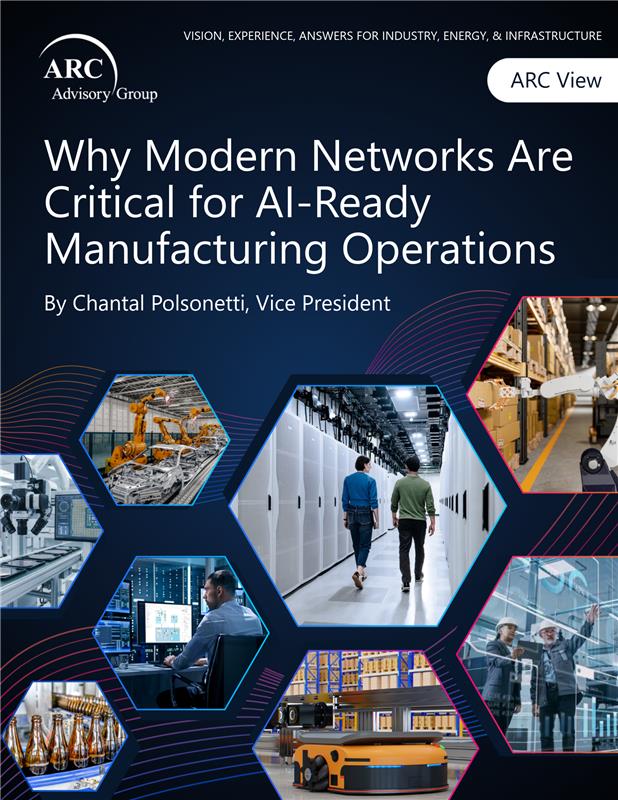
Manufacturers across every industry are under growing pressure to improve productivity, increase operational resilience, and accelerate innovation—often simultaneously. Artificial intelligence (AI), software‑defined automation, virtualization, digital twins, mobile robotics, and cloud‑connected production systems are increasingly central to these efforts. Yet many manufacturers are discovering that their ambitions for AI‑driven operations are limited not by applications or algorithms, but by the capabilities of their underlying network infrastructure. Without a modern, enterprise‑grade OT network, AI initiatives struggle to scale, remain secure, or deliver sustainable business value.
AI‑powered manufacturing systems introduce fundamentally new demands on the network. High‑resolution machine vision, real‑time analytics, cloud‑based digital twins, and virtualized control systems require deterministic performance, high bandwidth, ultra‑low latency, and uninterrupted availability. Legacy OT networks—often designed for isolated control systems and static traffic patterns—are poorly suited to these requirements.
At the same time, the increased connectivity required to support AI and cloud integration expands the industrial attack surface. Cybersecurity risks can no longer be addressed with bolt‑on tools and isolated firewalls. Security must be embedded directly into the network infrastructure and enforced consistently across IT, OT, edge, and cloud environments.
ARC’s analysis shows that AI‑ready manufacturing starts with the evolution of OT networks into enterprise‑grade industrial networks. These networks combine industrial determinism and ruggedization with enterprise‑class scalability, manageability, and security. Key capabilities include software-defined architectures, high‑performance Ethernet connectivity, support for high‑wattage Power over Ethernet (PoE) to power cameras and sensors, integrated edge computing, and centralized, intelligent management.
Modern networks also support operational visibility across the entire production environment. By enabling unified data flows from the shop floor to data centers and cloud platforms, manufacturers gain real‑time insight into operations—an essential foundation for AI‑driven optimization and decision‑making.
One of the most powerful enablers of AI‑ready operations is shop‑floor virtualization. By decoupling industrial applications from proprietary hardware, manufacturers gain flexibility, reduce both capital and operating costs, and significantly improve resilience. Virtualized environments make it possible to deploy updates faster, recover from failures more efficiently, and adapt production systems to new requirements without extensive physical reconfiguration.
These architectures also accelerate IT/OT collaboration. A unified network architecture allows manufacturers to apply proven IT best practices—such as segmentation, automation, and centralized policy management—within industrial environments, while still meeting OT requirements for reliability and determinism.
An ARC View report highlights Audi’s Edge Cloud 4 Production (EC4P) initiative as a real‑world example of how modern networking underpins software‑defined, AI‑enabled manufacturing. By virtualizing shop‑floor control assets and integrating edge, data center, and cloud resources, Audi has established a scalable platform for predictive maintenance, quality analytics, and continuous improvement. This approach demonstrates how a modern network architecture can unlock new operational models while maintaining high availability and security.
For manufacturers, the transition to AI‑ready operations is not a single project—it is a journey. ARC recommends adopting industry‑validated architectures, embedding security directly into the network, and prioritizing solutions that support virtualization, AI workloads, and future scalability. Organizations that approach network modernization as a strategic enabler rather than a tactical upgrade will be better positioned to compete as AI becomes integral to manufacturing performance.
To explore these insights in detail and understand how modern networks enable AI‑ready manufacturing operations, download the full ARC View developed in collaboration with Cisco:
Cisco White Paper: Why Modern Networks Are Critical for AI‑Ready Manufacturing Operations