Representative End User Clients







Representative Automation Clients







Representative Software Clients









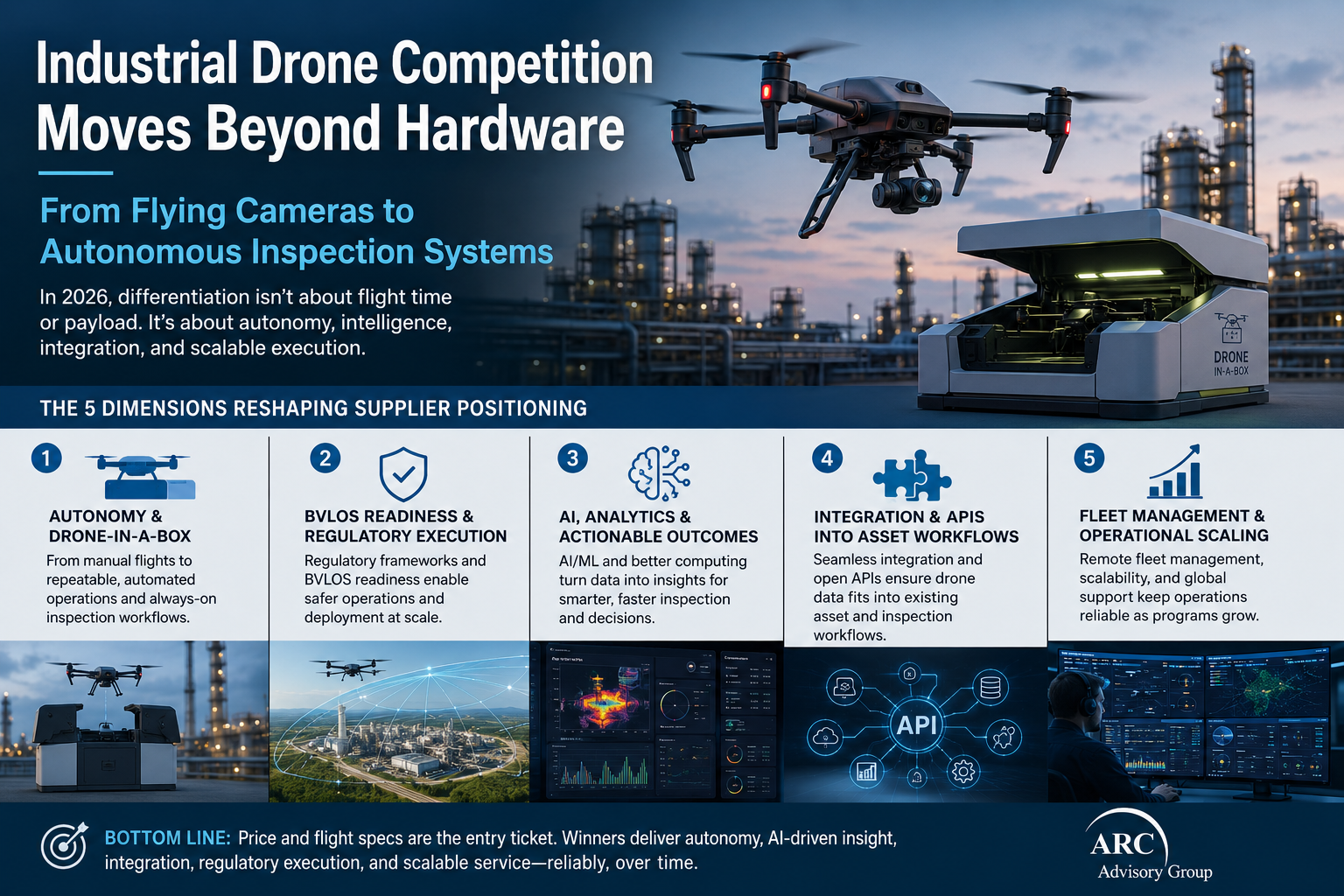
For years, evaluating drones in process industries felt like a hardware checklist: flight time, payload, camera quality, and price. But that model is fading fast. ARC research shows adoption is rising because companies want to keep people out of harm’s way, especially in hard‑to‑reach or confined environments—while capturing inspection data faster and more safely.
At the same time, improved payloads and onboard computing with AI/ML are turning drones into mobile inspection platforms for automated data collection and analysis, not just “flying cameras.”
ARC’s MarketMap framework provides a structured way to see how suppliers stack up by assessing solution capabilities and strategic vision/market strength.
When drones are viewed through this lens, one shift becomes clear: basic performance is table stakes. Differentiation now comes from suppliers that can deliver autonomy, data intelligence, and scalable operations reliably over time.
The market is moving from manual flights to repeatable, automated operations. ARC has covered Drone‑in‑a‑Box-style solutions that combine docking/charging, remote operations, and edge processing—pushing drones toward “always‑on” inspection workflows.
Scaling drone programs often depends on what companies can legally and safely fly. ARC highlights how regulatory constraints shape operations and how frameworks enabling more advanced missions (including BVLOS considerations) influence deployment at scale.
ARC notes drones are incorporating increasing levels of intelligence and autonomy, enabled by better computing and AI/ML, to support more sophisticated inspection and data workflows.
Buyers increasingly care about how drone data lands inside existing inspection/asset management processes. ARC explicitly advises evaluating API integration and the ability to integrate third‑party software or AI/ML.
As deployments expand, ARC recommends assessing supplier tools for remote fleet management, scalability, and operational support.
In 2026, price and flight specifications are only the entry ticket. Buyers increasingly evaluate suppliers on autonomy readiness, AI-driven insight, integration capability, regulatory execution, and scalable service delivery—This is the shift ARC research points to as drone programs mature.
ARC MarketMap Methodology: ARC MarketMap for Technology Products & Services
ARC Research Overview: Drones for the Process Industries
Drone‑in‑a‑Box Example Coverage: 5G Drone‑in‑a‑Box solution for industrial operations