Representative End User Clients







Representative Automation Clients







Representative Software Clients








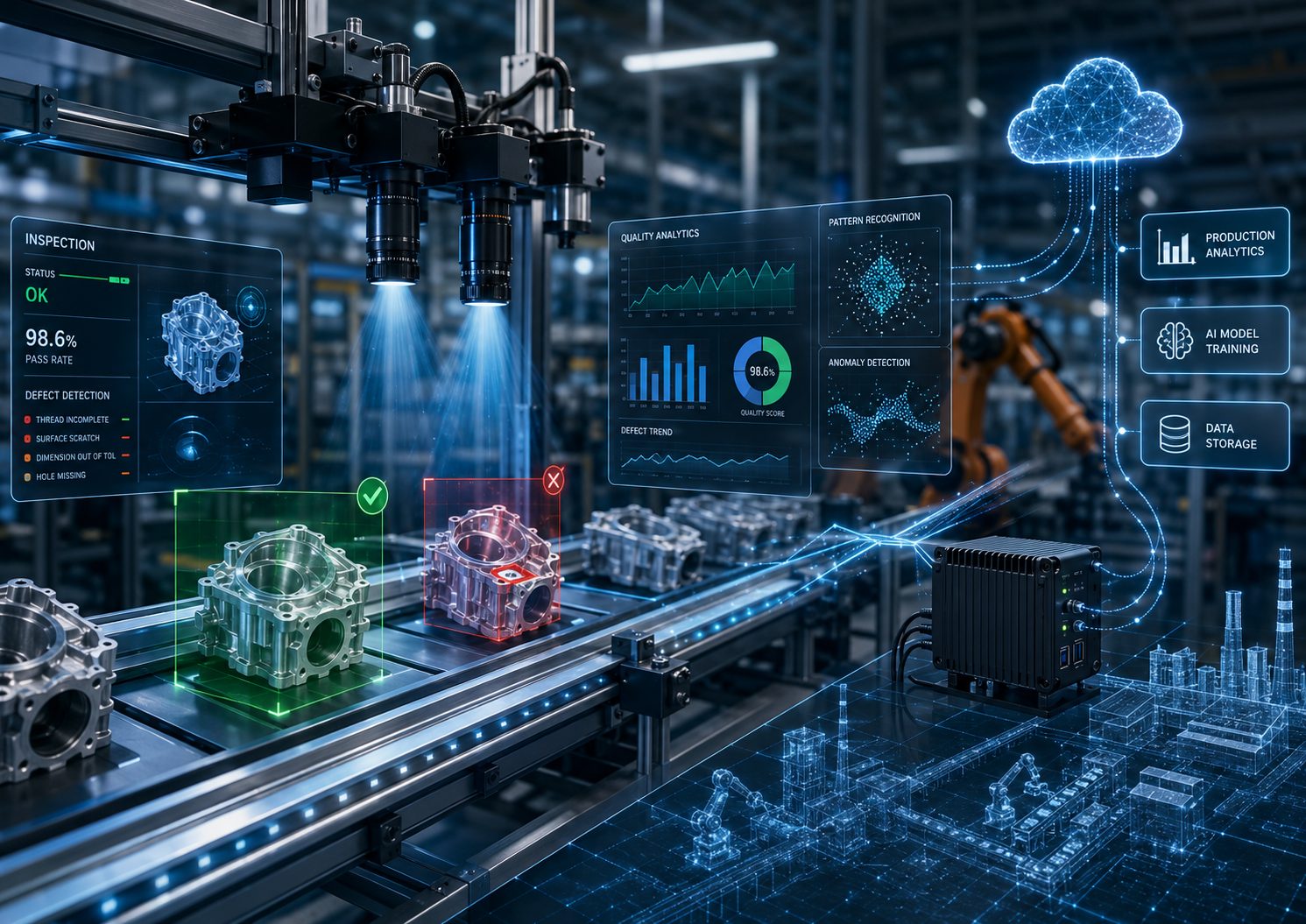
Machine vision has undergone a profound transformation over the past two decades. What began as a highly specialized, code-intensive engineering discipline has evolved into an increasingly accessible, AI-driven technology that plays a central role in modern manufacturing and quality control. Today, machine vision systems are no longer optional tools; they are essential enablers of precision, speed, and intelligence as organizations face mounting pressure to deliver flawless products at lower cost and higher throughput.
The most significant recent transformation has been the integration of artificial intelligence into machine vision systems. Traditional approaches relied on fixed, rule‑based logic, including predefined thresholds and rigid decision trees. While effective in stable environments, these methods struggled with variability in materials, lighting, and real‑world operating conditions.
AI fundamentally changed this paradigm. Rather than programming explicit rules, modern machine vision systems are trained using examples. By learning from labeled datasets of acceptable and defective outcomes, AI-based systems can identify complex patterns that are difficult—or impossible—to define manually. As a result, inspection is no longer just automated; it is increasingly intelligent, adaptive, and scalable across products and production lines.
Another major factor driving this evolution is the explosion of available data.
In the past:
Image storage was expensive.
Data transfer was slow.
Only small sample sets were used.
Today:
Storage is cheap and scalable.
High-speed networks are common.
Massive datasets are routinely collected and stored.
This enables:
Training AI models on large datasets.
Continuous improvement using real-world production data.
Post-analysis of manufacturing issues.
Better defect prediction and prevention.
Quality assurance is shifting from reactive detection to proactive and predictive decision‑making.
Today’s machine vision systems increasingly combine AI‑based inspection, real‑time edge processing, cloud connectivity, and analytics. Rather than operating in isolation, these systems are becoming integral components of broader digital and data‑driven production architectures. This convergence enables organizations to reduce scrap and rework, improve yield and consistency, and optimize processes using actionable insights. Machine vision is becoming a foundational element of intelligent, data‑driven operational environments.
As machine vision continues to evolve, traditional evaluation approaches focused solely on individual features or inspection accuracy are no longer sufficient. Decision-makers increasingly need to understand how well technologies support scalability, analytics integration, and advanced use cases such as predictive quality and data-driven operations.
To better reflect these changes, ARC developed the MarketMap framework as a structured, research-driven approach to evaluating technology markets. ARC MarketMap on Machine Vision Systems evaluates suppliers based on the depth and maturity of their technology capabilities, including system architecture, analytics integration, scalability, and readiness for advanced applications
. This perspective helps industry stakeholders assess not only current technical competence, but also how well machine vision suppliers are positioned to support evolving operational needs and sustained performance over time.
For more information on ARC’s MarketMap and how it supports technology buyer decision-making, please visit ARC MarketMap for Technology Products & Services | ARC Advisory Group.