Representative End User Clients







Representative Automation Clients







Representative Software Clients








Recent newspaper reports state that artificial intelligence is rapidly restructuring the workplace. It can write, analyze, automate, and even create. Yet the reality is less alarming than many headlines imply. If you’re asking, “Will AI take my job?” you’re not alone—it’s one of today’s most searched and debated questions. The bigger risk isn’t AI itself, but whether you can adapt.
A common misconception is that AI will eliminate entire professions; in practice, it mainly automates repetitive, predictable tasks (such as data entry, scheduling, and basic content generation) within roles that are made up of many activities. So routine work is reduced, higher-value work expands, and jobs evolve through redesign rather than disappearing.
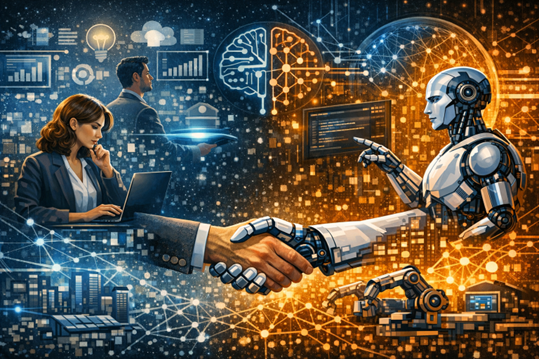
If AI isn’t replacing you, what is? It’s competition from professionals who use AI better. Today, people across industries are leveraging AI to complete tasks faster, improve accuracy, increase output, and cut manual effort, creating a new reality where two people in the same role can deliver very different value. The message is clear: you won’t lose your job to AI, but to someone who knows how to use it effectively, because this shift is no longer about company-wide adoption—it’s about individual capability.
AI is accelerating workplace change and widening the skills gap. The real danger isn’t job loss, but skills becoming obsolete faster than ever. Employers increasingly prioritize digital and AI literacy, data-driven decision making, problem solving, and cross-functional thinking, and roles become vulnerable when capabilities don’t evolve to match shifting market needs.
One of the biggest ironies of the AI revolution is that as technology advances, human skills matter more. AI still struggles with nuanced judgment, creativity, emotional intelligence, and making decisions amid ambiguity. So, as it takes over routine tasks, professionals are expected to lean harder into strategic thinking, collaboration, storytelling, and leadership. In short, success in the AI era isn’t just about being tech-savvy, but about being distinctively human.
The old career model: learn once and apply it for decades, no longer holds. In an AI-driven world, adaptability is the only durable advantage, which means continually learning new tools, refreshing your knowledge, and staying open to how your role evolves. The most successful professionals aren’t simply the most experienced—they’re the most adaptable, and continuous learning is now essential to remain relevant.
If AI is reshaping work, stay ahead by learning to work with it rather than against it and treating it as a productivity partner. Keep strengthening the core skills it can’t replicate, such as critical thinking, communication, and creativity, while building enough AI literacy to use tools responsibly and effectively. Finally, stay curious and proactive because change is accelerating—and waiting is no longer a safe strategy.
AI is undeniably one of the most powerful technologies of our time, and it will keep reshaping industries, redefining roles, and changing how we work—but it doesn’t decide your future; you do. The real divide isn’t between jobs that survive and jobs that don’t, but between people who adapt and people who don’t. Because AI won’t take your job, but ignoring AI just might.