Representative End User Clients







Representative Automation Clients







Representative Software Clients








KEYWORDS: Edge Computing, Cloud, Virtualization, Software-Defined Automation, Virtual PLC, TSN, Deterministic Networking, Containerization, Continuous Deployment, Industrial AI
At the 2026 ARC European Industry Forum in Spain, the session on Edge, Cloud & Virtualization underscored that industrial automation is entering a new architectural phase. The legacy model of dedicated hardware and tightly coupled software is increasingly misaligned with manufacturers’ needs for faster deployment, greater scalability, and a practical path to AI-enabled operations. The central issue is no longer whether automation will become software-defined, but which architectures can deliver flexibility without sacrificing determinism, safety, or lifecycle control in brownfield industrial environments.
This ARC Insight draws on presentations from four organizations, each addressing a distinct dimension of the transition to software-defined automation: Dr. Thomas Kampa of Audi on production virtualization and Edge Cloud 4 Production, Moritz Walker of the University of Stuttgart on TSN and interoperability, Michael Schwarz of Xentara on open real-time runtimes, and Leif Rønning of OTee on the operating economics of software-defined control.
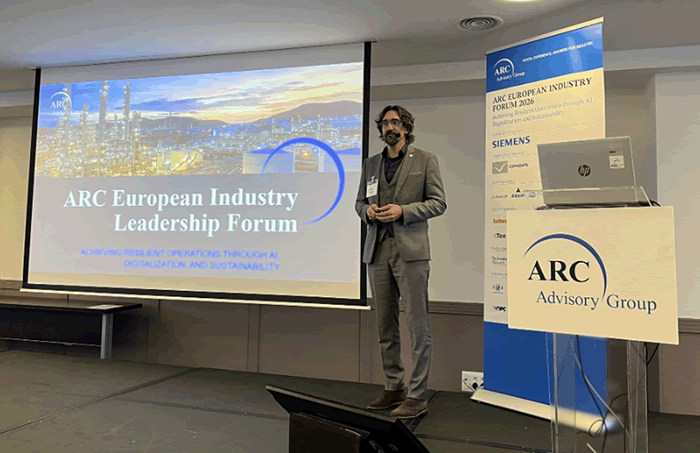
Dr. Thomas Kampa of Audi framed one of the session’s most important themes: software-defined automation is not simply a packaging change, but a shift in control architecture. His contrast between buying a new function in a dedicated “box” and deploying that same function as software on general-purpose hardware captured the transition clearly. Audi’s experience also shows why the shift is becoming necessary. In large factory environments with thousands of compute resources, the accumulation of IPCs, PLCs, HMIs, machine-learning nodes, and vision systems drives complexity, extends lead times, intensifies patch management, increases reliance on scarce expertise, and raises energy use. Audi’s argument is straightforward: factories are now changing faster than hardware refresh cycles, making hardware-centric expansion increasingly difficult to sustain.
Against that backdrop, Edge Cloud 4 Production (EC4P) takes on strategic importance. Audi positions EC4P as a shop floor platform intended to support thousands of virtual workloads. Equally important was the implementation message: enterprises should not attempt to virtualize everything at once. Audi’s current EC4P applications include MES clients, screwing applications, flashing and diagnostics, virtual engineering stations, vPLCs, and master PCs, with the emphasis placed on a limited set of high-value targets. This is a more credible adoption model than the broad transformation narratives often promoted in the market. It reflects the reality that confidence in virtualization must be earned through specific production use cases, not asserted through architecture diagrams.
In the discussion panel at the end of the session, Oliver Narr from Siemens and Tilman Taubert from Cisco Systems described their companies’ contributions to the EC4P project, with Siemens providing the virtual PLC and Cisco delivering the sophisticated software-defined networking that made the overall automation architecture possible.
ARC Advisory Group clients can view the complete report at the ARC Client Portal.
Contact Us if you would like to speak with the author.
Obtain more ARC In-depth Research Market Analysis.