Representative End User Clients







Representative Automation Clients







Representative Software Clients








In industrial level measurement, not all technologies are designed for broad applicability. While some methods are selected for their versatility across multiple process environments, others are chosen for their ability to solve highly specific measurement challenges. Capacitance level measurement belongs to the latter category.
Often overlooked in favor of more widely discussed technologies, capacitance level measurement continues to play a critical role in applications where precision, sensitivity, and material interaction are essential. Rather than being a universal solution, it is a targeted technology—one that delivers exceptional reliability when applied under the right conditions.
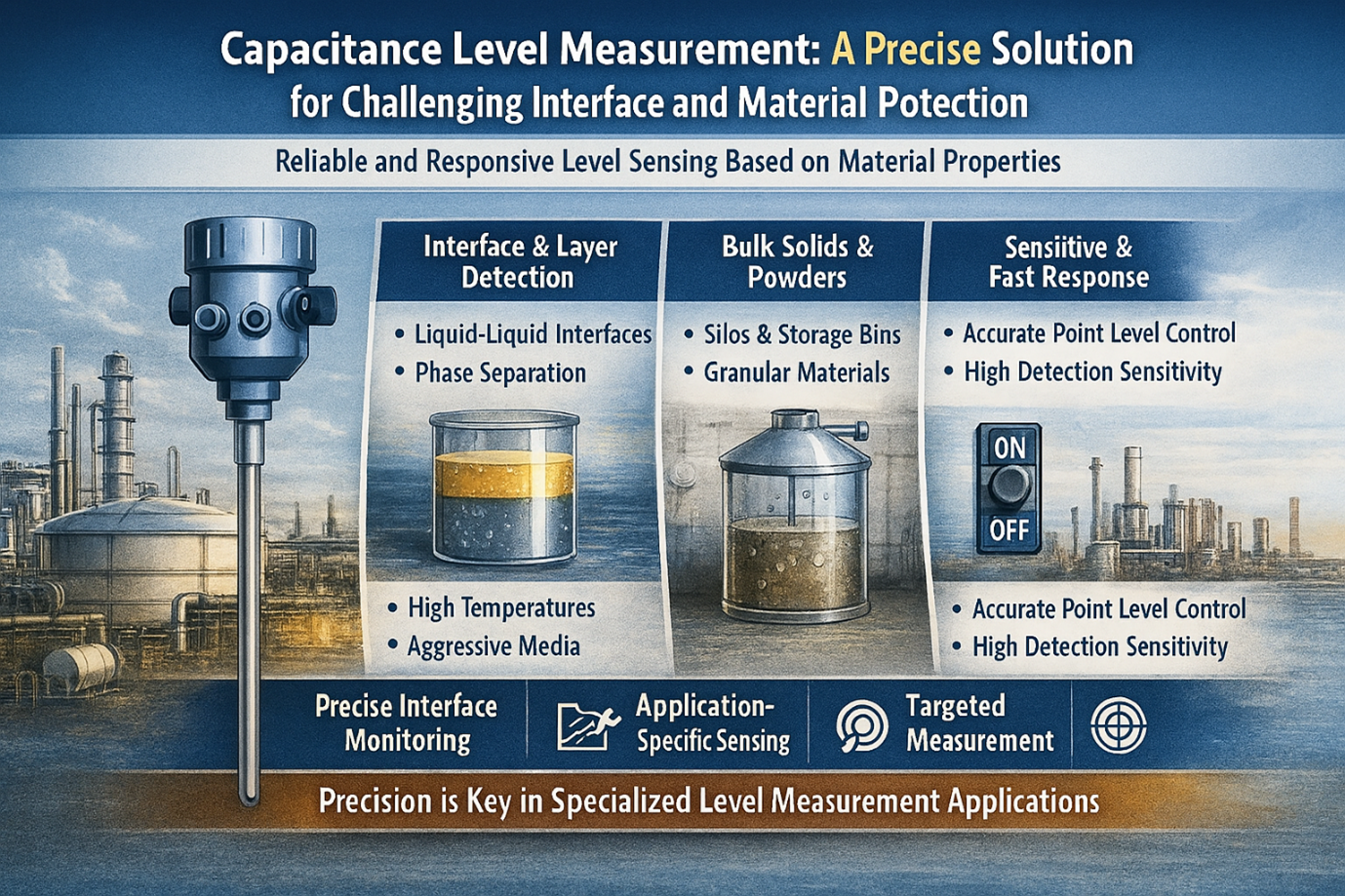
Capacitance level measurement operates on a fundamentally different principle than many other level sensing technologies. Instead of relying on distance or pressure, it measures changes in electrical capacitance caused by the presence or absence of a material around a probe.
As the level of a medium rises or falls, the dielectric constant between the probe and reference point changes. This variation is translated into a level measurement. Because the method is directly tied to the electrical properties of the medium, it enables detection with a high degree of sensitivity.
This characteristic makes capacitance measurement particularly well suited for applications where detecting small changes or interfaces is critical.
One of the strongest advantages of capacitance level measurement is its ability to detect interfaces between different materials. In processes where two liquids coexist—such as oil and water, or chemical layers—traditional level measurement technologies may struggle to distinguish between them.
Capacitance sensors, however, can identify variations in dielectric properties, making it possible to detect:
Liquid–liquid interfaces.
Phase separation in storage tanks.
Multilayer process conditions.
Transition points in chemical processing.
This capability is especially valuable in industries where product quality, separation efficiency, or process control depends on accurate layer identification.
Capacitance level measurement is also widely used in applications involving bulk solids, powders, and granular materials. Unlike technologies that depend on surface reflection or pressure distribution, capacitance probes detect material presence directly around the sensing element.
This makes them effective in:
Silos and storage bins.
Powder handling systems.
Cement and grain storage.
Plastics and pellet processing.
Because the measurement is localized, capacitance sensors can reliably indicate level presence even when material surfaces are uneven or subject to shifting.
Capacitance level measurement offers considerable flexibility in terms of installation and design. Probes can be configured in various forms to suit specific applications, including rigid rods, flexible cables, and coated sensors for corrosive environments.
This adaptability allows capacitance technology to be applied in:
High-temperature environments.
High-pressure vessels.
Aggressive chemical processes.
Compact or space-constrained installations.
In many cases, the sensor can be customized to match the process conditions, enhancing both reliability and longevity.
Because capacitance measurement responds directly to changes in the electrical field around the probe, it is inherently sensitive to small variations in level. This makes it particularly useful in applications where rapid response or precise switching is required.
For example:
Overflow protection in tanks.
Low-level detection for pump protection.
Process control requiring quick state changes.
The ability to respond quickly and accurately to level changes supports stable and efficient process operation.
While capacitance level measurement offers strong advantages, its effectiveness is closely tied to application suitability. Because the measurement depends on dielectric properties, it requires a clear understanding of the material being measured.
Key considerations include:
Variations in dielectric constant due to composition changes.
Material buildup or coating on the probe.
Sensitivity to moisture or contamination in certain applications.
These factors must be carefully evaluated during the design phase to ensure reliable performance. When applied correctly, however, these challenges can be managed effectively.
Capacitance level measurement is not intended to replace other technologies, but rather to complement them. Each level measurement method has its strengths, and selecting the right one depends on the specific requirements of the application.
Radar may be preferred for noncontact measurement in harsh environments.
Ultrasonic may be suitable for cost-effective liquid level monitoring.
Hydrostatic may provide stable measurement in submerged conditions.
Capacitance excels where material interaction and property detection are key.
Understanding these distinctions allows engineers to design systems that leverage the strengths of each technology.
Capacitance level measurement remains widely used across industries where precise detection and interface measurement are critical.
In chemical processing, it supports phase separation and reaction control. In oil and gas, it is used for interface detection in storage and processing systems. In the food and beverage industry, it assists in monitoring ingredients and product consistency. In manufacturing, it provides reliable level detection in material handling systems.
The common thread across these applications is the need for sensitivity and accuracy based on material properties rather than distance or pressure.
Capacitance level measurement demonstrates that not all level measurement challenges require broad, general-purpose solutions. In many cases, the most reliable results come from technologies that are specifically matched to the characteristics of the process.
By leveraging the electrical properties of materials, capacitance sensors provide precise and responsive level detection in applications where other methods may fall short. Their value lies not in versatility, but in their ability to deliver targeted performance where it matters most.
In modern process plants, capacitance level measurement continues to serve as a specialized yet essential tool—proving that precision, when applied correctly, is as important as reliability.