Representative End User Clients







Representative Automation Clients







Representative Software Clients








The inaugural edition of ImagiNxt 2026, held at Mumbai’s Jio World Convention Center and hosted by Maharashtra Tourism, marked a defining moment in India’s evolution as a global technology powerhouse. Bringing together over 10,000 attendees, 250+ startups, 100+ investors, and 150+ speakers, the event served as a high-impact convergence of policymakers, founders, enterprise leaders, academia, and innovators.
With a sharp focus on AI, DeepTech, SpaceTech, quantum technologies, and digital infrastructure, ImagiNxt 2026 positioned itself as a platform not just for discussion—but for shaping India’s long-term economic and industrial roadmap. Leaders including Union Minister Dr. Jitendra Singh and Maharashtra Chief Minister Devendra Fadnavis emphasized that emerging technologies are no longer peripheral—they are central to India’s growth strategy.
A defining highlight of the event was Maharashtra’s ambitious push to become a global AI hub. Under the proposed Maharashtra AI Policy 2026, the state is investing heavily in foundational infrastructure, including AI Centers of Excellence, AI Innovation Cities, shared GPU compute systems, and startup funding ecosystems.
Devendra Fadnavis outlined plans to deploy 2,000 GPUs through shared compute architecture, enabling startups, enterprises, and the public sector to scale AI innovation without prohibitive infrastructure costs. This signals a broader shift: governments are beginning to treat AI infrastructure as a strategic national asset, much like highways, ports, or power grids in earlier growth cycles. Sovereign control over compute capacity, data ecosystems, and innovation pipelines is increasingly seen as essential for both economic competitiveness and digital independence.
Beyond AI, the conference spotlighted India’s rapidly expanding DeepTech and SpaceTech ecosystem. Dr. Jitendra Singh highlighted how India's space economy is poised for exponential growth, fueled by private participation and startup-led innovation. India’s broader mission-driven approach was also evident through initiatives such as the India AI Mission, National Quantum Mission, Nuclear Energy Mission, and BioE3 biotechnology policy. These programs collectively aim to establish globally competitive capabilities across frontier technology sectors, reinforcing India's ambition to lead in the DeepTech domain.
A recurring theme throughout ImagiNxt 2026 was the convergence of AI, digital governance, and industrial transformation. Discussions highlighted how technologies such as intelligent automation, advanced analytics, and AI-driven decision making are rapidly reshaping industries including manufacturing, defense, enterprise operations, and public services.
Keynotes from technology leaders pointed to the rise of agentic AI systems—autonomous, task-oriented frameworks being deployed in real-world applications. This marks a shift from conceptual AI adoption to scalable, enterprise-grade implementation. The exhibition floor reinforced this transformation, featuring live demonstrations of humanoid robotics, VR-based spatial computing, and advanced hardware systems—underscoring the growing importance of physical and embodied AI systems alongside software innovation.
ImagiNxt 2026 also placed strong emphasis on talent development and grassroots innovation. In collaboration with Outskill, the event hosted hands-on masterclasses covering emerging workflows such as RAG (Retrieval-Augmented Generation) systems, vibe coding, and AI-driven revenue automation.
A partnership with the National Innovation Foundation (NIF) brought attention to technology innovation emerging from Tier-2 and Tier-3 cities, showcasing scalable solutions developed outside traditional metro ecosystems. This reflects a broader democratization of innovation across India.
In parallel, cross-border collaboration took center stage, with international delegations—including the Sweden–India Business Council—exploring investment partnerships and global capital flows into India’s technology sector. These interactions highlight India’s growing role in global innovation networks.
The event also witnessed strategic announcements beyond core technology sectors. Notably, Arnab Goswami launched Republic Global, signaling a push to project India’s perspective in global digital media and technology narratives.
This reflects a larger trend: India is not only building technological capacity but also shaping how its innovation story is communicated globally. As digital platforms and media intersect with technology ecosystems, narrative control and global positioning are becoming increasingly important.
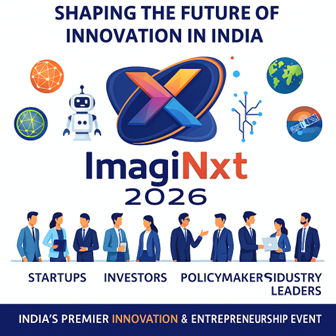
ImagiNxt 2026 highlighted a clear narrative: India is entering a new phase of growth powered by sovereign AI capabilities, mission-led DeepTech ecosystems, and large-scale digital infrastructure investments.
With strong government backing, increasing private sector participation, and a rapidly maturing startup ecosystem, the country is positioning itself at the forefront of global technological change. As initiatives scale and collaborations deepen, India’s ambition to lead the next wave of industrial transformation is no longer aspirational, it is actively unfolding.