Representative End User Clients







Representative Automation Clients







Representative Software Clients








ARC Advisory Group has initiated a new MarketMap research study focused on proximity sensors for industrial automation applications. This MarketMap will deliver a structured evaluation of technology suppliers, benchmarking their capabilities, strategies, and market positioning to support informed decision-making by end users, OEMs, and system integrators.
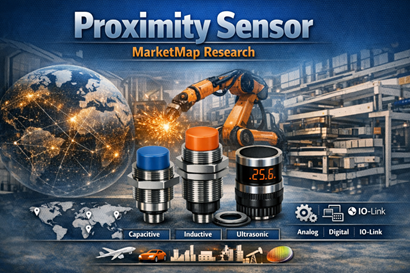
Proximity sensors play a critical role in modern automation architectures, supporting both discrete switching and continuous measurement functions across a wide range of industries. As industrial organizations pursue higher levels of automation, flexibility, and reliability, proximity sensing technologies are becoming increasingly central to machine design and plant operations.
Industrial automation investments continue to accelerate as manufacturers respond to labor constraints, productivity pressures, and the need for more resilient operations. Proximity sensors are foundational components within this transformation, enabling presence detection, position feedback, and distance measurement in demanding industrial environments.
Adoption is expanding across industries such as automotive, machinery, food and beverage, electronics, metals, and oil and gas, where accuracy, robustness, and integration with control systems are essential. At the same time, advances in digital communication, diagnostics, and configuration are reshaping expectations for sensor performance and lifecycle value.
For this MarketMap, ARC defines proximity sensors as industrial automation devices used for switching, such as presence or absence detection, and measuring, such as distance or position measurement. The research scope includes three core technology categories:
Capacitive sensors, supporting metal and nonmetallic target detection for switching and short-range measurement applications, with analog output options.
Inductive sensors, designed for metal target detection, supporting both switching and short-range measurement, including analog variants.
Ultrasonic sensors, used for object detection and distance measurement over longer ranges.
The study evaluates these technologies across global regions, sales channels, output signal types, including analog, digital, IO-Link, and CompoNet, detection ranges, and customer types. Coverage spans a broad set of end use industries, with detailed segmentation for machinery applications ranging from robotics and packaging to metal forming and semiconductor equipment.
Key drivers influencing the proximity sensor market include increasing machine complexity, higher expectations for uptime, and growing demand for standardized communication interfaces. Digital connectivity and configuration capabilities are becoming differentiators as users seek easier commissioning, predictive maintenance, and improved transparency at the device level.
However, the market remains fragmented, with a wide range of suppliers offering overlapping portfolios. Buyers must navigate trade-offs among performance, durability, integration effort, and total cost of ownership, while suppliers face pressure to balance innovation with backward compatibility and global scalability.
The ARC MarketMap on proximity sensors will assess suppliers based on their product capabilities, deployment readiness, strategic direction, and ecosystem support. The research will benchmark how well suppliers address diverse application requirements across industries, regions, and machine types.
By combining qualitative analysis with structured comparative frameworks, the MarketMap is designed to deliver decision-grade intelligence on competitive dynamics and technology maturity. This perspective enables users to identify best-fit suppliers and understand how the market is likely to evolve.
“The proximity sensor market is mature in many core applications, but it is also evolving as digital interfaces, configurability, and application breadth become more important,” said Santosh Kumar, Analyst, ARC Advisory Group. “This MarketMap will help clarify how suppliers are differentiating in an increasingly competitive and segmented landscape, and where end users should focus when evaluating solutions.”
ARC invites proximity sensor suppliers to participate in this MarketMap research. Participation includes structured data submission, analyst briefings, and the opportunity to be evaluated and positioned within the MarketMap framework. Suppliers interested in participating should contact ARC to initiate the engagement process.
ARC Advisory Group is the leading technology research and advisory firm for industry, infrastructure, and cities. ARC analysts have the industry knowledge and firsthand experience to help clients find the best answers to complex business issues. ARC provides technology supplier clients with strategic advice and marketing support to guide product and market development. ARC advises end user clients on technology selection, operational performance, and digital transformation strategies.