Representative End User Clients







Representative Automation Clients







Representative Software Clients








Ultrasonic flowmeters have traditionally been associated with flow measurement in established industrial applications where non-intrusive monitoring provides a practical advantage. Their ability to measure flow without direct contact with the process medium has made them particularly attractive in situations where pipeline modification is undesirable or operational interruption must be minimized.
However, the role of ultrasonic flowmeters is evolving. As process industries continue to adapt to new production requirements, emerging energy applications, and increasingly complex operating environments, ultrasonic technology is expanding beyond its conventional use cases.
This evolution reflects a broader shift in industrial measurement from standardized applications toward more specialized, flexible, and application-driven solutions.
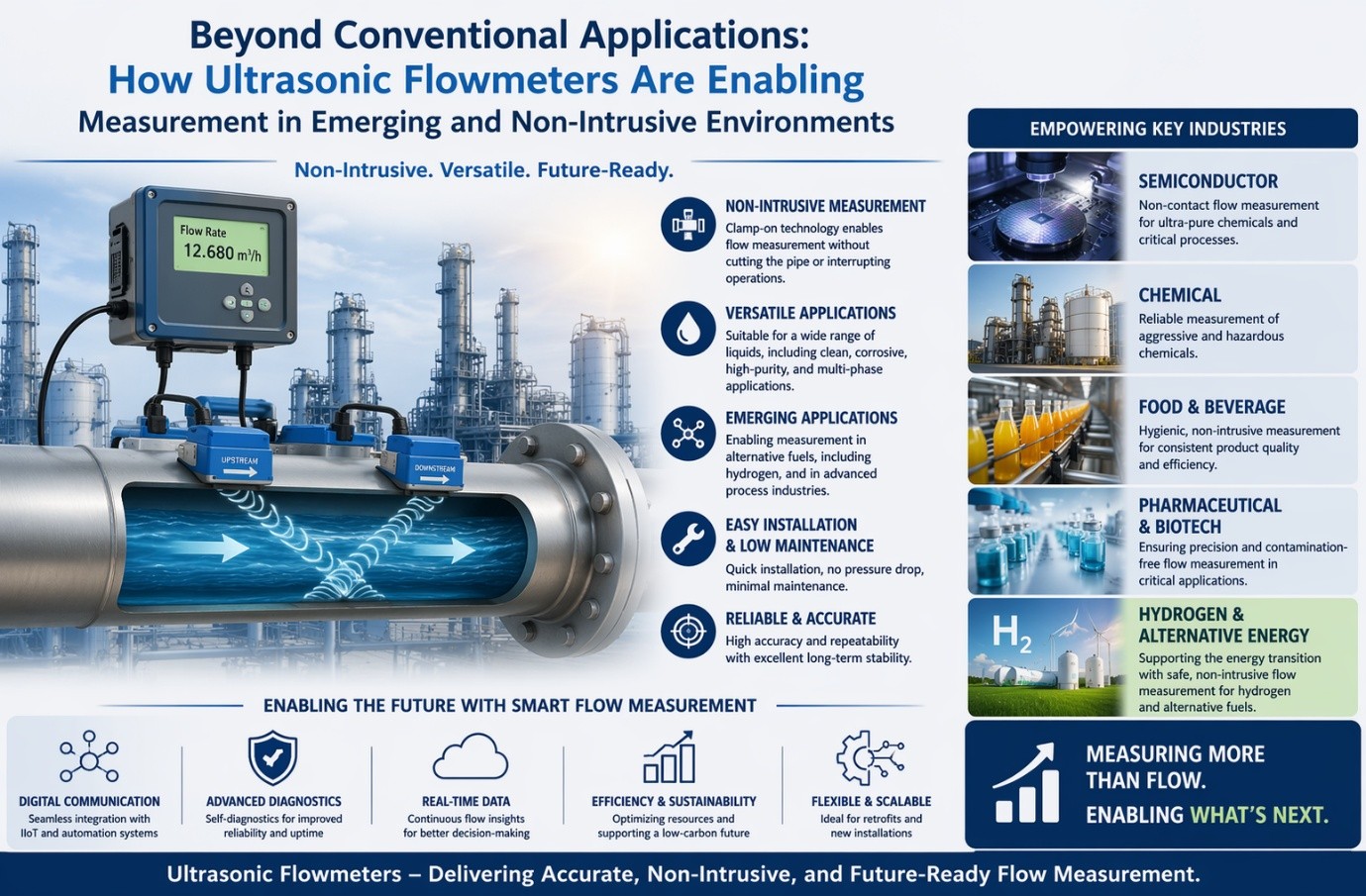
In conventional applications, ultrasonic flowmeters have primarily been used for measuring clean fluids in stable environments where non-invasive installation offers clear operational benefits.
Today, this scope is expanding.
A key trend is the growing relevance of ultrasonic flow measurement in applications involving non-traditional fluids and emerging process requirements, particularly in areas linked to energy transition and specialized industrial processes. These applications often require measurement solutions that can be deployed quickly, operate without direct fluid interaction, and adapt to changing process conditions.
As a result, ultrasonic flowmeters are increasingly being considered not just for convenience, but for their ability to enable measurement in scenarios where conventional technologies are less suitable, reinforcing the importance of application-driven selection as discussed in ARC’s blog, Choosing the Right Flow and Level Technology: Why One Size Does Not Fit All in Modern Process Plants.
One of the most notable developments is the role of ultrasonic flowmeters in the measurement of alternative fuels, including hydrogen and emerging gas mixtures.
As industries move toward decarbonization and cleaner energy systems, the need to measure new fluid types introduces additional complexity. Hydrogen, in particular, presents unique challenges due to its physical properties, system configurations, and evolving infrastructure.
Ultrasonic flowmeters provide a practical solution in these scenarios. Their non-intrusive measurement approach allows flow monitoring without modifying pipelines, introducing obstructions, or creating contamination risks. This is particularly valuable in early-stage hydrogen deployments and alternative fuel systems where flexibility and ease of installation are critical.
As energy systems continue to evolve, the ability to measure flow reliably without disrupting operations positions ultrasonic technology as an important enabler of these emerging applications.
Another important area of growth is in precision-driven industries, particularly those involving high-purity processes.
Applications such as semiconductor manufacturing demand extremely controlled environments where contamination must be avoided and process conditions must remain stable. In these cases, the ability of ultrasonic flowmeters to provide non-contact, non-invasive measurement becomes a critical advantage.
Instead of introducing additional components into the process stream, ultrasonic systems allow flow monitoring without affecting fluid integrity. This aligns well with the requirements of industries where product quality and process control depend heavily on maintaining clean and controlled conditions.
The evolution of ultrasonic flowmeters is also being influenced by the broader trend toward compact and integrated systems.
Modern industrial systems increasingly require instrumentation that can:
Fit within space-constrained environments.
Integrate with control systems such as PLCs and HMIs.
Support modular and scalable plant designs.
Ultrasonic flowmeters, particularly in clamp-on or compact configurations, are well suited to these requirements. Their ability to be deployed externally and integrated into broader measurement systems without extensive modification supports both new installations and retrofit applications.
As process industries adopt more advanced automation strategies, the need for real-time data and connectivity continues to grow.
Ultrasonic flowmeters are adapting to this trend by supporting:
Real-time monitoring of flow conditions.
Integration with connected industrial networks.
Improved data availability for analysis and optimization.
Technologies such as edge computing and advanced communication systems are further enabling ultrasonic flowmeters to function within connected environments where rapid data access and responsiveness are essential. In such settings, flow measurement becomes part of a broader system-level framework, consistent with approaches described in ARC’s blog, Measurement Architecture Becomes a Priority in Process Plants.
The increasing diversity of industrial applications is creating new demands for measurement technologies. These include:
Measurement in difficult-to-access pipelines.
Monitoring of evolving process fluids, including hydrogen and alternative fuels.
Minimizing downtime during installation or maintenance.
Ensuring flexibility in changing process environments.
Ultrasonic flowmeters address these requirements through their ability to deliver measurement without physical intrusion, supporting both adaptability and ease of deployment.
Historically, ultrasonic flowmeters were often selected for convenience, primarily because they allowed flow measurement without interrupting operations.
That perception is changing.
Today, their value lies increasingly in their capability to support new and evolving process scenarios. Whether used in hydrogen systems, precision manufacturing environments, or integrated process architectures, ultrasonic flowmeters are becoming essential tools in applications where flexibility and non-intrusive measurement are critical.
Measurement technologies are increasingly transitioning from standalone devices to contributors to operational insight and decision-making, as outlined in ARC’s blog, From Sensors to Strategy: Why Measurement Technology Is Becoming a Business Decision.
Ultrasonic flowmeters are no longer confined to conventional applications. Their role is expanding as industries adopt new processes, explore alternative energy sources, and move toward more flexible and connected operational models.
This expansion is not driven by a change in measurement principle, but by the ability of the technology to adapt to modern industrial requirements.
In today’s process environments, where change is constant and flexibility is essential, ultrasonic flowmeters are emerging as a practical and versatile solution, enabling measurement in places where traditional approaches may not be feasible.