Representative End User Clients







Representative Automation Clients







Representative Software Clients








The food manufacturing industry is entering a new era, one in which automation is no longer limited by variability. Unlike highly standardized sectors such as automotive or electronics, food production deals with constant inconsistency. From irregular shapes and sizes to unpredictable orientations on conveyor lines, food products challenge traditional automation systems at every step.
Today, as manufacturers face increasing pressure to boost productivity, ensure quality, meet strict safety regulations, and address labor shortages, a new solution is gaining momentum: 3D vision technology.
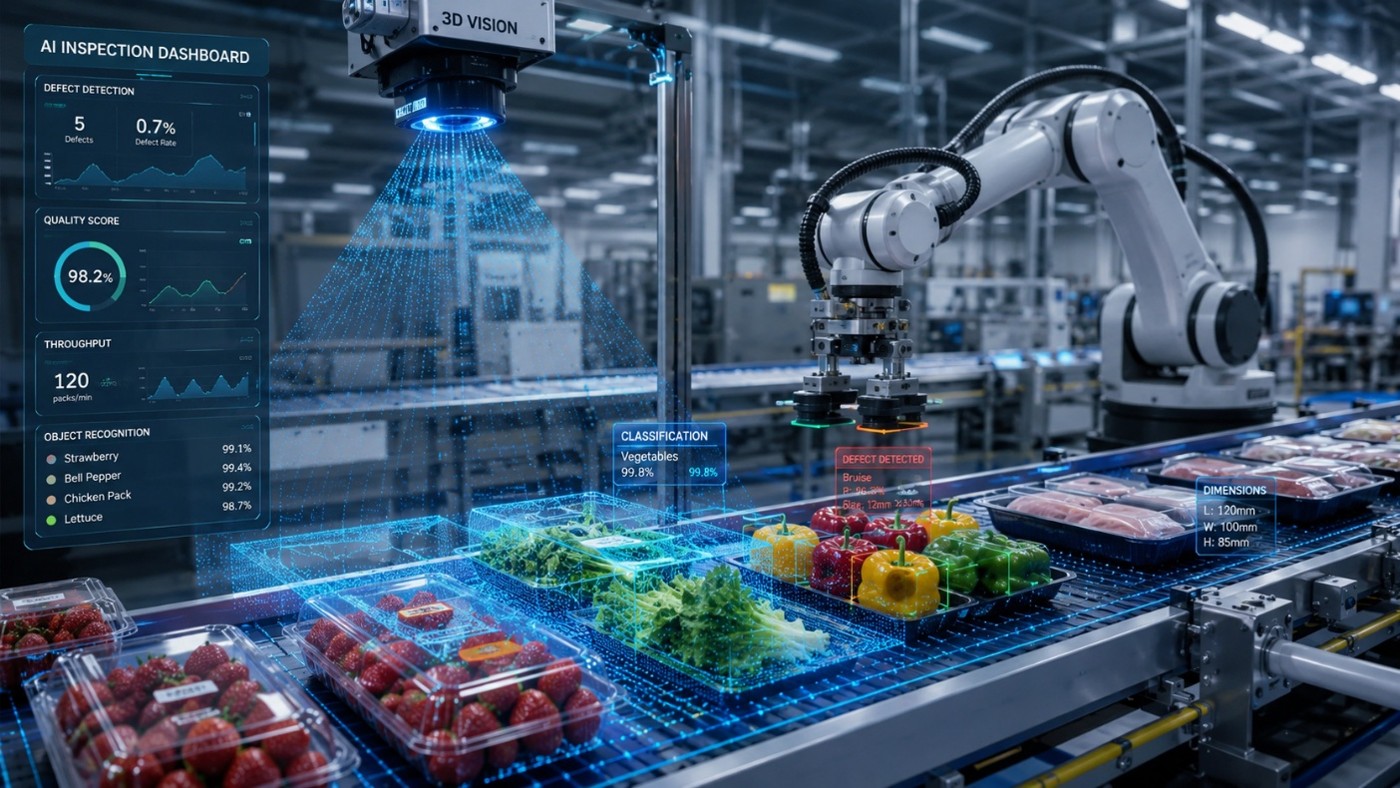
Most automation systems are built for repeatability. They perform best when products are uniform and predictable. However, food products are anything but consistent.
Whether handling fresh produce, meat, seafood, or baked goods, manufacturers must continuously adapt to natural variations. Conventional 2D vision systems and rule-based automation often struggle to keep up.
3D vision systems can help manufacturers:
Accurately detect product size, shape, and orientation.
Adapt to variability in real time.
Make smarter decisions without rigid programming.
This shift marks a critical evolution from static automation to intelligent manufacturing systems.
Historically, machine vision in food manufacturing focused on defect detection and quality control. Today, 3D vision applications extend far beyond inspection.
Modern food production lines leverage 3D vision for:
Robotic guidance and pick-and-place operations.
Material handling and sorting.
Process optimization and yield improvement.
Real-time production monitoring.
By creating a digital 3D representation of products and environments, manufacturers gain deeper visibility into operations, enabling faster and more accurate decision-making.
Robotics adoption is accelerating across food processing plants. However, robots require precise spatial awareness to function effectively.
Food items rarely arrive neatly aligned. They may overlap, rotate unpredictably, or vary in size, making them difficult for traditional systems to process.
3D vision empowers robots with advanced spatial intelligence, enabling them to:
Identify objects regardless of orientation.
Determine optimal grasp points.
Handle delicate or irregular products with precision.
This capability unlocks automation for tasks that previously depended on human dexterity, such as sorting, packaging, and assembly.
Consumer expectations for food quality continue to rise. At the same time, manufacturers must minimize waste and maximize throughput.
3D vision systems play a crucial role by:
Measuring product geometry with high accuracy.
Detecting deviations early in the production cycle.
Supporting real-time process control.
Early detection of inconsistencies reduces rework, improves yield, and ensures consistent product quality, which is especially important for naturally variable products.
Labor challenges remain a persistent issue in food manufacturing. Many facilities struggle to fill roles that are repetitive, physically demanding, or require specialized skills.
3D vision-enabled automation offers a practical solution by:
Reducing dependency on manual labor.
Improving operational efficiency.
Enhancing workplace safety.
Importantly, this shift is not about replacing workers. It is about augmenting human capabilities. Employees can focus on higher-value tasks while automation handles repetitive operations.
The integration of artificial intelligence (AI) with 3D vision is accelerating innovation in food manufacturing.
Unlike traditional systems that rely on fixed rules, AI-powered vision systems can:
Learn from large data sets.
Adapt to new product variations.
Improve accuracy over time.
When combined, AI, 3D vision, and robotics create highly flexible systems capable of handling complex, real-world production scenarios.
This convergence is driving the next generation of smart factories, where automation is not just efficient, but also adaptive and intelligent.
As digital transformation accelerates across the food industry, demand for technologies that enhance flexibility, visibility, and performance will continue to grow.
3D vision is rapidly becoming a foundational technology in modern food manufacturing because it enables:
Greater adaptability in production lines.
Improved robotic efficiency.
Enhanced product quality and consistency.
Data-driven decision-making.
What began as a tool for inspection is now a critical driver of end-to-end automation strategy.
As the industry evolves toward smarter, more agile operations, 3D vision will continue to redefine what is possible in food manufacturing automation, moving far beyond inspection into the realm of intelligent, autonomous production.