Representative End User Clients







Representative Automation Clients







Representative Software Clients









Industrial automation is at an inflection point. Increasing operational complexity, tighter sustainability targets, workforce constraints, and volatile market conditions are exposing the limitations of closed, hardware-centric automation systems. These architectures were designed for stability, not continuous change, making them costly to adapt, difficult to scale, and increasingly misaligned with modern digital and autonomous ambitions.
A new automation paradigm is emerging - one that treats software as the primary driver of flexibility, resilience, and long-term value. By decoupling control applications from proprietary hardware, open and software-centric automation enables portability, interoperability, and reuse across diverse environments. This shift reduces lifecycle risk, protects existing investments, and allows organizations to modernize incrementally rather than through disruptive replacements.
The international non-profit association UniversalAutomation.org (UAO) plays a critical role in turning this vision into operational reality. By providing a vendor-independent execution layer based on IEC 61499 and proven-in-use technologies, it enables scalable, interoperable control while supporting coexistence with legacy systems. Real world deployments across multiple industries demonstrate that open automation is not a future concept, but a practical pathway to higher autonomy, faster innovation, and sustainable digital transformation.
For industrial stakeholders, the message is clear: openness is no longer optional. Those who align early with open automation principles will be better positioned to adapt, collaborate, and compete in an increasingly dynamic industrial landscape.
Industrial organizations are operating in an environment of unprecedented complexity and pressure. Structural shifts in technology, markets, workforce demographics, and societal expectations are exposing the limits of traditional automation and operational models. ARC research consistently shows that incremental improvements are no longer sufficient; the industry must rethink how systems are designed, integrated, and operated to remain competitive, resilient, and sustainable.
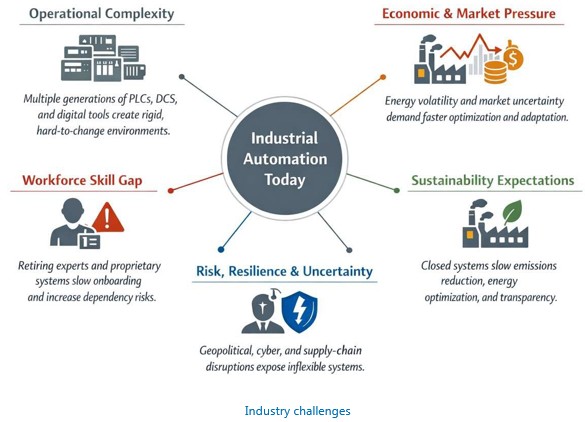
Industrial organizations face mounting pressure as traditional automation models struggle to keep pace with growing complexity, market volatility, and societal expectations. Many plants operate heterogeneous environments composed of multiple generations of PLCs, DCS platforms, and standalone digital solutions accumulated over decades. These fragmented, vendor-specific systems make even minor changes - such as adding optimization applications or modifying control logic - slow, costly, and risky, a challenge further intensified by IT/OT convergence.
At the same time, economic and market pressures are forcing companies to operate closer to their limits. Volatile energy prices, fluctuating raw material costs, and supply-chain instability demand frequent operational adjustments, particularly in energy-intensive industries. However, rigid automation architectures designed for long-term stability limit the ability to rapidly reconfigure or optimize operations. Shorter product lifecycles and higher customization requirements compound this issue by driving up engineering and commissioning costs.
Workforce dynamics add another layer of risk. The retirement of experienced engineers is creating critical knowledge gaps, as expertise is often embedded in proprietary systems and custom integrations. Younger engineers are frequently deterred by closed, vendor-specific environments, leading to longer onboarding times, greater reliance on external specialists, and increased operational risk.
Industrial operations are also increasingly exposed to geopolitical, regulatory, cyber, and supply-chain disruptions. Monolithic, tightly coupled systems reduce resilience, making it difficult to isolate failures, replace components, or comply quickly with new regulations. In parallel, sustainability pressures are accelerating the adoption of energy monitoring, emissions tracking, and electrification initiatives, yet closed architectures hinder data access and integration across systems.
Together, these forces underscore the need for more adaptable, interoperable, and resilient automation architectures that can evolve without repeated large-scale redesigns.
Table of Contents
Executive Overview
Why Industry Must Change
How Industry Is Responding
Enabling the Transformation: the Role of UAO
Conclusion and Recommendations
ARC Advisory Group clients can view the complete report at the ARC Client Portal.
Contact Us if you would like to speak with the author.
Obtain more ARC In-depth Research Market Analysis.