Representative End User Clients







Representative Automation Clients







Representative Software Clients








In my previous collection of observations on Automate 2026, I discussed AI, automation, and the US manufacturing renaissance.
Humanoid robots were hard to miss at Automate in Chicago. They drew crowds as they walked the halls and had an entire pavilion dedicated to showing them off. I can’t deny that the hardware is improving, the software stack is advancing, and the broader “physical AI” story is clearly pulling robotics along into a more strategic role for industry.
But here is my take after seeing the progress: the humanoid robot market still faces a significant gap between the marketing hype and current industrial feasibility.
I do not mean to count out the staggering engineering and innovation that has occurred over the last few years. But industry needs to talk about humanoids a little differently. A robot that looks impressive performing a routine in a booth does little to suggest it can survive an industrial deployment. A robot that can perform a choreographed task once is not the same thing as a robot that can deliver value safely and reliably across shifts. And a robot that attracts loads of investor capital is not automatically a robot that industrial customers are ready to buy.
In a previous blog, I argued that manufacturing is at an automation and AI inflection point, and I still believe that. But humanoids are a good test of whether the industry can separate real transformation from theater. If humanoid robots are going to matter in factories, warehouses, utilities, and heavy industrial environments, they need to start being judged by what industrial work they can actually perform.
The humanoid conversation has a feasibility gap. On one side is the vision: general-purpose robots that can move through human-designed environments, handle tools, adapt to changing workflows, and take on work that traditional automation has struggled to reach. That vision is powerful because industrial environments are full of tasks that are still difficult to automate. Material handling, inspection, loading and unloading, machine tending, basic tool use, and irregular manipulation all represent real opportunities.
On the other side is the reality: industrial operations are unforgiving. They care about uptime, safety, throughput, maintainability, integration, and cost. They care about whether a system works on Tuesday morning when the line is behind schedule.
Many humanoid systems can demonstrate useful capabilities. Fewer can show that those capabilities hold up under industrial conditions. Even fewer can prove that the system is easier, safer, and more economical than alternatives such as fixed automation, cobots, AMRs, mobile manipulators, or redesigned workflows.
This is the part of the conversation that needs more discipline. The question we all need to ask is, “Is a humanoid the best automation architecture for this outcome?” The answer may be yes, but often it will be no.
If a wheeled mobile manipulator can do the job faster, with lower risk, at a lower cost, and with easier certification, then the humanoid form factor is a liability, not an advantage. If legs are not needed, do not buy legs. If five-fingered hands are not needed, do not pay for five-fingered hands. If a human-like appearance does not improve the workflow, it is decoration.
The biggest bottleneck, however, is scaling. Many systems can demonstrate a task, but far fewer survive the prototype-to-production valley. If users and integrators have to custom-engineer these robotic solutions for each segment of each task, then reaching full-scale deployment and expanding the range of work performed will be a slow process.
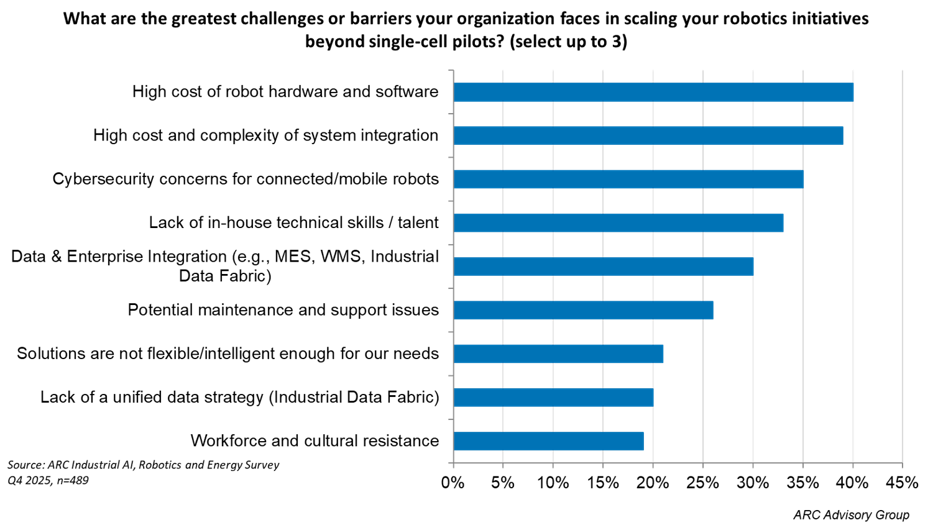
Another important hurdle is safety. Industrial deployment often requires deterministic, certifiable safety systems. Today, many of the required standards for humanoids are still evolving, and the certification frameworks are not fully in place.
The feasibility gap will close, but it will require significant effort. It will close through reliability engineering, safety validation, application-specific tooling, closer integration with existing industrial systems and workflows, and proof that humanoids can deliver measurable operational value.
The humanoid market has no shortage of investor enthusiasm. That enthusiasm is understandable. The total addressable market narrative is enormous. The technology is visually appealing and futuristic. The idea of a general-purpose robot worker is easy to explain.
But investors are not customers.
Industrial customers buy outcomes. They need to know how the robot integrates with existing operations, who supports it when it fails, how it is maintained, what safety certifications apply, how operators interact with it, and how the business case survives after the pilot. Industrial customers look at integration effort, lifecycle maintenance, uptime, and support models. In many cases, the robot itself is the smallest part of the investment.
The most credible humanoid suppliers will be the ones that understand the difference between fundraising momentum and customer adoption. They will talk less about replacing workers in some vague future and more about specific workflows, site requirements, task boundaries, safety cases, support models, and measurable returns.
The less credible ones will keep leaning on the same broad promise: general-purpose, human-like, adaptable, inevitable. How long will that take? Five years? Ten years? Longer?
There is nothing wrong with strategic investment in a promising category with, admittedly, some fantastic innovation happening. But companies should treat humanoid pilots as structured learning exercises, not as proof that large-scale adoption is around the corner. The winners will be the industrial organizations that ask hard questions early, not the ones that get swept up in the excitement.
If humanoid vendors want to be credible, show us the real work, not the gymnastics!
If it simply means “a robot with an LLM interface,” then the term is not very useful. Language is important, but language is not cognition in an industrial setting. A robot that can explain a task or respond to a prompt is not necessarily a robot that can reason through physical consequences.
A cognitive robot is not defined by language. It is defined by its ability to close the loop between perception, decision, action, and learning in a physical environment. It needs to understand the state of the environment, choose a course of action, predict what may happen next, execute safely, and learn from the result. That is a much higher bar than adding conversational AI. That is why world models, simulation, perception systems, and industrial data context matter so much.
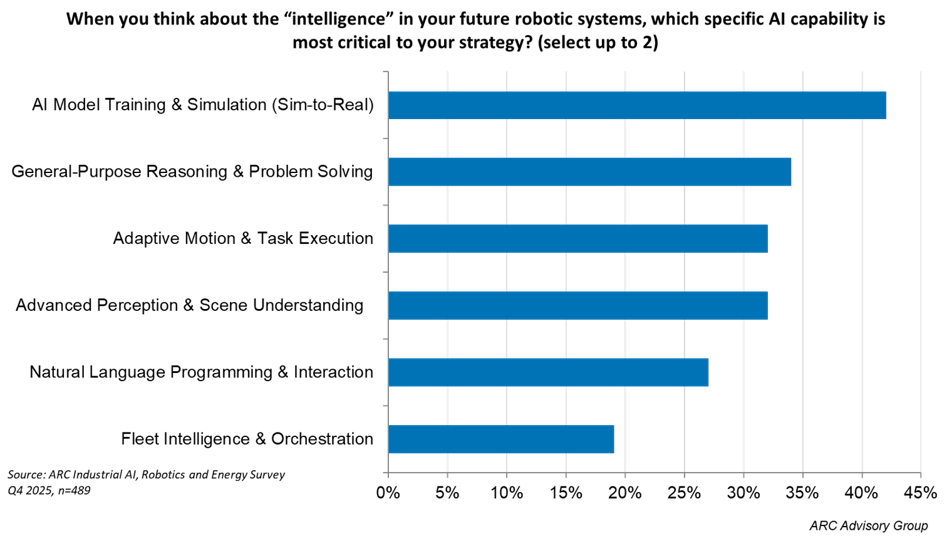
This is also where humanoids may prove deeply important. The investments being made in humanoid robotics are pushing the entire robotics stack forward: better actuators, better sensors, better simulation environments, better manipulation models, better edge compute, and better ways to train robots for unstructured tasks. Even if many industrial applications do not ultimately use a fully humanoid form factor, the innovation being driven by humanoid development could benefit robotics broadly.
That is the view I came away with from Automate. The hype is ahead of the deployment reality, but the engineering is real.
Humanoid robots need to prove they can do real work, in real environments, with real economics. Until then, industrial leaders should stay curious, run focused pilots, demand operational evidence, and resist the temptation to confuse human-like motion with industrial value.
There’s another way to look at the value of humanoids that I kept coming back to during Automate, and it’s a bit counterintuitive. What if the current wave of humanoids isn’t really about the future of manufacturing, but the past?
Industrial environments have been engineered around humans far longer than they have been engineered for robots. The layout of facilities, the height of workstations, the design of tools, the spacing of equipment, and even the way workflows are structured—all of it assumes a human operator. It’s an entire environment optimized for human interaction.
So when we talk about humanoids fitting naturally into these environments, that’s not an accident. It’s because the environment was built for them, or more accurately, built for us.
In that sense, humanoids start to look less like the “next generation” of automation and more like the ultimate legacy integration layer. Instead of redesigning the factory for automation, you bring in a machine that can adapt to the factory as it already exists.
There’s real value in that. Brownfield integration is one of the hardest problems in industrial automation. Ripping and replacing infrastructure is expensive, disruptive, and often unrealistic. If a humanoid can walk into an existing environment, use the same tools, operate the same interfaces, and fit into existing workflows, that’s a powerful proposition.
But there’s a little more to it. If the only reason a robot needs to look human is because the environment was designed for humans, then we have to ask a harder question: are we optimizing for the right system? In some cases, the better answer may still be to redesign the process, simplify the workflow, or deploy a non-humanoid system that performs the task more efficiently. A humanoid might be the most flexible way to deal with a legacy constraint, but that doesn’t make it the optimal long-term solution.
Humanoids might find their first big success not because they represent the future of automation, but because they are the most compatible with the past.
Human-like bodies are only one possible embodiment of advanced robotic capability. Any robot can, in principle, gain many of these capabilities. In real industrial use cases, other form factors will often make more sense. Over time, capabilities may converge. But right now, the smarter move is to focus on what the system can do, not what shape it takes.
We also need to move beyond the idea that large language models alone are the answer. Physics-driven models matter because industrial systems need to understand the likely consequences of actions in the real world. That is a much more serious industrial requirement than generating fluent text.
So yes, humanoids will keep attracting attention. But the real message is to focus on capability over form factor.
The companies that win will not be the ones that bet on a form factor alone. They will be the ones that build the full Physical AI stack—data, simulation, automation, and workforce integration—and deploy whatever robotic systems best execute the work.
Humanoids for Industry Blog Part 1: Why Humanoids? Why Now?
Humanoids for Industry Blog Part 2: Navigating the Ecosystem
Humanoids for Industry Blog Part 3: A New Market on the Horizon
For discussions on physical intelligence and the new wave of industrial robotics, or to offer feedback on this article, contact Patrick Arnold at [email protected].
Set up a meeting with myself and the Analysts at ARC Advisory Group to find out more about our Executive Insights Service for Industrial organizations, MarketMap efforts, and more.