Representative End User Clients







Representative Automation Clients







Representative Software Clients








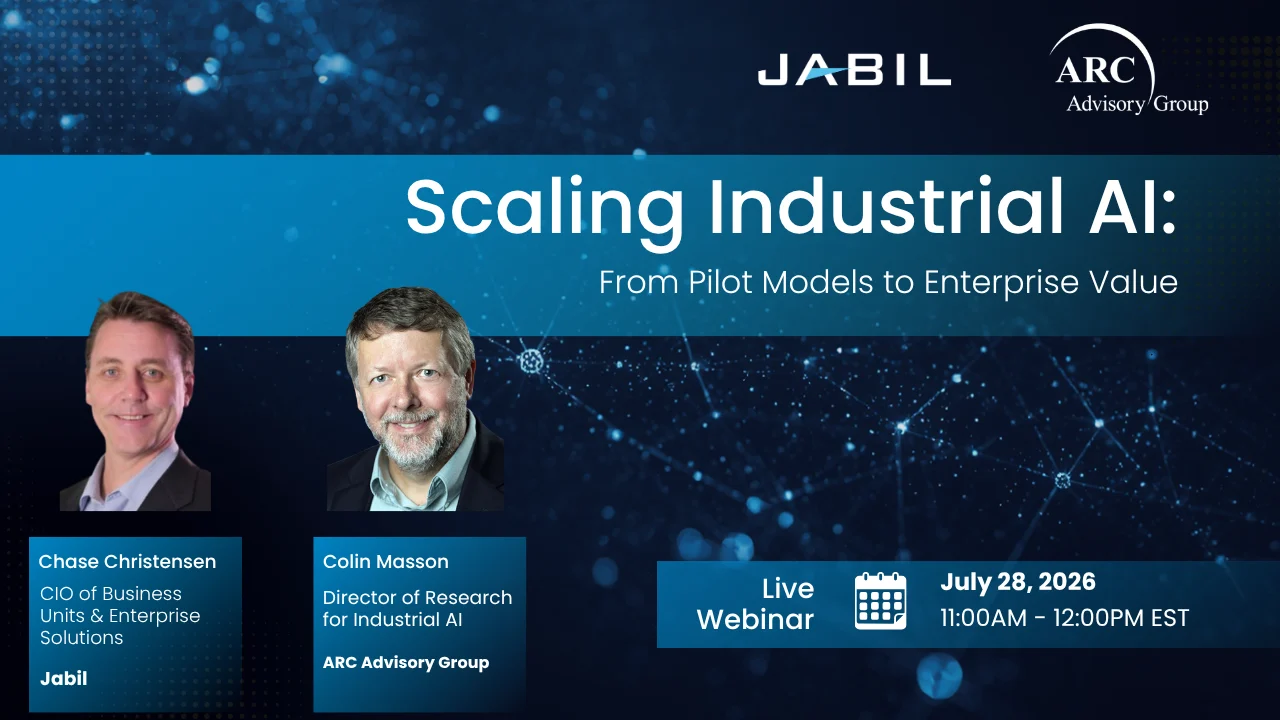
Missed the live event or want to share the presentation with your enterprise team? Access the full video recording, presentation slides, and audience Q&A session on demand:
Watch the ARC & Jabil Industrial AI Pacesetters Webinar Replay here or on YouTube:
If you’ve been following our ongoing research voyage here at ARC Advisory Group—particularly the empirical data capturing the strategic intent of hundreds of global industrial decision-makers—you know we’ve spent considerable time mapping out what I term “The Schism of Speed.” For decades, the standard playbook in manufacturing risk management was the “Fast Follower” strategy. The prevailing wisdom was simple: Let the brave pioneers take the arrows in the back, test the bleeding-edge software, and, once the hype settles and solutions mature, buy the technology off the shelf.
In 2026, our survey data proves that the Fast Follower strategy is dead.
The industrial market has irrevocably fractured into two distinct camps: an elite vanguard of Industrial AI Pacesetters, representing roughly 13 percent of the market, who are aggressively compounding their competitive advantage, and an 87 percent Mainstream majority that remains hopelessly entangled in “Pilot Purgatory.” Mainstream manufacturers are stuck running what I call “science fair projects”—spinning up isolated computer vision prototypes or deploying conversational copilots on single factory lines. But when they attempt to scale those models across 20, 50, or 100 global facilities, they hit an unyielding wall built of legacy technical debt, fragmented OT data silos, custom codebase traps, and exploding cloud API bills.
To explore how real-world Pacesetters break through that wall, I recently sat down for a one-on-one webcast with Chase Christensen, VP and CIO of Business Units and Enterprise Solutions at Jabil.
Jabil is an absolute powerhouse in global manufacturing solutions. Operating more than 100 facilities across over 25 countries with a workforce of more than 140,000 employees, Jabil orchestrates a supply chain of staggering complexity: 38,000 active suppliers, 700,000 distinct part numbers, and $30 billion in annual procurement spending. Operating in a highly complex manufacturing environment, Chase and his team don’t have the luxury of funding speculative technology experiments. Every AI deployment must deliver near-term, unassailable bottom-line value.
Below is my detailed breakdown of our conversation, deconstructing the architectural, operational, and financial playbook Jabil uses to move Industrial AI from isolated pilot models to enterprise value.
The first topic Chase and I tackled went straight to the heart of organizational friction: Why do so many enterprise AI initiatives stall? In many global companies, “AI Steering Committees” are where digital innovation goes to die—turning into decision hell and bureaucratic paralysis. Yet Jabil uses its central steering committee to actively accelerate execution and remove the need for “shadow AI.”
As Chase shared during our discussion, Jabil follows a three-stage portfolio lifecycle. Rather than letting teams linger indefinitely in proof-of-concept mode, Jabil evaluates projects against strict gating criteria:
Stage 01: IDEATE (Concept to Ingestion): Rapidly validating whether a specific operational problem can actually be solved using AI.
Stage 02: ADOPT (Embed into Everyday Workflows): Scaling proven use cases across sites without rewriting code for each facility.
Stage 03: VALUE (Measurable Enterprise Impact): Tracking ROI against explicit business KPIs with named executive owners.
To cross Gate 1, from Ideate to Adopt, a project cannot merely be “technically interesting.” It requires three non-negotiables: a trusted data baseline, an immediate measurable result, and an explicitly named business owner who assumes full operational accountability. If an ideation pilot relies on a “local-only workaround” or bespoke scripting that cannot be standardized across Jabil’s global footprint, Chase’s team pulls the plug immediately.
“We get really maniacal around the business case. What problem are we actually trying to solve, and what is the expected outcome? If an AI project doesn’t move a core operational or business metric within a few weeks, we stop it. Governance isn’t red tape. It’s how you scale innovation consistently without building technical debt.”
— Chase Christensen, VP & CIO of Business Units and Enterprise Solutions, Jabil
By establishing a private enterprise marketplace stocked with pre-vetted “starter apps,” standardized APIs, and low-code building blocks, Jabil provides regional plant managers with local flexibility while maintaining global architectural guardrails.
(For a detailed visual walkthrough of Jabil’s three-stage gating model and Gate 1 and Gate 2 criteria, refer to Slide 7 in the On-Demand Webinar Replay.)
A recurring theme in my analyst briefings with industrial executives is the Context Crisis. Horizontal cloud vendors love to pitch magical large language models that can allegedly reason across your entire enterprise. But when these models meet the brownfield reality of a plant floor—where Plant A runs a 20-year-old legacy MES, Plant B uses custom SQL tables, and Plant C logs maintenance in desktop spreadsheets—the models hallucinate wildly due to a lack of structured semantic context.
To solve the Context Crisis, Pacesetters understand that they must simplify their digital core before attempting to scale higher-order intelligence. While many Fortune 500 manufacturers operate with dozens—or even hundreds—of disjointed ERP environments, Jabil made the strategic decision to run its global enterprise on just two SAP instances across more than 100 sites.
This “Clean Core” strategy on SAP S/4HANA acts as Jabil’s single system of record. When global supply chain disruptions or tariff shifts hit, Jabil doesn’t wait 12 hours for overnight batch reporting. By pairing S/4HANA with SAP Analytics Cloud and SAP HANA Cloud, Jabil reruns complex global supply and demand models in seconds.
“You cannot build an agile, AI-driven enterprise on top of a fragmented core. By standardizing Jabil on a Clean Core with SAP, we eliminated decades of custom spaghetti code. It gives us a single source of truth that allows our teams to see open sales orders, inventory constraints, and plant capacities globally in seconds.”
— Chase Christensen, VP & CIO of Business Units and Enterprise Solutions, Jabil
(To see how Jabil structures its Clean Core on SAP S/4HANA while enabling low-code extensions at the edge through SAP BTP, view Slide 9 in the On-Demand Webinar Replay).
In classic IT architectures, scaling analytics meant copying petabytes of shop-floor time-series data out of local historians and dumping it into centralized cloud data lakes. This created massive data duplication, high egress costs, and severe latency.
During our webcast, Chase walked through Jabil’s architectural blueprint for a Governed Data Platform (GDP). Jabil’s modern approach aligns directly with ARC’s vision of the Industrial Data Fabric (IDF):
Systems of Record—Where Data Lives: Supply Chain, Finance, Engineering, and Operations retain native data ownership.
Industrial Data Fabric—Discover and Govern: Active metadata catalogs, semantic layers, and knowledge graphs map relational context across domains without copying files.
AI Ecosystem—Consume at the Top: Platform-native AI agents, custom foundation models, and workplace productivity tools query one unified access layer.
This contextualized data fabric bridges the historically hostile divide among Information Technology (IT), Operational Technology (OT), and Engineering Technology (ET).
“Our data strategy is centered on zero-copy virtualization and trusted context. We keep data where it lives in its native system of record, but we bring it together through a single governed layer. That way, whether an AI agent or a frontline operator queries the system, they are making decisions based on clean, real-time enterprise context.”
— Chase Christensen, VP & CIO of Business Units and Enterprise Solutions, Jabil
(Chase breaks down Jabil's complete data architecture—from Systems of Record up to the Agent Consumption Layer—on Slide 8 of the On-Demand Webinar Replay).
Regular readers of my columns know that I get deeply annoyed by the persistent marketing myth of the “lights-out factory.” The idea that autonomous AI and humanoid robotics will completely eliminate frontline human labor in complex, high-mix discrete manufacturing is detached from physical reality.
During the webinar, Chase and I explored a far more compelling human-centric framework: The Synapse Worker.
On a high-volume electronics assembly line, technicians face an overwhelming cognitive load. When a surface-mount placement machine throws an error code, the technician historically had to manually cross-reference customer schematics, vendor manuals, and legacy maintenance logs.
Jabil uses Industrial AI not to replace that technician but to act as a cognitive force multiplier. Edge-based computer vision handles much of the repetitive visual inspection, relieving operators of eyes-on-glass fatigue. When anomalies occur, conversational agents synthesize historical root causes in seconds, elevating frontline technicians into supervisory “Synapse Workers” who focus purely on higher-order problem-solving.
“We don’t look at AI as a headcount reduction tool; we look at it as hyper-augmentation. On the factory floor, it’s all about reducing cognitive overload. By giving our operators AI assistants that ingest complex engineering documentation and machine error states in real time, we allow our people to spend their time making critical decisions rather than hunting for data.”
— Chase Christensen, VP & CIO of Business Units and Enterprise Solutions, Jabil
(For more insights on how Jabil operationalizes human-in-the-loop safety controls and connected worker tools, review Slide 6 and Slide 8 in the On-Demand Webinar Replay).
To prove that this architectural discipline delivers real-world velocity, Chase detailed a standout use case: Jabil’s AI-Powered Debug Tool Assistant, built in partnership with Siemens Mendix and AWS.
Troubleshooting complex electronic assembly errors on the line was historically a major driver of unplanned downtime. Information was fragmented across customer specification sheets, component databases, and the tribal knowledge of senior engineers.
Rather than executing an 18-month legacy software development cycle, Jabil combined Siemens Mendix, as a low-code application orchestration wrapper, with Amazon Bedrock foundation models and centralized document storage on Amazon S3, integrating the solution natively into Jabil’s existing Manufacturing Execution System (MES).
The result? Jabil moved from initial concept to live operational validation on the factory floor in just four weeks. Line operators now use a conversational interface at the machine to perform instant first-level triage. Diagnostic resolution times have plummeted, and senior engineers are called only when complex physical interventions are required.
“By combining Siemens Mendix as our low-code orchestration layer with Amazon Bedrock’s generative AI capabilities, we built and deployed a production-grade Debug Assistant directly into our MES in just four weeks. That velocity is only possible because we built the low-code guardrails and data foundations first.”
— Chase Christensen, VP & CIO of Business Units and Enterprise Solutions, Jabil
When we opened the webcast to audience Q&A, our discussion turned to the stark financial and physical realities facing enterprise buyers in mid-2026.
I asked Chase how Jabil navigates the escalating financial anxiety surrounding cloud compute costs—a phenomenon I’ve written about extensively as the SaaSpocalypse and Tokenpocalypse. When enterprises deploy always-on, high-frequency autonomous execution agents that monitor thousands of plant tags every second, relying solely on cloud-metered API tokens creates an unpredictable and rapidly growing OpEx line item.
Chase outlined Jabil’s hybrid financial and edge deployment strategy:
“If you stream continuous, high-frequency shop-floor telemetry up to public cloud APIs, your monthly token bill will explode. Our approach is hybrid: We leverage AWS and public cloud infrastructure for heavy model training, enterprise knowledge aggregation, and global supply chain modeling. But for high-velocity, subsecond line operations—such as optical quality inspection—we push inference back to local edge hardware. That upfront CapEx investment in edge compute eliminates variable token fees, guarantees submillisecond execution, and keeps sensitive telemetry air-gapped inside our plant.”
— Chase Christensen, VP & CIO of Business Units and Enterprise Solutions, Jabil
In my closing remarks, I highlighted a unique dimension of Jabil’s business. Jabil is not merely an internal consumer of Industrial AI software; it is a primary contract manufacturing partner building the physical hardware grid for the global AI revolution.
The global rush toward gigawatt-scale AI factories has placed unprecedented strain on utility power grids and data center supply chains. Chase touched on how Jabil is leveraging its internal operational excellence to manufacture critical physical AI infrastructure at scale:
Siemens Smart Infrastructure Partnership: Operating Siemens’ new 300,000-square-foot, $30 million facility in Prince George, Virginia, to manufacture medium-voltage switchgear and integrated power delivery systems.
Adani Enterprises Strategic Alliance: Partnering in India to manufacture multi-gigawatt capacity for high-density AI server racks, liquid cooling units, and transformers.
Targeted Acquisitions: Acquiring Mikros Technologies, specializing in liquid cooling, and Hanley Energy Group, specializing in power management, to secure specialized IP for high-density computing environments.
“You cannot build the physical infrastructure for the gigawatt AI era using slow, legacy manufacturing processes. The operational speed we achieve internally through our Clean Core and AI low-code apps is the exact agility we bring to manufacturing liquid cooling, server racks, and power distribution hardware for partners like Siemens and Adani.”
— Chase Christensen, VP & CIO of Business Units and Enterprise Solutions, Jabil
My one-on-one webcast with Chase Christensen delivered a masterclass in operational credibility over technology hype. The key takeaway for COOs, CIOs, and manufacturing leaders is crystal clear: Industrial AI Pacesetters don’t win because they have bigger technology budgets; they win because they maintain architectural discipline.
If your organization is struggling to escape Pilot Purgatory, Jabil’s playbook provides a clear, three-part directive:
Standardize the Core First: Prune legacy application bloat. Establish a Clean Core ERP and build a zero-copy Industrial Data Fabric to solve the context engineering crisis.
Enforce Portfolio Discipline: Implement a strict stage-gate model: Ideate → Adopt → Value. Kill “local-only workarounds” early and demand that every AI project move a measurable business KPI within weeks.
Orchestrate for Speed and Augmentation: Use low-code platforms, such as Siemens Mendix, and managed cloud AI, such as Amazon Bedrock, to deploy four-week wrappers over legacy MES platforms. Focus entirely on augmenting the frontline Synapse Worker to eliminate cognitive overload.
The Industrial AI (R)Evolution is moving faster than ever. To benchmark your organization’s maturity, de-hype vendor marketing narratives, and evaluate your readiness across our 3-Axis Industrial AI Models Taxonomy, explore our tailored research and advisory services:
Executive Insights and Voice of Market Services: For direct advisory inquiries about governing IT/OT/ET convergence, data fabrics, and edge-cloud strategies, contact Colin Masson at [email protected].