Representative End User Clients







Representative Automation Clients







Representative Software Clients









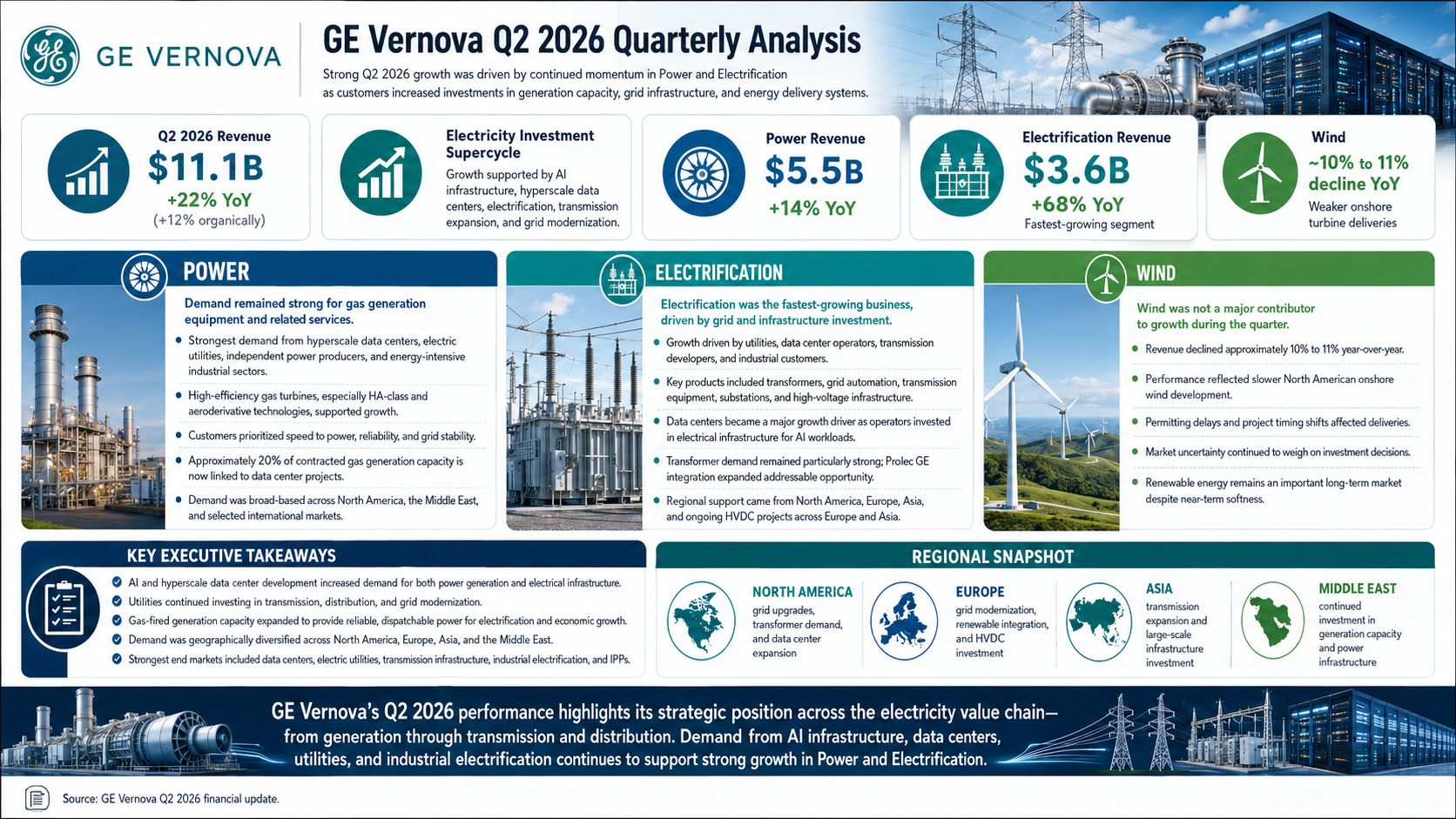
Artificial intelligence infrastructure, data centers, electrification, and grid modernization continue to reshape global electricity investment, and GE Vernova's second-quarter 2026 results provide another indication of how these trends are translating into demand for generation and electrical infrastructure.
The company reported second-quarter revenue of $11.1 billion, an increase of 22 percent year over year (12 percent organically), driven primarily by continued strength in its Power and Electrification businesses. The results suggest utilities, independent power producers, and industrial customers continue to expand investment across generation, transmission, distribution, and grid modernization as electricity demand rises.
Rather than reflecting growth in a single market, GE Vernova's performance highlights broad investment across the electricity value chain, from gas-fired generation and transformers to substations, grid automation, and high-voltage transmission systems.
GE Vernova's Power segment generated approximately $5.5 billion in revenue during the quarter, increasing 14 percent year over year.
Demand remained strong across multiple customer groups, including electric utilities, independent power producers, hyperscale data center developers, and energy-intensive industrial facilities requiring reliable long-term electricity supplies.
One of the strongest demand drivers continues to be AI infrastructure. As hyperscale cloud providers expand data center capacity, they require reliable baseload and backup power that can be deployed relatively quickly. High-efficiency gas turbines remain an important part of that strategy because they provide dispatchable generation while supporting grid stability.
GE Vernova reported that approximately 20 percent of its contracted gas generation capacity is now associated with data center projects, illustrating how AI infrastructure is increasingly influencing investment decisions within the power generation sector.
The company also benefited from continued demand for HA-class gas turbines and aeroderivative technologies as customers prioritized speed to power, operational reliability, and efficiency.
Growth remained geographically diversified across North America, the Middle East, and other international markets where governments, utilities, and private developers continue expanding generation capacity to support economic development and electrification.
Electrification was GE Vernova's fastest-growing segment during the quarter, with revenue increasing approximately 68 percent year over year to $3.6 billion.
Utilities continued investing heavily in transmission and distribution infrastructure to accommodate increasing electricity demand while improving grid reliability and resilience. At the same time, industrial customers accelerated electrical infrastructure upgrades to support broader electrification initiatives.
Demand also remained strong from data center developers investing in electrical distribution systems, substations, transformers, and other infrastructure needed to support AI computing facilities.
Key contributors included transformers, transmission equipment, grid automation technologies, substations, and high-voltage infrastructure.
Transformer demand remained particularly robust as utilities addressed capacity constraints, aging infrastructure, and growing interconnection requirements. GE Vernova also noted that the integration of Prolec GE has expanded its ability to address growing demand within this market.
Regional growth reflected similar investment priorities worldwide. North America benefited from utility upgrades, transformer demand, and continued data center expansion. Europe continued investing in grid modernization and renewable energy integration, while Asia saw ongoing transmission expansion and large-scale electrical infrastructure projects, including high-voltage direct current (HVDC) systems.
Unlike Power and Electrification, GE Vernova's Wind business experienced a slower quarter, with revenue declining approximately 10 to 11 percent year over year.
The decline primarily reflected weaker North American onshore wind activity, permitting delays, project timing shifts, and continued market uncertainty affecting customer investment decisions.
While wind energy remains an important long-term market, it contributed less to the company's overall performance during the quarter than investments in conventional generation and grid infrastructure.
One of the more significant themes emerging from GE Vernova's results is that AI investment extends well beyond data center construction.
Every large AI facility requires additional generation capacity, transmission infrastructure, substations, transformers, electrical distribution equipment, and grid modernization investments. As a result, spending is occurring across multiple layers of the electricity ecosystem rather than being limited to computing infrastructure itself.
This broader investment pattern benefits companies participating throughout the electricity value chain, from power generation equipment to transmission and distribution technologies.
GE Vernova's second-quarter performance illustrates how rising electricity demand is reshaping investment priorities across global energy infrastructure.
Although AI-driven data centers remain an important catalyst, the results indicate that utilities, power producers, and industrial organizations are investing across generation, transmission, distribution, and grid modernization to address broader structural increases in electricity consumption. These investments are supporting demand for gas turbines, transformers, substations, grid automation technologies, and high-voltage transmission systems.
The company's strong growth in Electrification is particularly notable because it reflects increasing recognition that expanding generation capacity alone is insufficient. Delivering additional electricity requires substantial investment in transmission networks, distribution infrastructure, and grid modernization.
While renewable energy deployment continues to evolve at varying rates across regions, GE Vernova's results suggest that dispatchable gas generation and electrical infrastructure remain central components of current investment strategies. As electricity demand continues to rise, suppliers capable of supporting multiple stages of the electricity value chain are likely to remain well positioned.