Representative End User Clients







Representative Automation Clients







Representative Software Clients









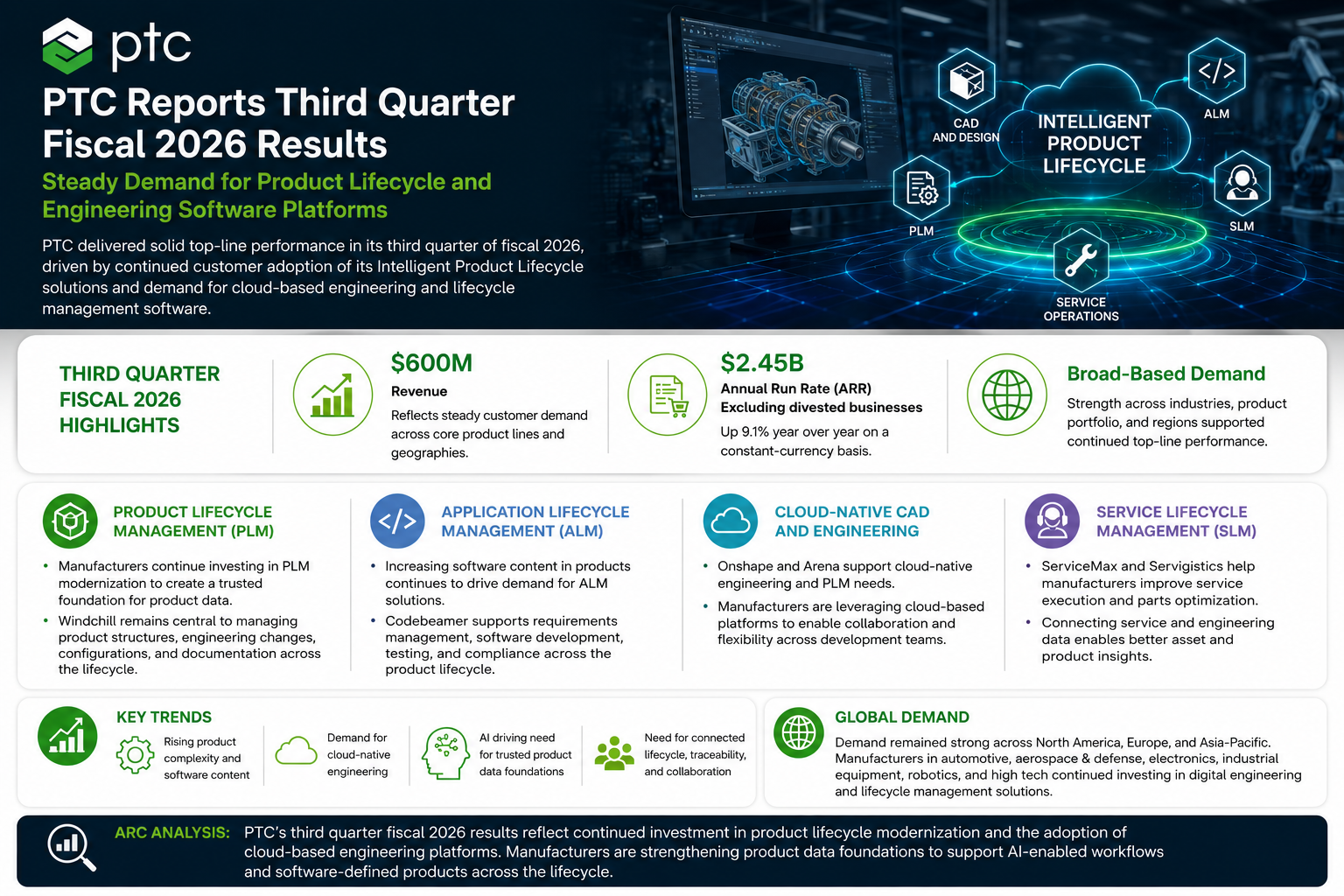
PTC reported solid performance for the third quarter of fiscal 2026 as manufacturers continued investing in product lifecycle management, engineering software, and AI-ready product data foundations.
Constant-currency annual run rate (ARR), excluding the divested Kepware and ThingWorx businesses, increased 9.1 percent year over year to approximately $2.45 billion, exceeding the high end of the company’s guidance range. On an as-reported basis, ARR was flat year over year because the prior-year comparison included the divested businesses.
PTC also reported third-quarter revenue of approximately $600 million. Revenue declined year over year on a constant-currency basis, partly reflecting the impact of the Kepware and ThingWorx divestiture and the timing of subscription revenue recognition under ASC 606.
Following the quarter, PTC raised its full-year guidance for ARR and revenue, citing stronger customer adoption, improved demand capture, and visibility into its fourth-quarter pipeline.
PTC continues to focus its product and go-to-market strategy on what it calls the Intelligent Product Lifecycle.
This strategy brings together computer-aided design, product lifecycle management, application lifecycle management, and service lifecycle management to help manufacturers connect product information across engineering, software development, manufacturing, quality, and service operations.
The approach reflects growing demand for trusted and connected product data as manufacturers manage increasingly complex products that combine mechanical, electrical, electronic, and software components.
PTC’s portfolio includes Creo and Onshape for product design, Windchill and Arena for product lifecycle management, Codebeamer for application lifecycle management, and ServiceMax and Servigistics for service operations.
AI has become a central topic in PTC’s customer discussions, particularly as manufacturers explore how generative and agentic AI can support engineering and product lifecycle workflows.
However, effective AI deployment depends on access to accurate, contextualized, governed, and traceable product information. Product data is often distributed across engineering applications, documents, software development systems, PLM environments, and service records.
Manufacturers are therefore modernizing their product data foundations before deploying AI across engineering and lifecycle processes.
PTC is positioning its existing software platforms as trusted systems over which an intelligence layer can be established. The company is introducing AI capabilities across CAD, PLM, ALM, and SLM applications to help users retrieve information, summarize documents, identify patterns, improve data quality, and support engineering decisions.
Product lifecycle management remains central to PTC’s strategy.
Manufacturers are investing in PLM modernization to connect product structures, bills of material, engineering changes, requirements, documentation, and configuration information across the enterprise.
Windchill supports these initiatives by providing a controlled environment for product information while improving collaboration among engineering, manufacturing, quality, procurement, and service teams.
The growing interest in AI is increasing the strategic value of PLM. AI-enabled workflows require reliable product context and lifecycle traceability to produce useful and trustworthy results.
PTC’s emphasis on Windchill AI reflects the company’s view that PLM platforms can evolve from systems of record into environments that also support AI-assisted engineering and lifecycle decisions.
Software continues to account for a larger share of product functionality across automotive, aerospace and defense, industrial equipment, electronics, medical devices, and other manufacturing industries.
This trend is increasing demand for application lifecycle management technologies that connect requirements, software development, testing, validation, risk management, and compliance.
Codebeamer supports these processes while helping organizations improve traceability between software development and physical product engineering.
As manufacturers develop more software-defined products, tighter integration between ALM and PLM is becoming increasingly important. Organizations need to understand how software releases, requirements, product configurations, and engineering changes relate across the lifecycle.
Cloud-native engineering platforms remain another important part of PTC’s portfolio.
Onshape combines cloud-native CAD and product data management in a shared environment designed for distributed engineering teams. Arena provides cloud-based PLM and quality management capabilities for electronics, high-technology, and other product companies.
These platforms support organizations seeking faster deployment, real-time collaboration, and reduced infrastructure requirements compared with traditional desktop and on-premise engineering systems.
Cloud-native platforms can also help manufacturers connect internal teams, suppliers, and development partners through shared product environments.
PTC’s ServiceMax and Servigistics solutions extend the product lifecycle into field service and aftermarket operations.
ServiceMax supports service execution, asset information, technician workflows, and field operations, while Servigistics focuses on service parts planning and optimization.
Connecting service information with engineering and PLM systems can help manufacturers improve product quality, reliability, maintainability, and customer outcomes.
Service records also provide valuable information for AI-enabled analysis. Data concerning failures, repairs, replacement parts, and technician activity can help manufacturers identify recurring problems and improve future product designs.
PTC completed the divestiture of Kepware and ThingWorx in March 2026.
The transaction created a more focused portfolio centered on product design, product lifecycle management, software development, and service lifecycle technologies.
The divestiture also affects year-over-year comparisons. PTC therefore reports ARR excluding Kepware and ThingWorx from the prior-year period to provide a clearer view of the continuing business.
This sharper portfolio focus aligns with PTC’s Intelligent Product Lifecycle strategy and its emphasis on connecting trusted product information across engineering and service processes.
PTC’s third-quarter results reflect continued manufacturer investment in product lifecycle modernization and AI-ready engineering environments.
AI is not replacing the need for core engineering systems. Instead, it is increasing the importance of accurate product data, lifecycle context, governance, and traceability.
Manufacturers seeking to apply AI across design, engineering, software development, quality, and service must first strengthen the systems that manage product information. This creates opportunities for vendors providing CAD, PLM, ALM, and service lifecycle platforms.
PTC’s Intelligent Product Lifecycle strategy aligns with these requirements by connecting information across product design, lifecycle management, software engineering, and service operations.
The strategy is particularly relevant in industries managing increasingly complex and software-defined products, including automotive, aerospace and defense, electronics, medical devices, industrial equipment, robotics, and advanced manufacturing.
Following the Kepware and ThingWorx divestiture, PTC has a clearer focus on product development and lifecycle software. Its 9.1 percent constant-currency ARR growth, increased full-year ARR and revenue guidance, and continued emphasis on AI-enabled product data indicate sustained customer interest in engineering modernization.
From ARC’s perspective, PTC is well positioned to benefit as manufacturers invest in connected product data foundations that support digital engineering, lifecycle traceability, cloud collaboration, and industrial AI.