Representative End User Clients







Representative Automation Clients







Representative Software Clients








KEYWORDS: SAP Digital Manufacturing, Agentic AI, Industrial Data Fabric, Autonomous Supply Chain, OT/IT Convergence, Edge Computing, Business Data Cloud
The global industrial sector has reached a defining inflection point. A rigorous, multi-site analysis of the ARC Advisory Group Q4 2025 Industrial AI, Energy, and Robotics Survey reveals a market that has permanently fractured into what we call the "Digital Divide." The market has trifurcated into three distinct operational cohorts:
For the past decade, the standard "Industry 4.0" playbook suggested a gradual, linear digitization cycle where "Fast Followers" could safely wait out the technology adoption curve. Today, our empirical data proves that the Fast Follower strategy is effectively dead in productively adopting AI. (To review our complete methodology for tracking these leaders, read my article: Closing the Digital Divide by Embracing Industrial AI).
The competitive gap is compounding exponentially. While followers hesitate, Pacesetters are actively scaling physical intelligence and multi-agent systems to lock in historic gains in throughput and quality. For the mainstream majority, the objective is clear: they must move beyond isolated "science projects" and construct a unified, scalable enterprise architecture capable of running the autonomous business.
To chart the path forward, we must address the traditional culture gap between corporate IT and plant-floor Operations Technology (OT). For decades, OT executives and industrial software vendors viewed enterprise software deployments with a healthy dose of skepticism. Historically, SAP implementations were often perceived as monolithic, inflexible, "headquarters-driven" IT mandates forced upon the factory floor by corporate leaders who did not understand the deterministic physics of manufacturing. We feared that connecting the shop floor to S/4HANA meant surrendering to heavy, slow integrations that choked on proprietary OT protocols and ignored the realities of localized, edge-based execution.
However, over the last two years, my perspective has fundamentally evolved. What I witnessed at Sapphire 2025, culminating in the major platform rollouts at Sapphire 2026, marks a clear transition. SAP has successfully modernized its Enterprise Architecture for the Agentic AI era. Through the SAP Business AI Platform—unifying the Business Technology Platform (BTP), Business Data Cloud (BDC), and Business AI into a single semantic fabric—SAP is no longer attempting to force the physical plant to adapt to a rigid, top-down ERP. Instead, they have built a collaborative, cloud-native blueprint that respects the unique requirements of the shop floor while providing the enterprise with unmatched supply chain visibility (see my baseline research: Navigating the AI Wars and the Escalating Industrial Robot Wars).
The underlying message is clear: while the best-run factories still rely on a trusted ecosystem of industrial automation and OT software, the best-run businesses run on SAP. The goal is no longer to fight the IT/OT culture war, but to achieve a secure, open, and productive coexistence between the two.
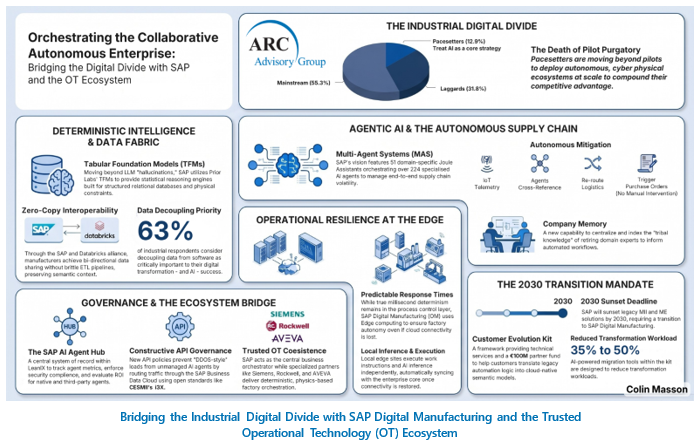
View the complete Orchestrating the Collaborative Autonomous Enterprise: Aligning SAP Digital Manufacturing with the Trusted OT Ecosystem report.