


ARC Advisory Group’s new MarketMap assesses suppliers enabling digital worker capabilities across manufacturing industries.
ARC Advisory Group announced the publication of its new ARC MarketMap: Digital Worker Technologies for Manufacturing 2026, an independent evaluation of technology suppliers helping industrial organizations connect frontline employees with the information, expertise, systems, and assets needed to perform work. The report arrives as manufacturers move beyond the digitization of paper procedures toward more connected, contextual, and AI-assisted approaches to frontline operations
Digital worker technologies provide industrial employees with timely access to colleagues, operational information, enterprise systems, and physical assets at the point of work. The report organizes the market around three principal capability areas: collaboration, training, and digital work instructions. Its scope encompasses dedicated software and associated services for industrial and infrastructure applications, while excluding the phones, tablets, computers, and wearable hardware used to access those solutions.
Market Forces Are Redefining Frontline Work
Manufacturers face a widening industrial skills gap, increasing operational complexity, and an ongoing need to improve the consistency and safety of work execution. Digital procedures, remote collaboration, and just-in-time training can help organizations make specialized knowledge more accessible while supporting workers as tasks are performed. At the same time, broader availability of mobile devices and advanced connectivity is making digital worker functionality practical across maintenance, operations, quality, and other plant functions.
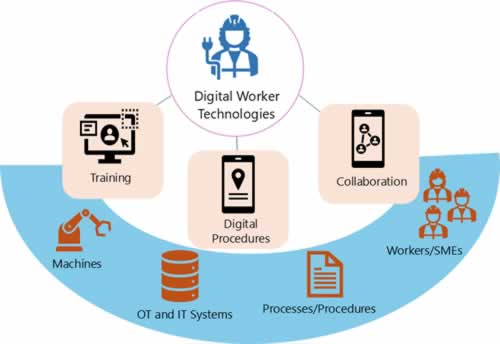
The market is also being reshaped by AI, Industrial IoT integration, mobile-first design, and the inclusion of digital worker functionality within larger automation and industrial software portfolios. Buyers increasingly expect platforms to connect with enterprise and operational systems, provide a consistent source of information, and support scalable deployment across sites. ARC’s related market research forecasts growth of more than 11 percent over its five-year forecast period, reflecting expanding demand for technologies that support safer, more efficient, and more effective frontline work.
These developments make supplier selection more complex. Solutions vary substantially in areas such as work instructions, collaboration, training, AI readiness, interoperability, deployment architecture, offline operation, visualization, configurability, industry specialization, and enterprise scale. Buyers must assess not only whether a platform meets an immediate use case, but also whether the supplier’s technology foundation, services, roadmap, and corporate strategy align with long-term operational objectives.
A Structured Assessment of Capabilities and Direction

The ARC MarketMap provides an analyst-led, independent assessment using a structured two-axis framework: Solution Capabilities and Strategic Vision. Each dimension carries an equal weighting in the report. Solution Capabilities encompass technical capabilities, functional capabilities, and execution and support services. Strategic Vision considers product vision and strategy, corporate strategy, and customer base. The research incorporates supplier responses, live capability demonstrations, secondary research, market inputs, and ARC analyst expertise
The MarketMap evaluates Andonix, Atheer, Augmentir, Azumuta, Dozuki, Glartek, Innovapptive, L2L, Librestream, Mobideo, Octave, Parsable, Poka, PTC, Redzone, Squint, SymphonyAI, TeamViewer, and Tulip. Inclusion in the report enables technology buyers to compare suppliers through a consistent framework while considering differences in solution breadth, market focus, delivery maturity, and strategic direction.
The report is intended to support CIOs, IT directors, digital transformation leaders, plant and operations managers, maintenance teams, procurement and finance executives, and strategy and innovation leaders. It provides a practical basis for developing shortlists, aligning sourcing and operational priorities, framing supplier discussions, and evaluating long-term vendor risk. ARC advises buyers to apply the MarketMap alongside organization-specific due diligence, technical requirements, budgets, risk profiles, and business objectives.
Analyst Perspective
“The digital worker technology market is moving from standalone digitization toward more intelligent, connected, and context-aware frontline execution,” said Inderpreet Shoker, Director of Research at ARC Advisory Group and lead analyst for the Digital Worker Technologies MarketMap. “ARC’s MarketMap helps buyers look beyond individual features and evaluate how well each supplier’s current capabilities and future direction align with the organization’s workforce, operational, integration, and scalability requirements.”
About ARC MarketMap
ARC MarketMap reports provide an objective view of how suppliers perform today and how they are positioned for the future. The assessments combine detailed supplier engagement, capability evaluation, market research, and analyst judgment to help technology buyers move from broad market understanding to informed supplier evaluation. For suppliers, MarketMap research offers an independent view of market expectations, competitive differentiation, and areas in which capabilities or strategies are evolving.
Learn More
Learn more about the ARC MarketMap for Digital Worker Technologies and see a sample report.