Representative End User Clients







Representative Automation Clients







Representative Software Clients








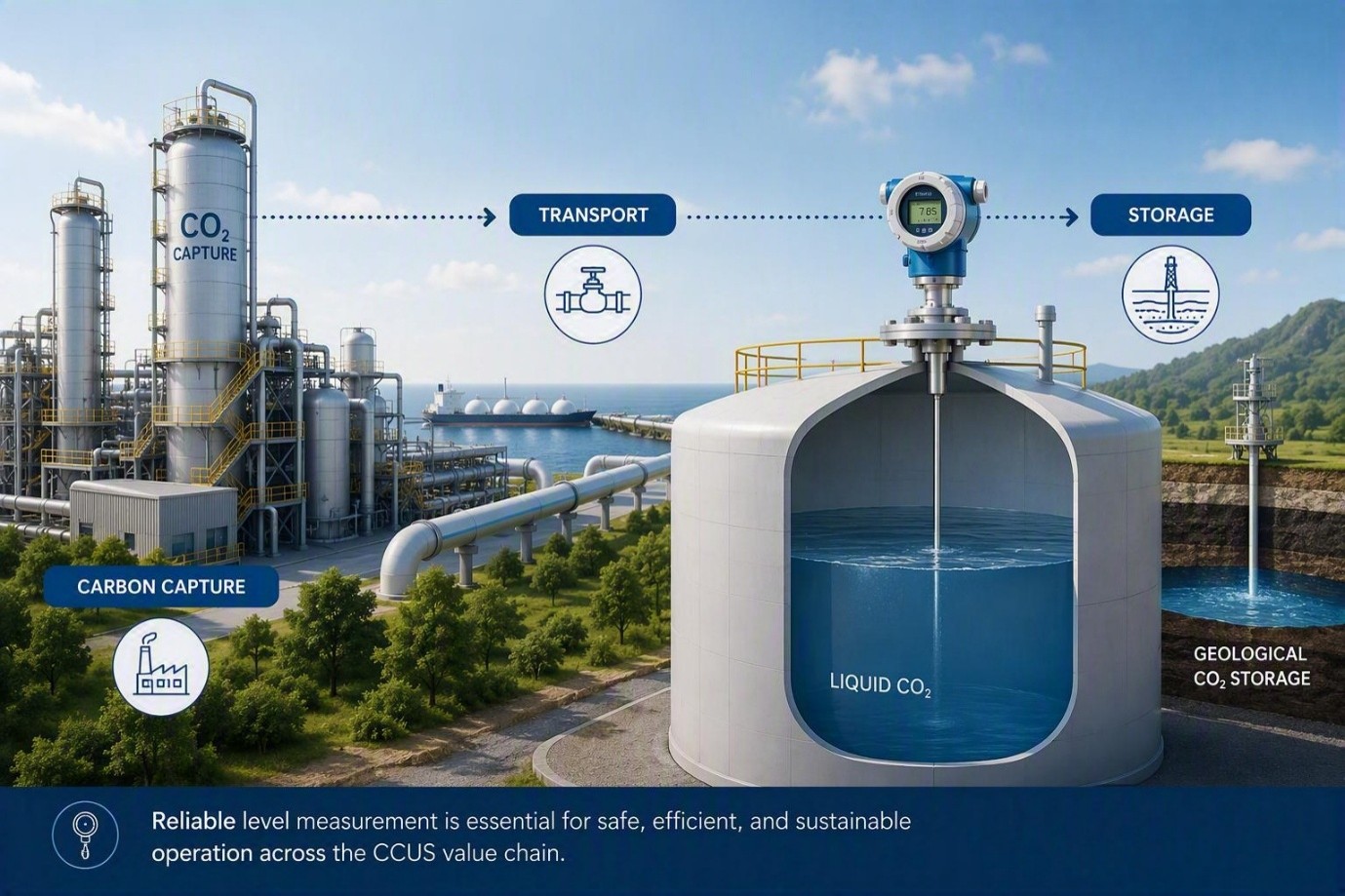
As industries worldwide pursue decarbonization goals, carbon capture, utilization, and storage (CCUS) has emerged as one of the most important technologies for reducing industrial carbon dioxide emissions. Significant investments are being directed toward projects that capture CO₂ from power plants, refineries, chemical facilities, cement plants, and other hard-to-abate industries before transporting and permanently storing or reusing it. Reliable measurement and monitoring are essential throughout the CCUS value chain to ensure operational efficiency, regulatory compliance, and safe handling of captured carbon dioxide.
While much of the discussion surrounding CCUS focuses on flow measurement, gas analysis, and emissions monitoring, level measurement also plays a critical role. From solvent management systems in capture facilities to liquid CO₂ storage tanks and water handling systems at sequestration sites, accurate level measurement supports safe, efficient, and reliable operation across multiple process stages.
CCUS facilities involve numerous vessels, tanks, separators, absorbers, regenerators, and storage systems handling liquids, gases, and often challenging process conditions. Maintaining proper inventory levels is essential for process stability, environmental compliance, and operational safety.
Inadequate level monitoring can result in solvent losses, process inefficiencies, equipment damage, unplanned downtime, or safety incidents. As CCUS projects scale from pilot installations to large commercial facilities, operators increasingly require robust instrumentation capable of performing reliably under demanding operating conditions.
Unlike conventional storage applications, CCUS processes often involve corrosive solvents, varying process temperatures, pressure fluctuations, and, in some cases, liquid or supercritical CO₂. These conditions increase the importance of selecting suitable level measurement technologies.
The capture stage presents several important level measurement challenges.
Post-combustion carbon capture systems commonly utilize absorption and regeneration processes that employ liquid solvents to remove CO₂ from flue gas streams. Various tanks and process vessels require continuous level monitoring to ensure efficient solvent circulation and inventory control.
Typical applications include:
Solvent storage tanks.
Lean and rich solvent vessels.
Knockout drums.
Condensate collection systems.
Chemical dosing tanks.
Wastewater treatment systems.
Reliable level measurement helps optimize solvent utilization while reducing the risk of overflow, underfill conditions, and process interruptions.
Following capture, carbon dioxide is frequently compressed and prepared for transportation via pipelines, ships, rail, or trucks. During these stages, operators must manage multiple vessels containing condensed liquids and process byproducts.
Examples include:
Liquid CO₂ storage tanks.
Separator vessels.
Condensate receivers.
Surge tanks.
Intermediate storage systems.
As carbon dioxide moves through various pressure and temperature conditions, accurate level measurement helps maintain stable operations and supports inventory management throughout transportation networks.
The storage phase represents the final stage of many CCUS projects. Carbon dioxide is injected into suitable geological formations for long-term sequestration.
While attention often focuses on subsurface monitoring, above-ground facilities also rely heavily on instrumentation.
Common applications include:
Buffer storage tanks.
Injection facility tanks.
Produced water systems.
Chemical treatment vessels.
Water management infrastructure.
Reliable level instrumentation contributes to safe injection operations while supporting environmental compliance and facility management objectives.
CCUS environments present unique measurement challenges, including pressure variations, changing process conditions, chemical compatibility requirements, and demanding reliability expectations.
Selecting the appropriate level technology for CCUS applications requires a detailed understanding of process conditions, installation requirements, and long-term operating objectives. As discussed in Choosing the Right Flow and Level Technology: Why One Size Does Not Fit All in Modern Process Plants, technology selection is increasingly application-driven rather than based on standardization across the facility.
Radar level technology is likely to be one of the most attractive options for many CCUS applications due to its non-contact measurement principle and ability to perform under a wide range of process conditions.
Advantages include:
Minimal maintenance requirements.
High accuracy.
Capability to operate under varying pressures and temperatures.
Suitability for large storage vessels.
Radar technology is particularly attractive where operators seek reliable performance while minimizing maintenance intervention.
This growing emphasis on reliability reflects a broader industry trend explored in Why Radar Level Measurement Is Redefining Reliability in Process Plant Design, where measurement performance is viewed not only in terms of accuracy but also in terms of long-term operational dependability and reduced maintenance requirements.
Guided wave radar is well suited for applications involving difficult media, narrow vessels, or process conditions where additional measurement stability is required.
Potential CCUS applications include:
Solvent vessels.
Process separators.
Interface measurements.
Chemical storage applications.
Its ability to deliver stable, reliable measurements in challenging process conditions makes guided wave radar a strong fit for many carbon capture installations.
Traditional differential pressure and hydrostatic level measurement technologies continue to provide value in many applications.
These solutions remain widely used because of:
An established installed base.
Familiarity among plant personnel.
Proven performance in many tank and vessel applications.
However, project-specific process requirements ultimately determine the most appropriate technology selection.
As CCUS facilities increasingly adopt digitalization initiatives, level transmitters are expected to provide more than a simple level reading.
Modern smart instruments can contribute valuable information regarding:
Device health.
Process diagnostics.
Maintenance requirements.
Asset performance.
As operators seek to maximize uptime and improve operational transparency, advanced diagnostic capabilities may become increasingly important selection criteria for future CCUS projects.
As CCUS facilities become increasingly data-driven, the focus is shifting from individual instruments to integrated measurement architectures capable of supporting operational, maintenance, and sustainability objectives across the entire facility. This evolution mirrors the concepts discussed in Measurement Architecture Becomes a Priority in Process Plants.
The global expansion of CCUS projects creates new opportunities for instrumentation suppliers. Industry participants increasingly recognize that successful carbon capture projects depend not only on capture technologies themselves but also on the measurement infrastructure needed to monitor and control operations effectively. Measurement providers are already emphasizing comprehensive monitoring solutions for CO₂ capture, transportation, and storage applications.
Although flow measurement and gas analysis currently receive significant attention, level measurement remains an essential component of overall plant reliability and operational efficiency. As project activity increases across sectors such as refining, chemicals, cement, steel, and power generation, demand for reliable level measurement solutions is likely to grow alongside broader CCUS investments.
The success of CCUS projects depends on accurate and reliable measurement throughout the carbon management value chain. While flowmeters and analyzers often dominate discussions, level measurement is equally important in ensuring safe operation, effective inventory management, and process reliability.
From solvent handling systems in capture plants to liquid CO₂ storage infrastructure and sequestration facilities, level transmitters help operators maintain control of critical processes under increasingly demanding conditions. As CCUS deployment accelerates globally, level measurement technologies will continue to play a vital role in supporting the industry's transition toward lower-carbon operations.
The importance of measurement technologies in CCUS extends beyond monitoring process variables. Reliable measurement directly influences plant availability, regulatory compliance, operational performance, and project economics, reinforcing the idea that measurement technology is increasingly viewed as a strategic business decision rather than simply an operational necessity.
For additional ARC perspectives on level measurement technologies, reliability, and the evolving role of instrumentation in modern process plants, see:
Choosing the Right Flow and Level Technology: Why One Size Does Not Fit All in Modern Process Plants
Why Radar Level Measurement Is Redefining Reliability in Process Plant Design
Together, these ARC insights provide additional context for evaluating level technologies as part of a broader measurement architecture, particularly as process industries place greater emphasis on reliability, diagnostics, digitalization, and long-term operational performance.