Representative End User Clients







Representative Automation Clients







Representative Software Clients








GE Vernova announced its new medium-voltage uninterruptible power supply (MV-UPS), designed to help data centers, AI factories, and other energy-intensive facilities maintain stable, continuous, high-quality power.
The new system is designed to:
Help maintain stable, high-quality power for AI data centers and other energy-intensive facilities during electrical disturbances.
Move UPS protection to medium voltage, enabling larger blocks of critical load to be protected through one coordinated system.
Add medium-voltage power protection and stability to GE Vernova’s broader power-to-rack data center portfolio.
As electricity demand increases, AI data centers are one of the fastest-growing sources of load growth. For these facilities, even brief electrical disturbances can interrupt critical workloads. Rapid changes in computing demand can also create significant fluctuations in electricity consumption, placing additional strain on grids or onsite generation resources.
UPS protection is typically deployed at low voltage after electricity has been stepped down, requiring smaller sections of a facility to be protected separately. GE Vernova’s MV-UPS moves power protection to medium voltage, creating a stability layer between the facility and its power supply.
This approach is designed to enable one coordinated system to protect larger blocks of critical load while helping prevent sudden changes in facility demand from being passed directly back to the grid or generation sources. The system can also help to protect gas turbines and grid networks from significant load fluctuations.
The MV-UPS is installed on a facility’s medium-voltage network between the power supply and critical loads. It combines power conversion technology, advanced controls, and integrated energy storage to help maintain stable voltage and frequency for critical operations while buffering sudden changes in demand.
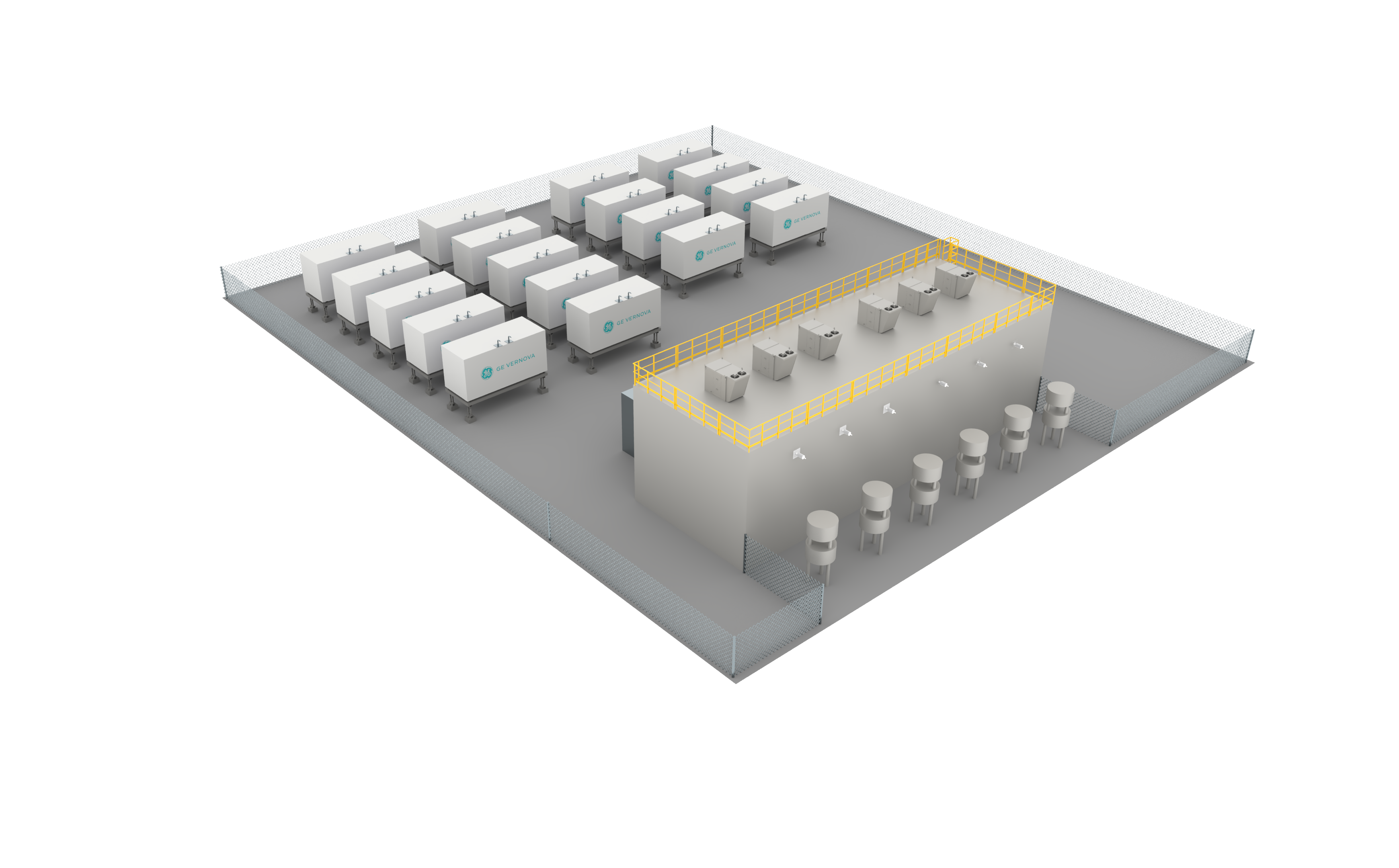
By providing protection at medium voltage, the system can support larger blocks of critical load than traditional low-voltage UPS configurations. GE Vernova reports that the approach can also help to simplify downstream electrical infrastructure, enable more flexible use of energy storage, and help customers to address power-quality and grid-connection requirements.
GE Vernova expects to begin shipping MV-UPS systems in mid-2027, with energization of the first project expected in late 2027.
The MV-UPS expands GE Vernova’s end-to-end data center portfolio by adding medium-voltage power protection and stability to its power-to-rack capabilities.
The company’s existing data center portfolio includes gas turbines for power generation; substations; high- and medium-voltage transformers; switchgear and gas-insulated switchgear; energy management systems; and power conversion technologies used to generate, connect, manage, and deliver electricity to computing infrastructure.
GE Vernova is also developing solid-state transformer technology intended to help enable more compact and efficient power conversion closer to the rack. Together with the MV-UPS, these technologies are designed to address the increasing scale, reliability, and electrical-efficiency requirements of AI data centers and other high-density loads.
The growing power requirements of AI data centers are driving changes in how facilities approach electrical architecture, grid interaction, resilience, and onsite power infrastructure. ARC has examined several of these developments, including modular power architectures, grid constraints, and new approaches to supplying large-scale data center loads.
As AI workloads continue to increase power density and introduce more dynamic load profiles, data center operators will need to consider power quality, grid stability, energy storage, and electrical architecture as interconnected parts of facility design. Technologies, such as medium-voltage UPS systems, will become an increasingly important component of efforts to help improve resilience, while supporting larger and more demanding computing environments.