Representative End User Clients







Representative Automation Clients







Representative Software Clients









Schneider Electric launched Schneider Charge, a smart Level 2 residential electric vehicle (EV) charger now available in the US and Canada.
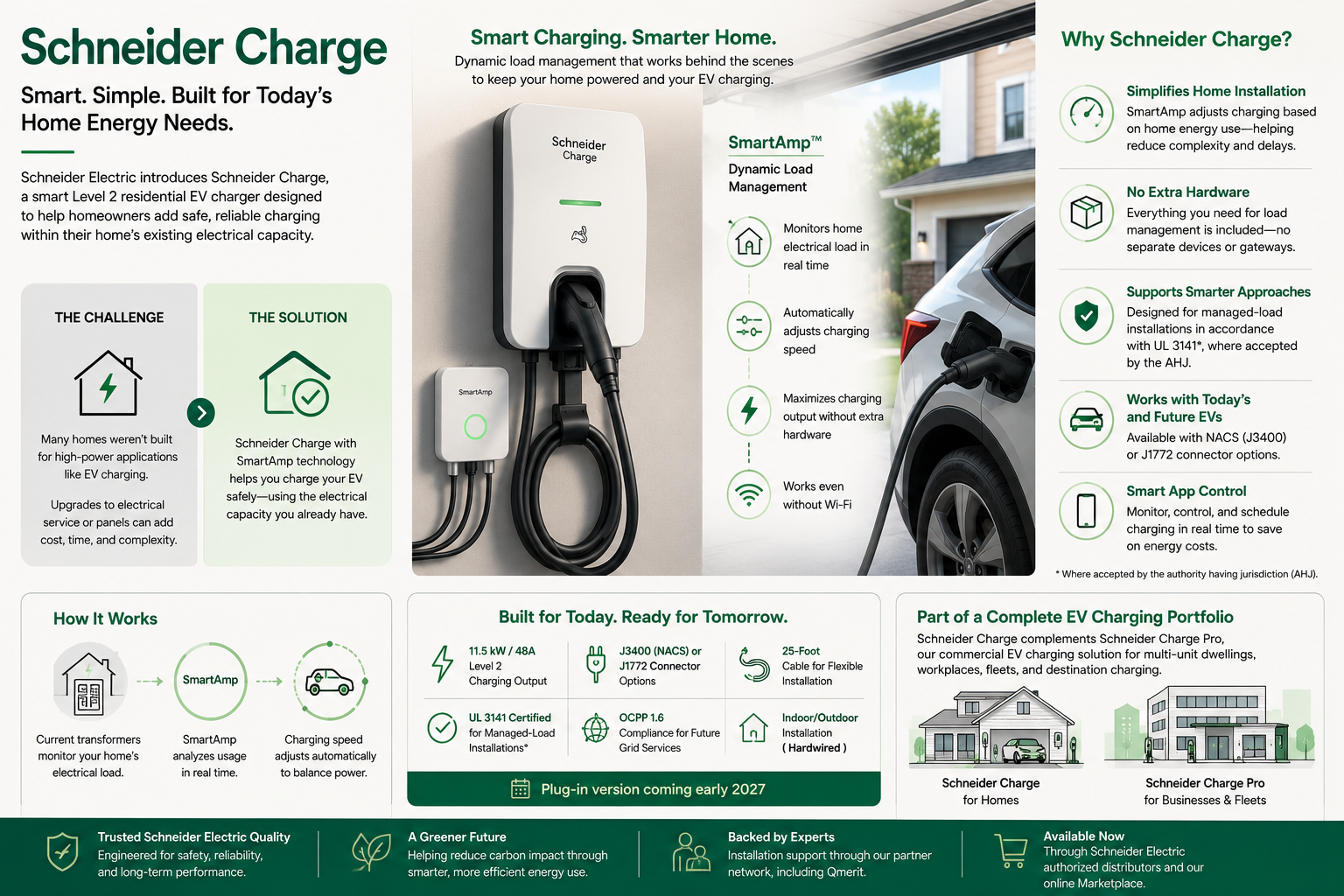
The charger is designed to help address a growing challenge associated with home electrification: many residential electrical systems were not originally designed to accommodate high-power loads, such as EV charging. In some homes, installing a Level 2 charger can require electrical service or panel upgrades, adding cost and complexity to the project.
Schneider Charge is designed to help homeowners add Level 2 charging while operating within the home’s available electrical capacity. Its SmartAmp dynamic load-management technology monitors household electrical demand in real time and automatically adjusts EV charging output when other appliances require power. Schneider Electric reports the approach can help to reduce the need for separate monitoring devices or gateway systems.
SmartAmp uses include current transformers to monitor electrical load and dynamically adjust charging speed as household demand changes. The load-management function continues to operate even if Wi-Fi connectivity is unavailable.
By incorporating load management directly into the charger, Schneider Charge is intended to simplify managed-load installations and help homeowners avoid electrical service upgrades where existing capacity and local requirements allow.
The charger also supports managed-load installations in accordance with UL 3141, where accepted by the local authority having jurisdiction (AHJ). This can provide installers with greater flexibility when integrating EV charging into existing residential electrical infrastructure.
Schneider Electric is also working with Qmerit to provide installation support for homeowners. The arrangement is intended to help support the process from charger selection through professional installation. Qmerit has identified itself as the official installation partner for Schneider Charge in the US and Canadian markets.
Schneider Charge provides up to 11.5 kW of Level 2 charging output at 48 A and is available with either J3400 (NACS) or J1772 connector options, supporting a broad range of electric vehicles.
The Schneider Charge app allows homeowners to monitor charging, adjust settings, and schedule charging periods, including during times when electricity rates may be lower.
Additional capabilities include:
Up to 11.5 kW/48 A Level 2 charging output.
J3400 (NACS) and J1772 connector options.
A 25-foot charging cable.
UL 3141 support for managed-load installations where accepted by the AHJ.
OCPP 1.6 compatibility to support potential future grid-service applications.
Hardwired residential installation.
Indoor and outdoor installation capability.
Schneider Electric plans to introduce a plug-in version in early 2027.
Schneider Charge expands Schneider Electric’s EV charging portfolio alongside solutions for commercial properties, fleets, workplaces, and multi-unit dwellings.
The company recently introduced additional capabilities for Schneider Charge Pro, its commercial Level 2 charging solution for applications including workplaces, fleets, multi-unit dwellings, hotels, and retail locations.
The residential launch also reflects a broader trend toward integrating EV charging with home energy management. As households add electric vehicles and other high-power electrical loads, technologies that coordinate energy consumption across chargers, appliances, solar, batteries, and other systems are becoming increasingly important to residential electrification strategies.
The growing adoption of EVs is increasing the need for charging infrastructure that can operate within existing electrical capacity while coordinating intelligently with other energy loads. The following ARC Insights examine developments in residential energy management, smart charging, load management, and broader EV charging infrastructure.
Schneider Electric Launches AI-powered Home Energy Management Feature for Wiser Home
Schneider Electric Upgrades Charge Pro for Commercial EV Charging in the US
Together, these developments illustrate how EV charging is increasingly becoming part of a larger energy-management architecture rather than operating as a standalone electrical load.