Representative End User Clients







Representative Automation Clients







Representative Software Clients








Bosch has confirmed that its Bühl, Germany, facility will begin series production of Humanoid's HMND Gamma robots in August 2027, creating what appears to be Europe's first dedicated humanoid robot production line with a publicly announced manufacturing date and identified customer relationship. Amid major investor and press buzz, humanoid robot discussion has centered on prototype demonstrations and ambitious roadmap projections toward industrialization. While many humanoid developers continue to focus on technology validation, the Bosch-Humanoid partnership introduces a more tangible manufacturing timeline supported by an established industrial producer.
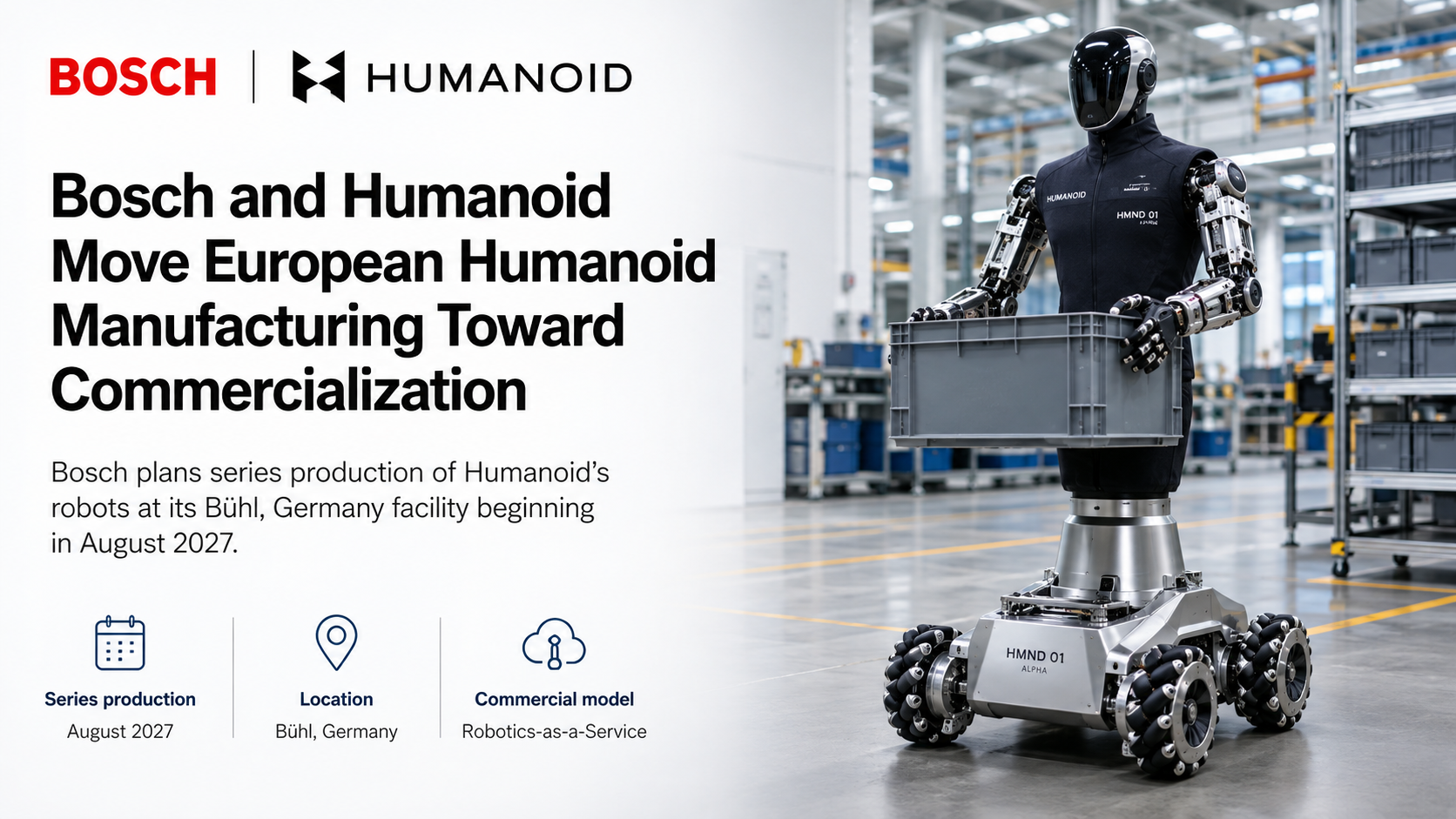
A notable aspect of Humanoid's strategy is its emphasis on a wheeled mobile manipulator rather than a fully bipedal platform for initial commercialization. The HMND 01 Alpha Wheeled concentrates most of its degrees of freedom in its upper body while relying on an omnidirectional wheeled base for mobility. This design choice reflects a practical approach to industrial deployment. Many warehouse, logistics, and manufacturing environments have relatively structured floor layouts where wheeled mobility may be sufficient while avoiding some of the safety, certification, and reliability challenges associated with dynamic walking systems. For industrial users evaluating near-term automation opportunities, wheeled humanoids may represent a lower-risk path to commercial adoption than fully bipedal designs.
The production announcement is also tied to a broader ecosystem strategy. Humanoid's relationships with Bosch and Schaeffler extend beyond traditional supplier and customer arrangements. Bosch is expected to manufacture the robots and may eventually provide sensors, drives, and other components, while Schaeffler serves as both an early deployment partner and strategic supplier. This creates a vertically connected industrial network that could help accelerate commercialization by aligning robot design, component supply, manufacturing, and customer validation. Such partnerships may become increasingly important as humanoid suppliers move from pilot projects toward larger-scale deployments.
Humanoid plans to deploy its systems through a Robotics-as-a-Service model rather than conventional equipment sales, allowing customers to consume humanoid automation as an operational expense while shifting performance and maintenance responsibilities to the supplier. This model has become increasingly common across advanced robotics markets because it can simplify adoption and reduce capital risk for manufacturers. However, it also places greater emphasis on supplier stability, service capability, and long-term ecosystem partnerships.
For the broader European robotics sector, the Bosch-Humanoid agreement represents an early test of whether humanoid robotics can transition from industry experimentation to repeatable production and deployment. The significance of the announcement lies less in the projected scale of production and more in the presence of several elements that remain uncommon across the humanoid market: a confirmed production date, a named manufacturing partner, formal customer agreements, and ongoing industrial validation efforts. Whether these advantages translate into sustainable commercial success will depend on deployment performance, economics, and customer outcomes over the next several years, but the agreement provides one of the clearest indicators yet that Europe's robotics industry is beginning to move toward commercialization.
What I saw at Automate 2026, Part 1: The US Manufacturing Renaissance
What I saw at Automate 2026, Part 2: The Future is Humanoid?
Humanoids for Industry Blog Part 1: Why Humanoids? Why Now?
Humanoids for Industry Blog Part 2: Navigating the Ecosystem
Humanoids for Industry Blog Part 3: A New Market on the Horizon
For discussions on physical intelligence and the new wave of industrial robotics, or to offer feedback on this article, contact Patrick Arnold at [email protected].
Set up a meeting with me and the analysts at ARC Advisory Group to find out more about our Executive Insights Service for industrial organizations, MarketMap efforts, and more.