Representative End User Clients







Representative Automation Clients







Representative Software Clients








On September 10, 2026, ARC Advisory Group hosted a 59-minute webinar presenting the progress of its Open Digital Ecosystem (ODE) Working Group, a forum of asset owners, EPCs, vendors, and standards bodies formed in 2022 to remove practical barriers to scalable industrial digital twins and enterprise software. The session, moderated by ARC industry analyst and ODE co-chair Peter Reynolds, combined a formal presentation from ARC Senior Advisor Manoj Dharwadkar with a live panel discussion featuring digital asset leaders from ExxonMobil and BP.
The central message was direct: industrial AI is not constrained by technology, but by trusted, well-governed data. ARC research cited during the session found that only roughly 13% of organizations are “pace setters” realizing full value from AI, with the gap attributable to fragmented, low-context, poorly governed data rather than immature algorithms. The webinar laid out a four-step path from ODE principles to an Open Data Foundation readiness assessment, to a Target Operating Model, to measurable value realization intended to convert those principles from aspirational “slideware” into contractual and operational reality.
Panelists from ExxonMobil and BP substantiated the thesis with direct field experience, citing redundant data capture, “handover hell” between engineering, operations, and vendor systems, and low trust in received information as the costliest symptoms of fragmentation. Both operators affirmed that owner-operators, not vendors or standards bodies, must continue to lead in defining requirements, because outsourcing that definition has historically left the underlying problems unresolved.
The webinar was ARC Advisory Group's platform for disseminating the ODE Working Group's principles and progress to a broader industry audience of asset owners, EPCs, and software vendors. The ODE Working Group itself was formed in 2022 at the request of ARC's longstanding advisory clients. It launched its first cross-industry collaboration in 2023, broadened requirements-gathering through surveys in 2024, published a formal set of principles and requirements in 2025, and in 2026 is scaling that work to additional global events and workshops. Three active subgroups anchor the technical work: P&ID interoperability (including AI readiness), reality capture and 3D CAD/workflow standardization, and industrial data ontologies (including AI-enabled HAZOP).
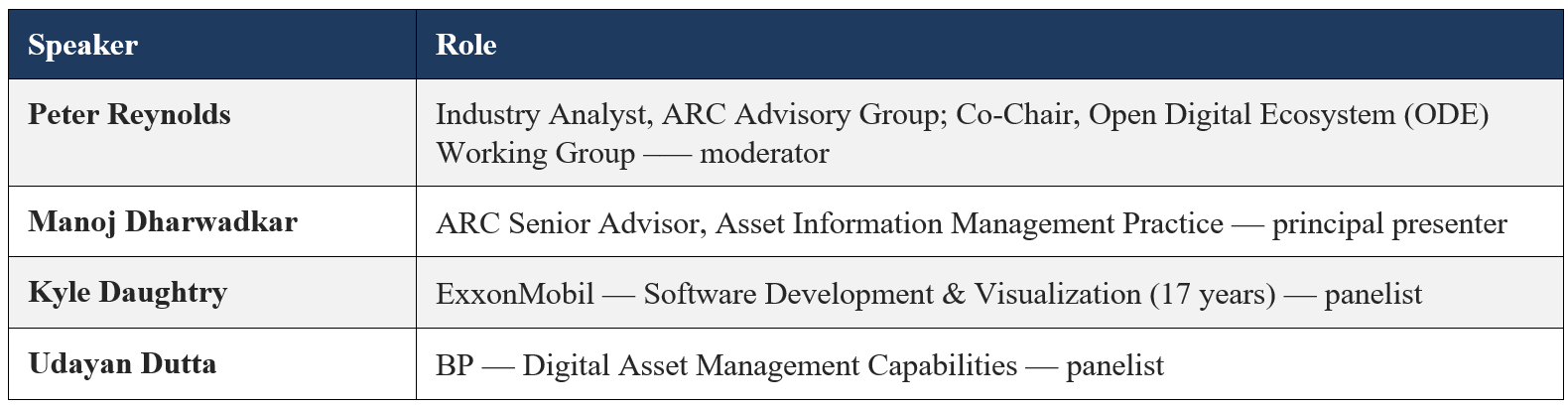
Manoj Dharwadkar opened the technical portion of the session by reframing the industry's AI challenge. Open Digital Ecosystem principles, he noted, have already been articulated and the market demand for them is well established, but principles alone are not enough. They must be operationalized: teams need a concrete path from principle to measurable business value, not another restatement of intent. He outlined that path as running through two linked bodies of work: building the data foundation (the “readiness bridge”) and then converting that readiness into an executable operating model, and framed the remainder of his presentation, and the panel that followed, around those two pillars.
Engineering, operations, maintenance, and business information, he explained, typically evolve in organizational silos, without shared, trusted context. The resulting fragmentation is not a shortage of AI capability but instead is what stalls pilots before they scale. He cited ARC survey data indicating that only about 13 percent of organizations qualify as AI “pace setters,” with the majority still unable to extract full value from their AI investments. Critically, he argued this is not fundamentally a data-volume problem: organizations are, in his words, “drowning in data,” but lacking the context required to make decisions from it. Quality is inconsistent, lineage is not tracked, and the data that does exist is fragmented across systems that were never designed to share meaning.
He was explicit that the underlying AI model capability is, in most cases, already advanced and continuing to mature quickly, and the constraint is not the algorithm. Rather, it is quality, governance, workflow, and decision rights around the data feeding those models. Until a trusted data foundation is stabilized, AI initiatives cannot scale beyond isolated pilots, regardless of how sophisticated the models themselves become. This premise—is that the data foundation, not the model, is the binding constraint—was the analytical spine connecting the rest of his presentation.
This framing was echoed almost verbatim by both operator panelists later in the Q&A. Udayan Dutta (BP) described data fragmentation across multiple ecosystems as his organization's primary limiter on process-safety and event-prediction AI work. Kyle Daughtry (ExxonMobil) went further, estimating that roughly 90 percent of his team's “digital time” is spent on data-related work rather than expanding technology footprint, and framed the core issue as trust: if the reliability of incoming information cannot be assured, AI-driven outcomes, whether process, safety, or asset navigation, related will be wrong.
ARC's Open Digital Ecosystem is defined as a framework for mapping the principles of an open, interoperable ecosystem to measured business value through disciplined data management. Five principles form its blueprint, intended to serve as the test against which every architecture decision, contract, and vendor selection should be measured:
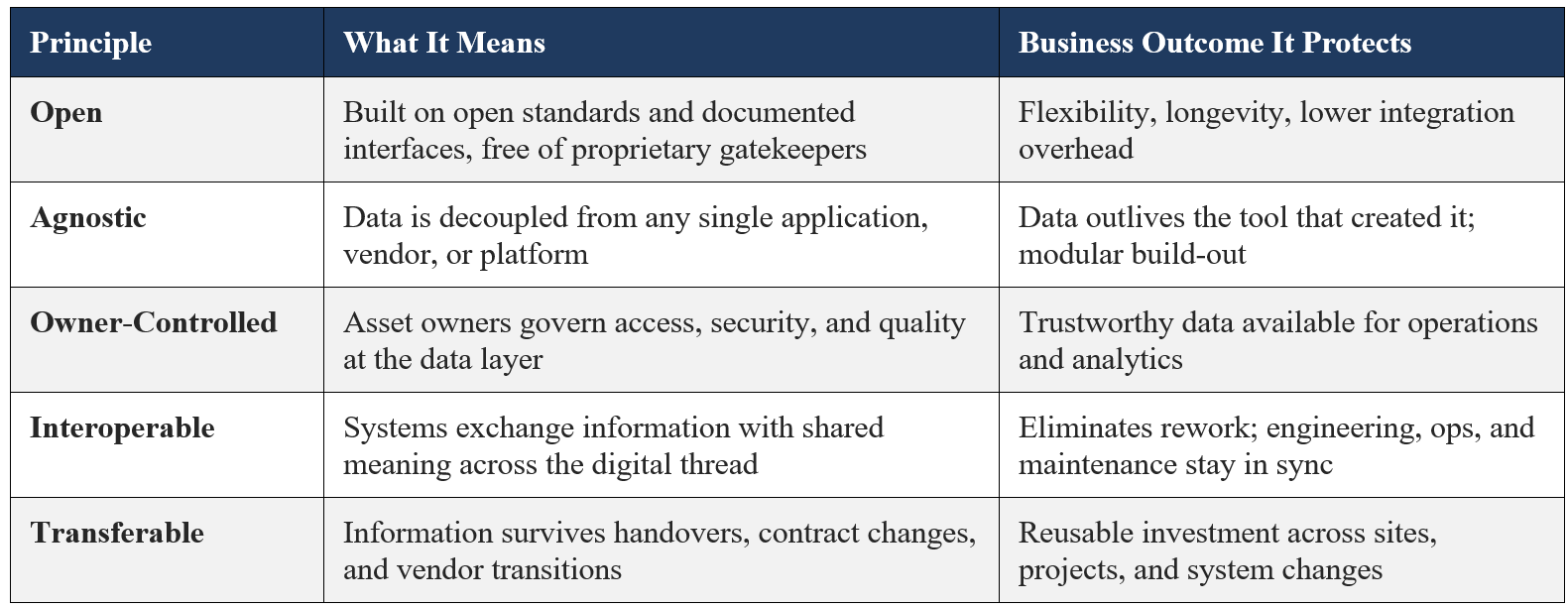
An ARC survey of the broader owner community confirmed strong market alignment behind these principles: extending asset lifecycle value, avoiding vendor lock-in, interoperability across tools, and component/data reuse each drew support from more than 40 percent of respondents—with each priority traceable to one or more of the five principles above. Dharwadkar was explicit about the lineage: extending asset lifecycle value is delivered primarily by the transferable and data-ownership principles; avoiding vendor lock-in is a direct function of open and agnostic architecture; interoperability across tools underpins the digital thread that connects engineering, operations, and maintenance; and component/data reuse—building once and reusing across projects, units, and sites—is delivered by the transferable principle. He noted these principles took roughly a year to align across the owner community before being ratified, underscoring that the survey results validate, rather than merely restate, the working group's own prioritization.
He drew a further distinction that shaped the rest of the presentation: business transformation built on these principles is not an IT initiative, even though IT plays a significant enabling role. The strategy must be interoperable by design, grounded in open standards that carry information across the full asset lifecycle and must explicitly address the quality and effort of information handling at each of the multiple handover points that recur throughout that lifecycle, from initial greenfield project handover through the continuous modifications that follow. Treating any single handover as a one-time event, rather than a repeating pattern to be engineered for, is itself a common source of lost value.
Dharwadkar was also careful to temper the scope of this ambition: organizations should not wait for a perfect, comprehensive solution before acting. Every organization can start immediately with the specific actions that generate immediate value and then build on that foundation continuously. This incremental posture starts now, prioritize by value, and compound improvements over time was presented as being as important to the strategy's success as the principles themselves.
The presentation's operational core was a four-step path for converting principles into measurable business value:
Market Signal (ODE Principles) — Owner-defined expectations for open, agnostic, owner-controlled, interoperable, and transferable information across the asset lifecycle.
Readiness Bridge (Open Data Foundations) — A structured assessment of governance, data quality, architecture, integration, and lifecycle continuity to locate the specific gaps constraining value.
Target Operating Model — Assigning clear accountabilities, workflows, required skills, and partner responsibilities (owner, EPC, IT/OT) so that readiness can be converted into repeatable execution.
Value Realization — Selecting priority use cases, tying execution to KPIs and adoption evidence, and phasing investment against demonstrated results.
Dharwadkar described the data foundation itself as spanning five interlocking areas: governance and trust, quality, architecture, integration, and lifecycle continuity, all held together by metadata that preserves meaning as information moves between systems and teams. Governance and trust, in his framing, require named owners and defined quality baselines. Without a named accountable person, quality standards tend to erode unnoticed. Organizations should benchmark their current data flows, interfaces, and shared context against established data-management standards and bodies of knowledge, rather than assessing maturity in the abstract.
He illustrated the architecture requirement with a concrete example: an engineer should be able to navigate from a piece of 3D valve data to its associated P&ID, and from there to its ontology and other associated metadata, with all of that context available to support downstream decisions. That kind of navigable, connected context—not just the underlying data points themselves—are what a sound architecture built on the five principles is meant to deliver. Finally, lifecycle continuity requires that information remain traceable and transferable at every handover gate, surviving changes in systems, contracts, or lifecycle phase, supported by disciplined change management both for the data itself and for the organization absorbing it.
To operationalize the readiness assessment, Dharwadkar introduced a maturity-scoring framework that breaks organizational competencies into columns (for example: capital projects, process operations, reliability, turnarounds, feedstock and products, and digital/data) and cross-references them against three accountability rows:
Direct: the strategic layer: digital and information strategy, open standards, policy, and architecture decisions.
Control: the governance and assurance layer: data quality ownership, master data management, and information governance that ensures what feeds digital twins and AI is genuinely trustworthy.
Execute: the delivery layer: the people responsible for day-to-day business actions, inputting and moving data forward.
Reading maturity and business value across this grid identifies where “hot components” sit—areas where information maturity is currently low, but potential business value is high, and therefore where foundation-building effort should be concentrated first. Dharwadkar noted that the pattern ARC most commonly observes is a workforce that is well organized at the Direct and Execute layers—clear strategy at the top, people doing the work at the bottom—but with a weak or absent Control layer in between. That missing middle is where ownership gaps hide, governance is lost, and trust in the data ultimately breaks down.
He extended the same logic to a component-level scoring exercise—digital and asset information components such as strategy, architecture, and governance - visualized as a simple heat map: white space for good coverage, dark space for gaps (for example, neutral standards and open APIs not yet implemented, or solid equipment and P&ID coverage undercut by weak document standards). The specific pattern will differ by organization, but the method—score each component, visualize the gaps, prioritize the darkest cells—is directly reusable as a self-assessment tool.

To make the framework tangible, Dharwadkar walked through examples already underway within ODE work streams where openness is being converted into measurable value. These included reusing 3D models across multiple applications to support digital twin deployment; open P&ID exchange using the DEXPI standard so that topology and machine-readable engineering data remain current, accurate, and available as engineering context changes; and AI-assisted HAZOP built explicitly on ODE principles so that its outputs can be governed and its underlying data reused across other efforts rather than siloed to a single use case. He framed this reuse—building an AI capability once and then extending it across multiple applications rather than re-implementing it for each new use case—as the mechanism by which technical debt is reduced and returns compound over time.
Even a fully trustworthy data foundation delivers no value, Dharwadkar cautioned, unless the organization's operating model changes to absorb it. He identified accountabilities as the first requirement—clear ownership over who decides whether data is “good enough,” and who controls outcomes and services across functions—followed by workflows that explicitly define handovers, exception handling, and where a human remains in the loop as information moves across lifecycle stages. Beyond process, he pointed to capability planning: determining what skills and workforce are required, how much should be built in-house versus sourced through consulting, and how responsibility should be split between the owner, EPCs, and IT/OT partners. Performance, in turn, must be tied to KPIs and adoption evidence that the owner organization values, closing the loop back to measurable business outcomes.
He summarized the argument in a single governing statement: technology can only scale when the operating model can absorb it, with clear ownership, repeatable work, and measurable outcomes—and distilled the session into four linked decisions (principles → open data foundations → target operating model → value realization), encouraging organizations to select a small number of use cases and treat the result as a repeatable engine for value rather than a one-time project.
Asked where fragmented asset information hurts most, Kyle Daughtry pointed to rework, delay, and safety risk, illustrating with a recurring real-world scenario: multiple contracting teams independently commissioning duplicate reality-capture (e.g., laser scanning or photogrammetry) of the same physical location within days of each other, because no single trusted dataset existed for them to draw on instead. Dharwadkar, drawing on three decades of cross-industry experience, added that this cost is rarely documented or measured, and teams repeat work because they do not trust existing data, and the resulting value loss goes largely unquantified even as AI initiatives are layered on top of the same unresolved data problems.
Reynolds asked why an owner-operator-led group, rather than vendors or standards bodies, was needed to advance this agenda. Dutta responded that direct owner input was essential because contracting, bidding, and requirements-setting all depend on owners articulating their own constraints; when that responsibility was left to others, the underlying problems historically went unresolved. Daughtry agreed, noting that individual assets or projects lack the leverage to drive change alone, but a coordinated ecosystem voice, spanning multiple owner-operators, carries far more weight with vendors and standards bodies.
Responding to an attendee question on how an upstream operator's business model would change under full data openness, Dutta emphasized time as the critical variable: pilots consistently show that greater data standardization reduces the time required for mid- and low-level (though still human-judgment-dependent) decisions, and no pilot participant has asked to revert to prior ways of working. Daughtry linked lower overhead directly to competitive advantage; faster decisions on one issue free capacity to address the next, while flagging that the industry has not yet solved how to safely flatten persona-based access as information sharing expands across traditional role boundaries.
On intellectual property protection under greater openness, panelists were candid that this remains unresolved. Daughtry stated plainly that his organization has not yet solved role-based access and governance trade-offs as persona boundaries blur, and he explicitly invited cross-industry input. Dharwadkar reframed this as a maturity and coordination gap rather than a capability gap, noting that the necessary standards and technical capabilities largely already exist and suggested ARC is well positioned to convene the right stakeholders to close remaining implementation gaps, including contractual and cross-company collaboration governance.
Asked which of the five principles is hardest to operationalize in a real handover, both operator panelists pointed to interoperability/agnosticism. Dutta described “handover hell,” the significant manual effort still required to move information across company, vendor, platform, and lifecycle-phase boundaries while acknowledging meaningful improvement as vendors standardize exchange formats and owners enforce stronger contract language. Daughtry cited data ownership transitions (particularly project-to-operations handover) and the substantial cost of migrating data (“FEED-to-ops” transitions) as a persistently expensive, unresolved friction point.
On embedding these principles into vendor and EPC contracts, Dutta cited BP's current reliance on PDF-based P&ID handovers as a legacy constraint and pointed to DEXPI-based (digital exchange) P&ID standardization as the intended direction, enabling a single, interchangeable, continuously maintained P&ID file across software platforms, though full adoption is not yet complete. Daughtry cautioned that contract language must be sequenced to standard and workflow maturity: mandating requirements ahead of the underlying standard or process being ready risks adding significant time and cost without corresponding benefit. He noted that reality-capture requirements have already moved into contracts more easily, given a lower adoption barrier. Dharwadkar suggested vendors and EPCs proactively document their current openness posture, even where gaps exist, so owners can prioritize and close them systematically.
Reynolds posed a pointed internal question: within a typical owner organization, who most needs to hear this message: business process owners, IT, or enterprise architecture? Dharwadkar's answer was that all three must ultimately become interoperable, but the starting point should be business process owners, since they are best positioned to demonstrate value to end users and financial stakeholders. IT contributes the underlying data foundation, but governance and execution—and the layer that converts foundation into realized value—must be jointly owned. He emphasized identifying and empowering cross-functional champions from both business and IT as a practical success factor.
Treat data governance as a funded, accountable capability and not a byproduct of IT infrastructure. The panel's own admission that IP protection and role-based access remain unsolved signals this is a live gap in most organizations today.
Sequence contractual mandates to standards maturity. Panelists explicitly warned against imposing requirements (e.g., specific exchange formats) ahead of the readiness of the standard or the workflow to support them.
Start with high-value, low-maturity “hot components” rather than waiting for an enterprise-wide solution; both the presentation and panel reinforced that incremental, evidence-based value capture builds the case for further investment.
Anchor transformation ownership with business process owners, supported by IT and enterprise architecture, rather than treating this as a purely technical initiative.
Engage the ODE Working Group directly. ARC is disseminating these principles through partners including IOGP, Texas A&M, and the Digital Twin Consortium, and is soliciting continued owner, EPC, and vendor participation across its active work streams.
ARC indicated it will distribute the webinar recording to all registrants, follow up with a short questionnaire to continue gathering requirements, and encourage attendees to forward the invitation to colleagues who would benefit from the ongoing dialogue. The ODE Working Group meets biweekly, with in-person sessions held alongside ARC's regional forums (Orlando, Europe, Asia, Japan, India, and the group's first Brazil event this November).
For organizations evaluating digital twin, AI, or enterprise software investments, this webinar reinforces a consistent, cross-validated message: the near-term constraint on industrial AI value is not model capability but the trust, governance, and interoperability of the underlying data. Organizations that begin readiness and operating-model work now—even incrementally—are positioned to convert that constraint into a durable advantage.