Representative End User Clients







Representative Automation Clients







Representative Software Clients








Industrial companies have never been strangers to software execution. For decades, manufacturers and other industrial organizations have relied on control systems to regulate physical processes, MES and MOM applications to coordinate production, maintenance systems to manage work, and enterprise applications to execute transactions. Advanced process control has optimized operating conditions, production schedulers have generated manufacturing sequences, and workflow technologies have moved tasks through established business processes.
Execution, in other words, is not a new concept in industry.
What is changing is the intelligence applied before and around that execution. For most of industrial software’s history, applications have operated according to models, control strategies, workflows, and business rules defined in advance. These systems can be exceptionally sophisticated. They can execute quickly, reliably, and at a scale that no human organization could match. Yet they generally operate within a predetermined structure. Engineers configure the control strategy. Planners define scheduling objectives. Operations personnel establish production priorities. Business leaders set policies and performance goals. The software executes within that framework.
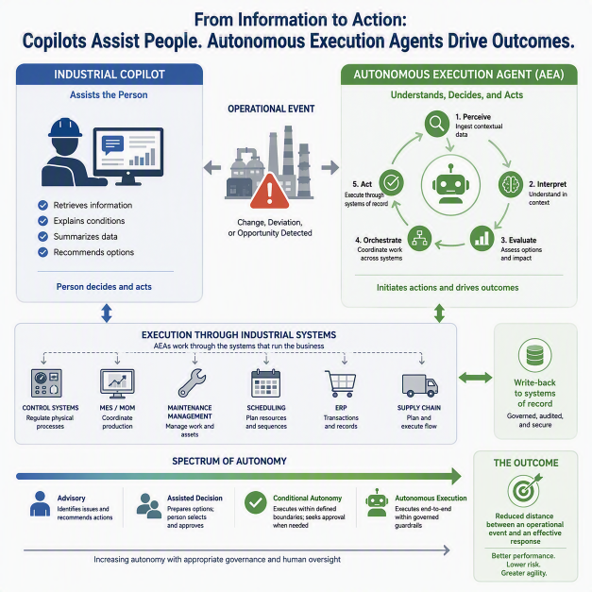
Autonomous Execution Agents, or AEAs, represent an important extension of this established model. They are designed to perceive changing operating conditions, interpret those conditions in context, evaluate possible responses, orchestrate work across relevant applications, and initiate physical or transactional actions. ARC defines AEAs as software-defined operational agents that ingest contextualized data and adjust operating or transactional processes in pursuit of business objectives. A defining characteristic is the ability to write actions back into core systems rather than stopping at monitoring, prediction, or recommendation.
This helps distinguish AEAs from the industrial copilots that have attracted considerable attention in recent years. While Industrial Copilots serve as cognitive accelerators for engineers and plant personnel (Human-in-the-Loop), as detailed in ARC’s Copilots research, while Autonomous Execution Agents transition the human operator into an oversight role (Human-on-the-Loop). The copilot synthesizes context and proposes action; the AEA is granted bounded agency to execute.
Copilots make industrial information more accessible. They can retrieve documents, summarize telemetry, explain alarms, help users navigate applications, and provide natural-language access to operational knowledge. These are useful capabilities, particularly as industrial organizations contend with complex technology environments and changing workforce demographics. But a copilot generally assists a person who remains responsible for determining and initiating the response. An AEA is intended to carry the operational process further.
Consider predictive maintenance. A copilot might summarize an asset’s history after an abnormal vibration pattern is detected. An AEA could correlate the condition with run hours, review maintenance records, check the availability of required parts, identify a suitable downtime window, and prepare or generate a work order. The intelligence is not confined to explaining the condition. It is applied to coordinating a response through the systems that already manage maintenance and production.
The same distinction applies in production operations. A copilot might explain why a schedule has become infeasible following a machine failure. An AEA could evaluate alternate equipment, tooling, labor qualifications, material availability, energy costs, and customer priorities, then generate and potentially implement a revised sequence through the scheduling and MES/MOM environments.
In process operations, a copilot might explain a quality deviation or identify relevant variables. An AEA could evaluate feedstock changes, ambient conditions, equipment performance, downstream quality measurements, and operating constraints before proposing or initiating an adjustment to a recipe, dosage, or setpoint.
None of this makes the established execution infrastructure less important. AEAs will not replace MES/MOM, control, maintenance, scheduling, ERP, or supply chain systems. Those applications contain the workflows, production context, records, controls, and transaction integrity on which industrial operations depend. AEAs are also different from traditional advanced process vontrol (APC). APC operates on rigorous linear/nonlinear multivariable models within milliseconds to seconds; AEAs operate at the multi-system transactional and optimization layer (minutes to shifts), arbitrating cross-functional tradeoffs between energy, throughput, and asset health. AEAs are more likely to work through these systems, connecting capabilities that have historically operated within separate functional boundaries. The agent may determine which applications and models are relevant, assemble the required context, evaluate alternatives, and coordinate execution through the appropriate systems of record.
That is why write-back capability matters. Many AI applications can identify a problem or recommend an action. An AEA must also have a governed path through which the selected response can influence an operating or transactional state. ARC’s original AEA definition places these systems on a spectrum ranging from advisory recommendations to more autonomous execution, but the ability to participate in action is central to the archetype.
The boundary between assistance and execution will not always be absolute. An AEA may act autonomously in routine, well-understood situations while requesting human approval when uncertainty or potential consequences increase. In some applications, it may assemble and recommend the entire response but leave the final command to an operator, engineer, planner, or supervisor. In others, it may execute bounded changes directly.
Industrial automation has always employed different levels of authority for different actions. We should expect AEAs to develop in much the same way. The industrial copilot improves the interaction between people and software. Autonomous Execution Agents address a different challenge: reducing the distance between an operational event and an effective response.
Industry has automated execution for decades. AEAs bring a more adaptive form of intelligence to deciding what should be executed, coordinating how it should occur, and initiating action through the systems already responsible for running industrial operations.