Representative End User Clients







Representative Automation Clients







Representative Software Clients









The European Union's Cyber Resilience Act (CRA) is reshaping how manufacturers, automation suppliers, and end users think about cybersecurity. While industrial organizations have long focused on safety, reliability, and availability, the CRA introduces new obligations around secure product design, vulnerability management, software maintenance, and cybersecurity throughout the product lifecycle. For companies deploying digital process automation architectures, a key question is emerging: How can existing industrial networking and device integration technologies help simplify CRA compliance?
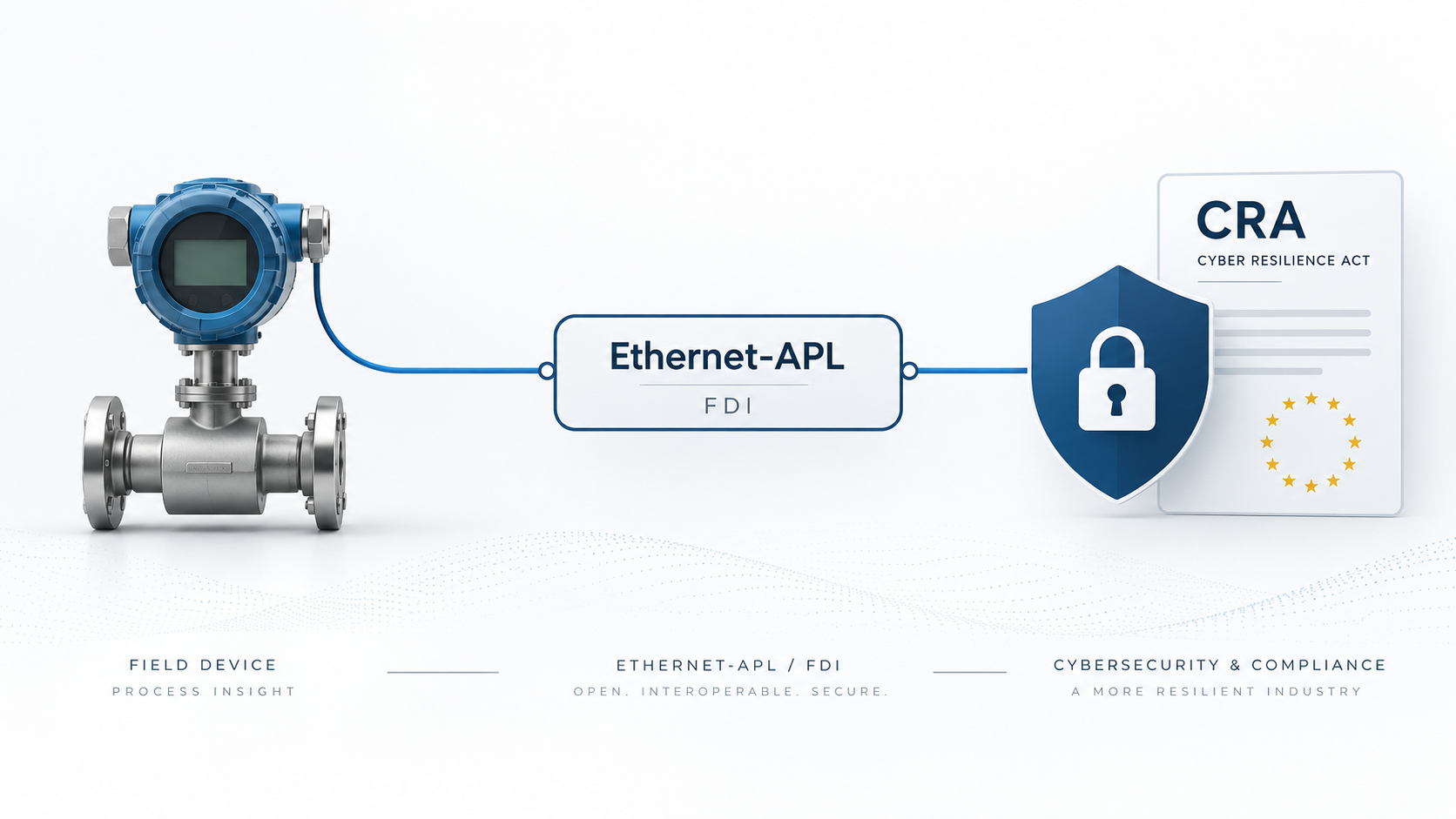
Historically, many industrial cybersecurity initiatives focused on plant networks, control systems, and enterprise connectivity. However, the CRA extends cybersecurity expectations to the products themselves, including connected field devices.
As process industries continue their transition toward Ethernet-connected instrumentation, Ethernet-APL provides a modern physical layer capable of delivering high-speed communications directly to field devices in hazardous and non-hazardous environments. Unlike legacy fieldbus architectures, Ethernet-APL enables the use of modern Ethernet-based security technologies throughout the automation stack.
This capability becomes increasingly important as organizations seek to demonstrate compliance with requirements related to secure communications, device authentication, and protection against unauthorized access.
While Ethernet-APL receives significant attention for its networking capabilities, FDI plays an equally important role in enabling cybersecurity compliance. FDI, short for Field Device Integration, is a standardized technology for integrating intelligent field devices into host systems such as DCS platforms, engineering tools, asset management systems, and maintenance applications. FDI provides a standardized method for integrating field devices into these host systems, allowing engineering, configuration, diagnostics, and lifecycle management functions to be handled consistently across multiple device suppliers.
Recent enhancements to the FDI specification have incorporated requirements aligned with the European Cyber Resilience Act. This helps manufacturers and end users establish a more consistent approach to device management and cybersecurity throughout the operational lifecycle. Rather than relying on proprietary device integration methods, FDI creates a common framework that supports secure deployment, maintenance, and monitoring of intelligent field devices.
One of the central themes of the CRA is “secure by design.” This concept extends beyond network protection and requires manufacturers to demonstrate that cybersecurity considerations have been incorporated into products from the beginning.
When combined with Ethernet-APL, FDI supports this objective by enabling:
Standardized device integration across suppliers.
Consistent device configuration and management.
Improved visibility into device status and diagnostics.
Structured lifecycle support for updates and maintenance.
Reduced dependence on custom integration approaches.
Together, these capabilities help organizations establish more secure operational environments while reducing complexity for engineering teams.
The CRA also places significant emphasis on vulnerability management and ongoing support. Manufacturers must be prepared to identify, address, and communicate cybersecurity vulnerabilities throughout a product's lifecycle.
FDI contributes to this requirement by providing standardized access to device information and diagnostics. With Ethernet-APL delivering high-bandwidth connectivity to field instruments, organizations gain greater visibility into device health, configuration status, and operational conditions. This improved visibility can support vulnerability assessment programs, asset management initiatives, and maintenance workflows that are increasingly important under emerging regulatory frameworks.
Another advantage of the Ethernet-APL ecosystem is its alignment with established industrial cybersecurity standards and technologies. Ethernet-APL networks can support secure industrial protocols such as OPC UA with TLS encryption and CIP Security for EtherNet/IP implementations. These technologies provide mechanisms for authentication, encryption, integrity checking, and secure communication between devices and systems. For organizations already pursuing IEC 62443 cybersecurity programs, Ethernet-APL and FDI can complement broader security architectures and provide additional evidence supporting CRA compliance efforts.
Many organizations initially view the Cyber Resilience Act as another regulatory challenge. However, the technologies being adopted to support compliance often deliver operational benefits that extend well beyond regulation.
Ethernet-APL provides the foundation for greater connectivity, diagnostics, and digital transformation at the field level. FDI delivers a standardized framework for device integration and lifecycle management. Together, they help create a more secure, manageable, and interoperable automation environment.
As the process industries continue their digitalization journey, organizations that leverage open standards such as Ethernet-APL and FDI may find themselves better positioned not only for CRA compliance but also for the broader operational demands of Industry 4.0. The result is a practical example of how cybersecurity, interoperability, and digital transformation can reinforce one another rather than compete for attention.
ARC is currently completing Supplier Positioning MarketMaps on both Ethernet-APL and the underlying Single Pair Ethernet (SPE) technologies. Find out more by contacting the author at [email protected].