Representative End User Clients







Representative Automation Clients







Representative Software Clients









Vention has introduced MachineAgent, an agentic AI capability designed to support multiple stages of the industrial automation lifecycle, including machine design, programming, monitoring, and troubleshooting.

MachineAgent works across Vention’s Manufacturing Automation Platform and uses plain-language prompts to generate automation cell layouts, assist with application development, provide performance analytics, and support troubleshooting. The system also includes open interfaces such as the Vention command-line interface (CLI) and Model Context Protocol (MCP) server, allowing users to connect supported AI coding agents to Vention workflows.
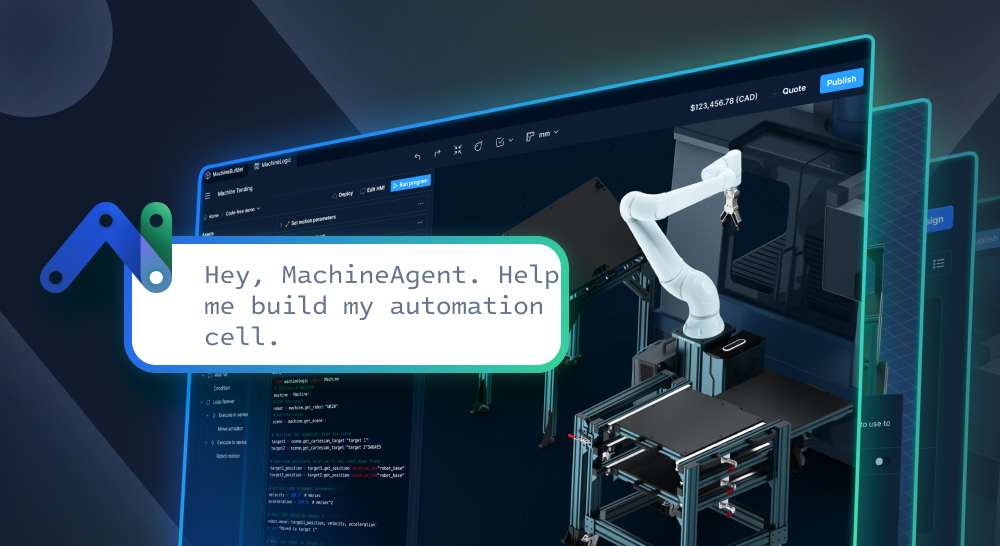
Vention is positioning MachineAgent as a common AI layer spanning design, programming, and machine operations. Rather than requiring users to move between separate tools and specialist workflows at each stage, the platform is intended to provide a more connected automation development environment.
MachineAgent supports three primary areas:
Design: Users can describe an automation cell or provide floorplan information using natural-language prompts. MachineAgent can generate layouts in Vention’s MachineBuilder environment.
Program: MachineLogic Copilot can generate, modify, and debug applications within MachineLogic. Developers can also use the Vention CLI and Developer Toolkit to work from local development environments and supported AI coding agents.
Operate: Users can query deployed machine performance using natural language, retrieve analytics, examine logs, and receive troubleshooting suggestions without first navigating conventional dashboards.
During the design stage, MachineAgent can generate automation cell layouts from plain-language descriptions and floorplan information.
Vention notes that these generated layouts should be treated as starting points rather than completed engineering designs. Users are expected to review them using Vention’s Automated Design Checker, while safety-related design elements require approval from a qualified engineer before proceeding.
This human-review requirement is particularly relevant as agentic AI capabilities move from information retrieval and coding assistance into physical automation environments.
MachineAgent also extends into machine programming through MachineLogic Copilot. The tool has access to machine configuration and robot scene information, allowing users to reference actuators, robots, and outputs directly in prompts.
Users can generate applications by describing the intended behavior or use prompts and error information to modify and debug existing applications. For more complex applications, Vention provides its CLI and Developer Toolkit, allowing engineering teams to work from local integrated development environments and connect AI coding tools through their existing development workflows.
Once machines are deployed, MachineAgent can interact with operational information through Vention’s MCP server and monitoring capabilities.
Users can ask questions about machine or production-line performance in natural language, including queries involving downtime and other operational metrics. The system can also retrieve machine logs, assist in diagnosing faults, identify potential cable or sensor issues, and suggest corrective actions based on information reported through MachineAnalytics.
The approach extends agentic AI beyond engineering and programming tasks into operational support, while retaining human oversight for decisions and deployment.
Vention explicitly notes that AI-generated outputs can be incorrect or incomplete and should be reviewed by appropriate technical personnel before deployment. Generated layouts must also undergo design checks, with safety-related elements requiring qualified engineering approval.
MachineAgent reflects the broader movement toward embedding AI across engineering and operational workflows rather than deploying it as a standalone application. For manufacturers and system integrators, the development illustrates how agentic AI is beginning to extend from software-oriented tasks into machine design, programming, and operational support.
ARC has been examining this shift toward agentic AI and increasingly software-defined industrial operations across manufacturing environments.
Industry Has Automated Execution for Decades. Autonomous Execution Agents Automate Decisions
Industrial AI SPARC: Software Defined Manufacturing in the Era of Agentic AI
The Industrial AI (R)Evolution: How Agentic AI Will Unleash the FULL Industrial AI Toolbox
Together, these ARC Insights provide additional perspective on the role of agentic AI in industrial decision-making, software-defined manufacturing, and the evolution of more autonomous industrial systems.