Representative End User Clients







Representative Automation Clients







Representative Software Clients









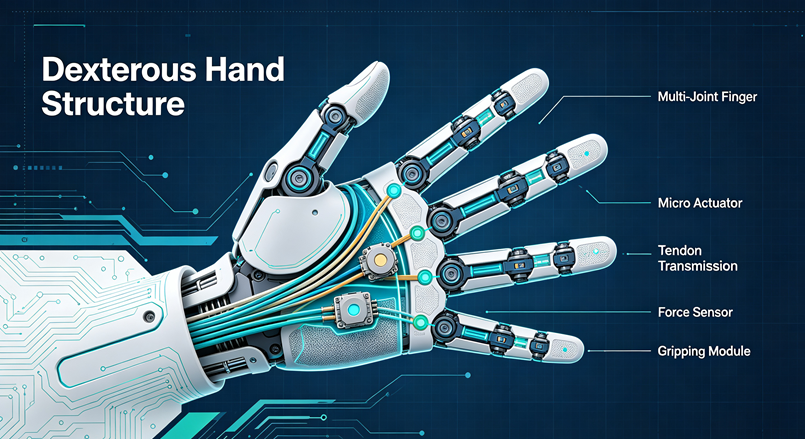
Dexterous hands are widely regarded as the “last-mile execution system” of humanoid robots and one of the most technologically demanding components required for achieving embodied intelligence. By converting perception and cognition into precise physical actions, they determine whether humanoid robots can truly replace human labor in complex and unstructured environments. Consequently, dexterous hands are not only a core hardware component but also a key bottleneck constraining the commercialization of humanoid robots.
As the bridge between digital intelligence and physical execution, dexterous hands are increasingly becoming the central arena of competition in the humanoid robotics industry. Their technological sophistication directly influences a robot's operational versatility, task adaptability, and commercial viability. As the industry enters the mass-production era, 2025 has become a watershed year, marking the transition of dexterous hands from a research-driven niche technology into a scalable and commercially viable market with broad industrial adoption potential.
The core technical challenge of dexterous hand development lies in integrating driving, transmission, sensing, and control modules within the extremely confined space of human-like palms and fingers. Currently, three mature technical routes dominate the industry, with differentiated motor configurations for diverse application scenarios:
Coreless motors feature no iron core, low inertia, fast dynamic response, and ultra-compact size, making them ideal for integration inside finger joints. This is the mainstream solution for high-degree-of-freedom anthropomorphic dexterous hands. Equipped with micro planetary or harmonic reducers for torque amplification and steel tendon ropes for power transmission, this route achieves human-like finger appearance and ultra-fine manipulation performance. A representative manufacturer is Linker Hand.
Nevertheless, coreless motors have inherent limitations, including limited continuous torque output and relatively high costs. Initially, high-end miniature coreless motors relied heavily on imports, which was a major reason for the high pricing of high-precision dexterous hands.
This route adopts iron-core micro motors and screw structures to form integrated micro electric cylinders, which are generally installed inside the palm and drive finger movements through connecting rod mechanisms. It delivers higher grasping force and better durability, making it more suitable for mass production and cost reduction, while slightly compromising bionic slimness. A representative manufacturer is InTimes Robotics.
Motors are placed in the palm or forearm, driving finger movements through tensioned tendon ropes. The driving motors can be either coreless motors or conventional micro motors. The structure is relatively simple, yet tendons are prone to stretching and wear during long-term operation, requiring real-time tension compensation. A representative manufacturer is DH-Robotics.
China’s anthropomorphic multi-fingered dexterous hand industry has achieved rapid growth in recent years, emerging as one of the fastest-developing and most commercialized core component segments in the local humanoid robot industrial chain. Initially, domestic dexterous hand applications relied heavily on imported customized research-oriented products, which were extremely costly and limited to university laboratories and scientific research scenarios. Benefiting from continuous breakthroughs in micro actuators, precision sensors, and motion control algorithms, as well as the improvement of local supporting supply chains, Chinese enterprises have realized independent R&D and large-scale mass production of dexterous hands, substantially reducing market application costs. Currently, industry application scenarios have expanded significantly, moving beyond pure scientific research toward industrial teleoperation, high-end equipment manufacturing, and batch supporting applications for humanoid robots. Domestic dexterous hands have become a critical pillar supporting the industrialization of China’s humanoid robot industry.
Rapid Local Iteration and Scenario Adaptation: Local manufacturers closely align with the actual demands of domestic humanoid robot and automation enterprises. They can rapidly iterate actuator structures, control algorithms, and overall product solutions, delivering faster on-site technical response and customized development compared with overseas brands, which suits the fast-upgrading characteristics of China’s manufacturing industry.
Independent and Controllable Local Supply Chain: Core components, including micro electric cylinders, precision reducers, structural parts, and driving chips, have achieved large-scale domestic substitution, forming a complete local supporting system. Compared with imported products, domestic dexterous hands feature shorter delivery cycles, better cost controllability, and significant advantages in mass production.
Diversified Full-Coverage Product Matrix: Chinese manufacturers cover multi-scenario demands, including high-end bionic research, special industrial operations, and mass production matching for humanoid robots. The coexistence of high-end, high-DOF bionic models and cost-effective mass-production products addresses hierarchical market needs and supports the full development cycle of domestic industrialization, from R&D verification to large-scale commercialization.
Deficiencies in Core Components: Ultra-small high-end coreless motors, ultra-high-precision micro encoders, and high-sensitivity tactile sensors still rely partially on imports, restricting cost reduction and high-end upgrading of domestic dexterous hands.
Insufficient Verification of Industrial Long-Term Reliability: Most domestic dexterous hands perform well in short-term demonstration tests, yet key industrial indicators, including continuous cycle lifespan, impact resistance, and high- and low-temperature stability, lack long-term and large-scale industrial verification, limiting their broader application in high-end industrial scenarios.
Limitations in Tactile Sensing and Fine Control: High-reliability tactile skin solutions developed domestically remain costly. Core technologies such as force control, slip detection, and flexible grasping are still under iterative optimization, falling behind top overseas products and restricting the deployment of high-precision complex operation scenarios.
Lack of Unified Industrial Technical Standards: Multiple technical routes, including electric cylinder direct drive, coreless tendon drive, and hybrid drive, coexist in the Chinese market. The absence of unified industry standards leads to poor product compatibility and inconsistent iteration rhythms, constraining large-scale and standardized industrial development.
Based on technical routes, business models, and domestic market positioning, China’s dexterous hand suppliers can be divided into two core categories: market-oriented third-party professional manufacturers and in-house R&D manufacturers of humanoid robot bodies. Traditional automation cross-border manufacturers and vertical niche scenario suppliers are integrated into the two systems, forming a distinct dual competition pattern in the domestic market. The first category focuses on external market supply and drives industrial scale growth, covering industrial cross-border and vertical niche scenarios. The second category adopts closed-loop internal iteration, focusing on adaptive optimization for local humanoid robots, with negligible large-scale external sales. Together, they constitute the complete supply system of China’s dexterous hand industry.
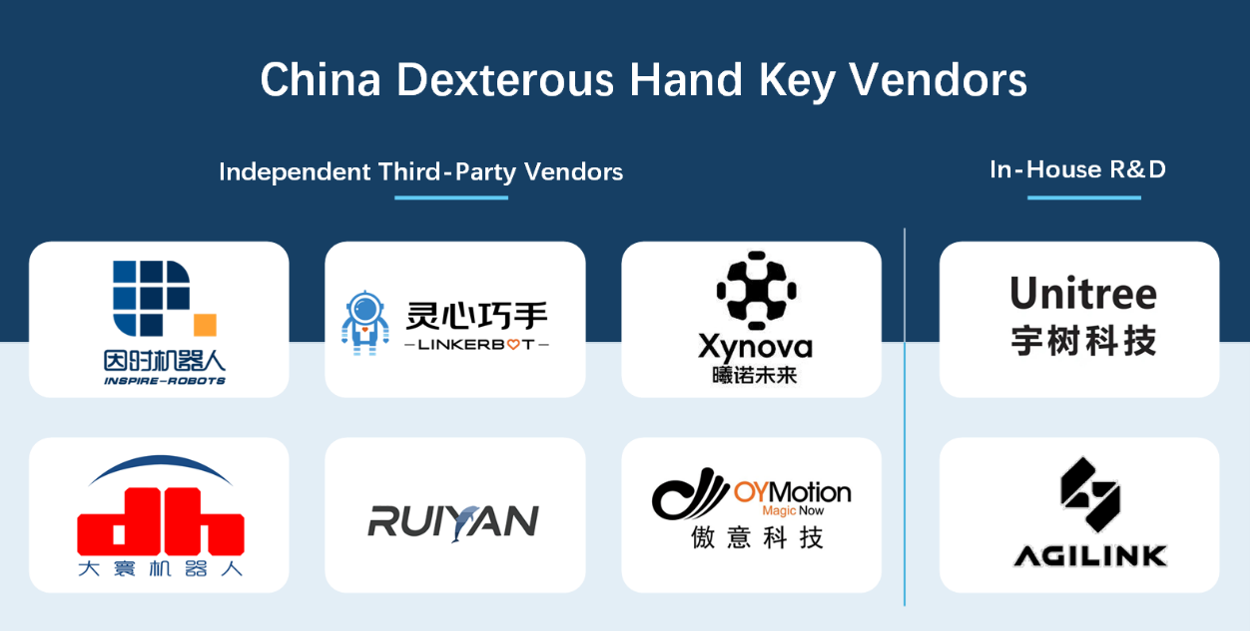
As the backbone of industrial commercialization, these manufacturers focus on independent R&D, product iteration, and market-oriented sales of dexterous hands. Equipped with complete upstream R&D capabilities and mass-production capacity, they cover full-tier scenarios, including general industrial operation, high-end bionic manipulation, and special industrial tasks. With diversified technical routes and comprehensive product layouts, they dominate domestic market shipments and commercial deployment cases, including traditional automation cross-border enterprises and vertical niche manufacturers.
InTimes Robotics: A typical representative of industrial mass-production-oriented dexterous hand suppliers. Adopting a coreless-free micro servo electric cylinder solution with fully self-developed micro screw actuators, it features high load capacity, superior stability, and excellent mass producibility. Its products are widely applied in continuous industrial operations and batch matching for humanoid robots, ranking among the top players in domestic market maturity and shipment scale.
Linker Hand: A leading manufacturer in high-end bionic and scientific research markets. It adopts a coreless motor + micro reducer tendon-driven solution, focusing on lightweight high-DOF bionic hands with industry-leading bionic accuracy and fine motion performance. It targets high-end scientific research, humanoid robot prototype development, and global high-end markets, maintaining strong competitiveness in the high-precision bionic segment.
XYNOVA Future: An emerging high-DOF dexterous hand manufacturer. It develops hybrid tendon-driven and micro electric cylinder solutions tailored for humanoid robot adaptation. Currently in the prototype R&D and small-batch iterative testing stage, it is steadily advancing large-scale commercialization.
DH-Robotics: A cross-border player from traditional industrial automation. Leveraging mature industrial gripper technology and on-site delivery capabilities, it develops tendon-driven five-fingered dexterous hands focusing on industrial teleoperation and equipment operation and maintenance scenarios. Its strong adaptability to complex industrial conditions fills the application gap of domestic dexterous hands in special industrial operations.
OYMotion Technologies, Ruiyan Intelligent Control, XENSE Robotics: Vertical niche-scenario manufacturers focusing on medical rehabilitation, assistive devices, specialized scientific research, and special industrial fields. They adopt customized development and small-batch project delivery models, covering niche market demands that cannot be satisfied by general mass-production manufacturers.
These manufacturers focus on the R&D and production of complete humanoid robots, with dexterous hands as self-developed supporting components. Prioritizing internal adaptation and matching for complete robot bodies, they rarely conduct large-scale external commercial sales. Product iteration relies on joint debugging with self-owned robot platforms, emphasizing integrated software and hardware optimization, and the product upgrade rhythm is highly bound to the iteration cycle of their own complete machines.
Unitree: Develops dedicated dexterous hands to support the iteration of its self-developed H1 humanoid robot. The products are specially optimized for the body’s motion logic, with only small-batch external trial supply and internal matching verification as the core objective.
AGILINK (Affiliated with AgiBot): Develops the proprietary OmniHand series of dexterous hands, fully adapted to the AgiBot humanoid robot ecosystem and focusing on whole-body collaborative optimization. At present, its development focuses on internal supporting iteration and small-scale scenario verification, with a low degree of market-oriented external availability.