Representative End User Clients







Representative Automation Clients







Representative Software Clients









The third ARC Industry Leadership Forum Singapore, held on August 27, 2026, brought together more than 200 industry professionals under the theme, “How AI Is Driving the Future of Industrial Operations and Supply Chain.” SUPCON International Business participated as a Gold Sponsor. Kenneth Lim, Director of Strategy and Marketing at SUPCON International Business, delivered a presentation titled “Blueprint for Autonomous Operating Plants of the Future.”
Kenneth presented SUPCON’s perspective on how process manufacturers can progress from conventional automation toward more autonomous operations. The transition involves more than adding an AI model to an existing plant. Industrial data and intelligence must also be connected with the systems that control the process.
Within SUPCON’s proposed architecture, its Universal Control System (UCS) provides a software-defined control environment, while its Time Series Pre-trained Transformer (TPT) applies AI to industrial time-series data.
Watch the full presentation here or on YouTube.
Most process plants already operate with some degree of automation, but this does not necessarily make them autonomous. Automated systems generally execute predefined control strategies. Kenneth described a more autonomous plant as one in which interconnected systems have sufficient context to understand plant conditions, analyze possible responses, and optimize operations according to defined objectives and constraints.
From SUPCON’s perspective, this involves three broad changes:
From people being on call to 24/7 intelligence: Systems continuously sense and analyze plant conditions.
From stable operation to pursuing optimality: Operations move beyond stability and reliability toward lower energy consumption, higher throughput, and better use of resources.
From reacting to problems to developing “proactive immunity”: The plant anticipates changing conditions while continuing to operate within constraints defined by people.
Autonomy does not necessarily mean removing people from plant operations. Kenneth described it as reducing work that does not require human involvement and allowing employees to concentrate on higher-value responsibilities.
Plants also face practical barriers to this transition. Existing facilities may contain hardware and software from multiple suppliers, while operational data can be fragmented, unavailable when required, or insufficiently contextualized for AI. Greater connectivity introduces cybersecurity considerations, and plant personnel must also prepare for changes in their responsibilities and working practices.
Kenneth therefore emphasized that the transition is gradual:
There’s no one silver bullet to get you all the way to the end in one go.
Kenneth used the human body as an analogy for an autonomous operating plant. Field sensors provide information about operating conditions, connectivity carries that information, and control valves and robots act on the process. The industrial data platform and AI provide the information and intelligence needed to understand plant conditions and determine a response.
Within this architecture, UCS and TPT perform different but connected roles.
UCS is SUPCON’s software-defined approach to industrial control. Kenneth contrasted it with architectures in which plant data is stored in a historian and transferred from the operational environment into IT or cloud systems for AI applications.
SUPCON’s approach brings computing and AI capabilities closer to the field, alongside control applications. Control logic traditionally associated with distributed control systems and programmable logic controllers can be deployed as containerized applications within the UCS environment. According to Kenneth, UCS also provides redundancy at the server and application levels, helping control applications remain available if part of the system fails.
TPT provides the industrial intelligence layer. It is a foundation model pre-trained on industrial time-series data and is intended to support simulation, prediction, control, optimization, and evaluation.
Kenneth described TPT as the “brain” within SUPCON’s autonomous operating plant architecture. It analyzes operating conditions and can provide an operating strategy and execution path. Connecting its output with the control environment allows the resulting decision to influence plant operations.
Kenneth cited an implementation at Senior, a European lithium battery manufacturer, to illustrate UCS being used in an operating facility.
The project replaced the existing control systems with UCS and used it to manage approximately 4,500 I/O points. Kenneth emphasized that the implementation involved basic control rather than advanced AI.
The example distinguishes software-defined control from autonomous operation. UCS changed how the facility’s control functions were deployed, but the implementation did not introduce AI-based analysis or optimization. It shows that software-defined control can be introduced as one stage of modernization without requiring an immediate move to autonomous operations.
A pH control application at Wanhua Chemical illustrated the connection between industrial AI and process control.
The pH control process has a delayed response. Under conventional operation, an engineer may adjust an input, wait for the pH value to stabilize, and then make another adjustment. This delay can cause continued fluctuations before the desired condition is reached.
TPT was trained on historical operating data to predict future pH values based on previous actions and steady-state results. Its output was then connected with the control system, closing the loop between the model and the process.
According to Kenneth, the application helped the process achieve stability in a significantly shorter time. He described it as a quick win that allowed the end user to assess the value of applying intelligence to a defined process problem before proceeding with further operational changes.
The case also demonstrates the difference between generating a prediction and changing an operating outcome. The prediction becomes operationally useful when it is connected with the system controlling the process.
SUPCON’s blueprint places UCS and TPT within a broader approach covering architecture, data, security, governance, and implementation.
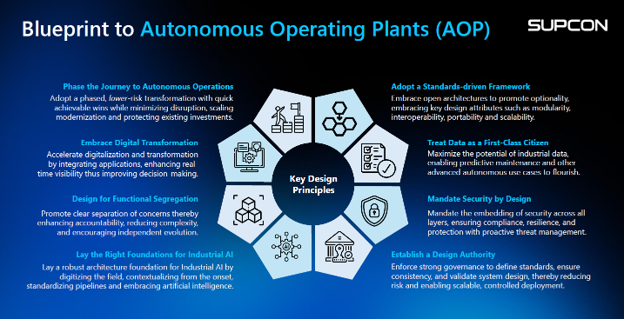
The blueprint identifies eight principles:
Phase the journey to autonomous operations.
Embrace digital transformation.
Design for functional segregation.
Lay the right foundations for industrial AI.
Adopt a standards-driven framework.
Treat data as a first-class citizen.
Mandate security by design.
Establish a design authority.
Open and modular architectures support interoperability, while functional segregation allows individual components to be changed or isolated without unnecessarily affecting the wider system.
One of the blueprint’s central principles is to treat data as a first-class citizen. Field information needs to be digitized and contextualized, with suitable data pipelines established to support industrial AI. As Kenneth emphasized:
Data is king, and you need to treat data as a first-class citizen.
Security and governance form another part of the blueprint. Security should be incorporated across the architecture, and a design authority helps define standards, maintain consistency, and validate system designs.
These principles reinforce the wider message that autonomous operations cannot be treated solely as an AI deployment. Control, data, architecture, security, governance, and organizational readiness must develop together.
SUPCON’s blueprint presents an autonomous operating plant as the integration of sensing, connectivity, industrial data, intelligence, and control. UCS and TPT represent the company’s approach to the control and intelligence layers of that architecture.
Software-defined control can provide part of the technical foundation, but it does not by itself make a plant autonomous. Greater autonomy requires intelligence to be applied to defined operational requirements and connected with the systems that act on the process.
The practical route is therefore to establish the necessary foundations, begin with focused applications, validate their operational value, and expand their use as the technology, data, and organization become ready.