Representative End User Clients







Representative Automation Clients







Representative Software Clients









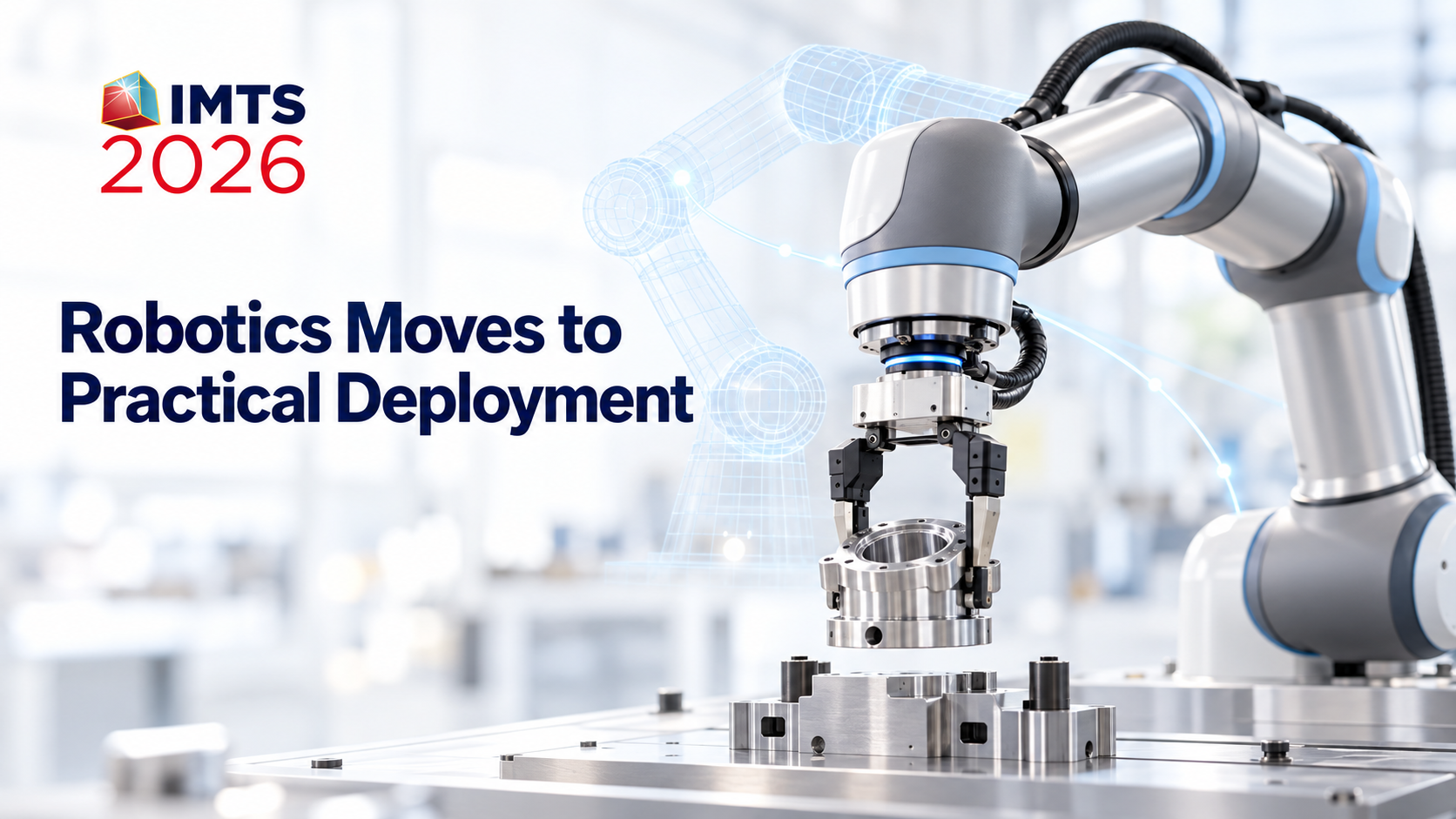
During ARC Advisory Group’s September 14–17 visit to IMTS 2026 in Chicago, the clearest message was that digital transformation is becoming more operational. Across supplier meetings, presentations, and demonstrations, the discussion centered on how manufacturers can connect engineering, production, quality, maintenance, and supply chain workflows while retaining human oversight and working with the systems and data already in place.
Industrial AI, agentic workflows, physical AI-enabled robotics, digital twins, Industrial DataOps, digital inspection, and cloud-to-edge architectures were prominent themes. What distinguished the event was the focus on practical deployment. Suppliers increasingly framed advanced technologies in terms of faster machine commissioning, better production decisions, reduced inspection bottlenecks, more usable industrial data, and scalable architectures that support measurable operational outcomes.
Industrial AI was a central theme at IMTS, but the discussion has matured beyond generic capability claims. Suppliers emphasized the requirements for using AI in production environments: contextualized industrial data, governance, cybersecurity, traceability, and clear human accountability.
Rockwell Automation and Microsoft used their “Smart Factories, Smarter Futures” session to frame industrial AI as a path from isolated pilots toward broader manufacturing transformation. Rockwell highlighted MES, Plex, Emulate3D, digital twin, FactoryTalk, automation, work-instruction, analytics, and vision-AI capabilities, while Microsoft emphasized Copilot, agent governance, organizational knowledge, and AI-enabled process handoffs. The message was that value will come from embedding AI into everyday engineering, production, quality, maintenance, and scheduling workflows—not from disconnected experiments.
AWS focused on agent-driven industrial and supply chain workflows across its booth meeting, fulfillment-center tour, and “Quantum Meets Manufacturing” event. The discussion highlighted how AI agents can support planning, demand sensing, exception management, optimization, simulation, packaging automation, and decision support when they can combine enterprise, operational, and external data sources. A recurring consideration was how manufacturers can adopt these capabilities while continuing to work with existing systems and maintain control of their data.
The practical implication is clear: industrial AI adoption will depend as much on data architecture, governance, and workflow design as on models themselves.
One of the strongest themes at the event was the growing connection between engineering, simulation, commissioning, and production. Manufacturers are under pressure to reduce product-development and machine-startup time while managing more product variation, workforce constraints, and demanding quality requirements.
Siemens introduced its “Meet at the Machine” initiative at IMTS in a press event featuring Mark Hindsbo, Dr. Stefanie Frank, and Steve Pinto of TRAK Machine Tools. The initiative brings together CAM, CNC, machine-specific digital twins, automation, and machine-builder expertise to help manufacturers validate programs, train operators, and resolve setup issues before equipment reaches the shop floor. Siemens and TRAK positioned the approach as relevant both to small job shops seeking faster day-one productivity and to larger aerospace, defense, and industrial manufacturers working to extend digital threads across their supply chains.
The broader importance of this approach extends beyond a single supplier initiative. Digital twins and connected engineering workflows are becoming practical tools for reducing commissioning risk, improving collaboration between engineering and operations, and accelerating time to production. The value lies in connecting the virtual and physical worlds early enough to identify problems before they affect throughput.
PTC added another IMTS proof point around engineering-to-manufacturing convergence. Its discussions covered Onshape AI Advisor, text-to-CAD, simulation-led engineering, configurable design features, connected product data, and AWS-based AI infrastructure using Amazon Bedrock, guardrails, governance, and model flexibility. The examples showed how AI-assisted tools can help generate CAD logic, automate engineering calculations, create reusable design features, and move design outputs closer to manufacturing readiness.
Robotics at IMTS increasingly focused on sensing, connectivity, software, and deployment simplicity rather than robot hardware alone. The objective is to make robotic systems easier to integrate into real production workflows, particularly where manufacturers need flexibility across products, tasks, and operating conditions.
Teradyne Robotics and Universal Robots used IMTS to discuss the Universal Robots Gen 7 platform and the broader Physical AI strategy with ARC. The platform was positioned around AI-ready robot arms, expanded sensing, PolyScope X software, cybersecurity, connectivity, and a redesigned controller intended to simplify deployment of AI-enabled industrial applications. The announcement stood out because it connected robotics hardware with the software, sensing, safety, and ecosystem capabilities required for practical shop-floor adoption.
The announcement reflected a wider market direction. Physical AI requires more than a capable robot arm; it depends on the ability to combine sensing, machine vision, motion, compute, safety, and industrial connectivity in a way that can be deployed and maintained on the shop floor.
Supplier discussions with Flexxbotics, Standard Bots, and others similarly highlighted robot orchestration, connected automation, machine tending, AI-native robotics, simplified deployment, and integration of robotics with broader production workflows. Flexxbotics emphasized manufacturing autonomy and software-defined coordination between robots, CNCs, and inspection systems, while Standard Bots reinforced the growing interest in AI-native robotic systems that can be deployed with less integration complexity.
Hexagon Manufacturing Intelligence used IMTS to present a practical, measurement-led approach to automation through its “Architecting the Connected Future” press activity and related demonstrations. Rather than treating automation as an all-or-nothing investment, Hexagon emphasized helping manufacturers start with familiar handheld and portable metrology technologies and then extend those capabilities into automated measurement, AMR-supported workflows, shop-floor data capture, and digital inspection.
This is an important shift. Inspection has often been treated as a necessary quality-control activity that occurs alongside production. Increasingly, manufacturers are looking to integrate metrology and quality intelligence directly into production workflows to prevent inspection from becoming a bottleneck.
The value of AI, automation, and digital twins ultimately depends on the accuracy, accessibility, and context of the data they use. Quality and measurement data are therefore becoming essential inputs for manufacturing intelligence, not simply records of completed work.
The continuing focus on AI and autonomy should not obscure a more basic requirement: industrial systems must be able to exchange usable, secure, contextualized data across engineering, operations, and enterprise environments.
Discussions at IMTS covered Industrial DataOps, industrial networking, Single Pair Ethernet, cloud-to-edge architectures, and connected operational technologies. These technologies are foundational for scaling advanced analytics, AI-assisted workflows, connected quality, and robotics.
For many manufacturers, the challenge is not a lack of data. It is the fragmentation of data across legacy machines, automation systems, applications, and business systems. The next phase of digital transformation will depend on creating architectures that make this data available where it is needed while maintaining cybersecurity, governance, and operational reliability.
Several IMTS discussions reinforced this point with company-specific examples. HighByte emphasized Industrial DataOps, contextualized industrial data, and architectures that prepare operations data for AI and enterprise use. Weidmüller, Phoenix Contact, Rosenberger, and the Single Pair Ethernet Association highlighted simplified Ethernet connectivity, interoperability, and ecosystem coordination. MachineMetrics connected machine monitoring and manufacturing analytics with Industrial AI, while MaintainX and Telit Cinterion / DeviceWise pointed to maintenance, connected operations, and edge-to-enterprise data movement as practical entry points for smart manufacturing.
The major takeaway from IMTS 2026 is that manufacturers are being offered a more practical path toward advanced automation. The most relevant technologies are not necessarily those with the most ambitious claims, but those that can improve a specific engineering, production, quality, maintenance, or supply chain workflow now and then scale across the enterprise.
Manufacturers should evaluate these offerings through a few practical questions:
Does the solution address a defined operational constraint or business outcome?
Can it work with existing machines, applications, and data sources?
Are governance, cybersecurity, and human decision rights clear?
Can the organization scale the capability beyond a single demonstration or pilot?
Does the required data have sufficient quality, context, and accessibility?
IMTS 2026 reinforced that the opportunity is no longer simply to digitize manufacturing. It is to connect the people, systems, data, and processes required to make digital capabilities operational, measurable, and scalable.