Representative End User Clients







Representative Automation Clients







Representative Software Clients









Machine builders are increasingly adopting digital twin technologies to address the growing complexity of modern, software-driven equipment and to improve engineering efficiency across the entire machine lifecycle. Traditionally, mechanical, electrical, automation, software, and service engineering disciplines have operated in separate tools and data silos, creating challenges in collaboration, traceability, change management, and lifecycle visibility. As machines become more connected, autonomous, and service-oriented, manufacturers require digital twin platforms that provide a unified representation of the machine from design through operation and service. Key requirements include multi-domain integration, virtual commissioning, lifecycle traceability, remote service capabilities, fleet-level visibility, and secure lifecycle management.
At the same time, Artificial Intelligence is emerging as a major enabler of digital twin value. Machine builders are increasingly leveraging AI to analyze engineering and operational data, identify root causes of failures, predict maintenance needs, optimize machine performance, automate engineering tasks, and accelerate decision-making across the product lifecycle. AI-powered digital twins can correlate information across mechanical, electrical, software, quality, and service domains, allowing organizations to capture engineering knowledge, improve change impact analysis, and reduce troubleshooting effort. As a result, the market is evolving from traditional simulation-centric digital twins toward intelligent digital twin platforms that combine simulation, operational insights, lifecycle management, and AI-driven engineering intelligence.
Several technology trends are shaping this evolution. Virtual commissioning is becoming a strategic priority as manufacturers seek to validate PLC logic, robotics, motion control, and safety systems before physical hardware is available, reducing startup risk and commissioning costs. At the same time, organizations are pursuing a continuous digital thread that synchronizes engineering models, deployed assets, software versions, and operational data throughout the machine lifecycle. Open interoperability standards such as OPC UA, MQTT, AutomationML, FMI/FMU, and Asset Administration Shell (AAS) are gaining importance to support heterogeneous ecosystems, while cloud-scale architectures enable remote service, predictive maintenance, and fleet-wide performance management. Together, these trends are driving demand for digital twin platforms that provide a single source of truth, end-to-end traceability, cybersecurity, and AI-enhanced decision support across engineering and operations.
Champions Radar maps provider solutions to specific market demands. It evaluates how effectively these solutions meet market needs. This research provides valuable insights for both end users and solution providers. For end users, it identifies market leaders that can address their specific requirements. By leveraging the research findings, end users can pinpoint potential providers that align closely with their unique needs.
For solution providers, the Champions Radar offers a different kind of value. It provides a comparative analysis, highlighting strengths and weaknesses relative to competitors. Additionally, it identifies opportunities for growth and market expansion. Notably, participating in this survey offers benefits: it helps vendors better understand their solutions and how effectively they communicate them to the market.
The research began with engaging users (machine builders) of digital twin solutions to discuss their specific challenges. We explored their perspectives, the obstacles they faced, and the solutions they currently use or are seeking. Additionally, we examined what they value most in solution providers. The machine builders include those designing, manufacturing, and deploying machines and production lines across industries, including Food & Beverage, Semiconductor, Electronics, Lumber & Wood, Pulp & Paper, Plastics & Rubber, Textile, Metal Cutting, Metal Forming, and Material Handling.
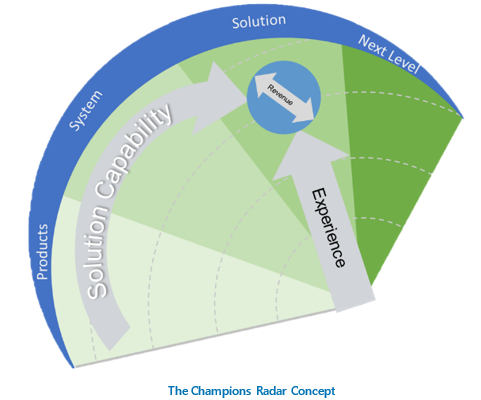
The next step involved mapping market needs to the value propositions offered by digital twin stack solution providers worldwide. This included researching software and service offerings aligned with insights gathered from end users. ARC verified the collected information with solution providers for accuracy. This was essential to ensure precise insights in this ARC report. Next, ARC developed the Champions Radar by evaluating each solution using indicators agreed upon with end users. These indicators assessed solution capabilities, provider experience, and revenue to provide a comprehensive analysis. This analysis covers the digital twin as we define it in the next section.
Table of Contents
Executive Overview
The Value of Champions Radar
Digital Twin for Machine Builders (Excluding Manufacturing Processes)
Solution Calculation Methodology
Champions Radar Results
Zoom In Through Heat Map
Champions Radar Software Vendor Profiles
Recommendations
ARC Advisory Group clients can view the complete report at the ARC Client Portal.
Contact Us if you would like to speak with the author.
Obtain more ARC In-depth Research Market Analysis.