Representative End User Clients







Representative Automation Clients







Representative Software Clients








KEYWORDS: Why Oil & Gas Majors Are Redesigning Governance, Process, Technology and People to Absorb Agentic and Autonomous AI at Scale
For most of the last twenty years, Oil & Gas operators evolved their Target Operating Models (TOMs) along a well-worn path: consolidate fragmented business-unit silos into standardized, process-optimized functions, then centralize shared services finance, procurement, IT, HR into enterprise-scale shared service centers. This is the classic “enterprise-optimized” trajectory framework, and most integrated majors and national oil companies have substantially completed it. The result is a generation of operating models that run yesterday's processes efficiently but were never designed to host a cognitive layer that reasons, recommends, and increasingly acts.
Artificial intelligence has moved from the analytics layer into the operating fabric of the Oil & Gas majors. That shift, more than any single technology decision, is why the Target Operating Model, the blueprint that has governed how these enterprises organize, decide, and execute for the past two decades, now needs to be rebuilt rather than patched.
Three forces are now converging to force a redesign. First, the AI capability curve has passed an inflection point: enterprises are moving from AI-assisted decision support (2018–2022), through agentic, multi-step, tool-calling workflows (2023–2026), toward bounded autonomous operation inside registered domains, with the operator authorizing by exception rather than approving every step.
Second, IT-OT convergence, long discussed, rarely completed, has become structurally unavoidable, because AI capabilities that reason over production, reliability and safety data must sit astride the historical IT/OT boundary, and every crossing of that boundary is now a governance decision, not just an integration project. Third, capital discipline and portfolio complexity have not gone away: majors are still expected to run leaner, safer and more predictably even as they absorb this new capability layer.
The correct response is not to bolt an “AI strategy” onto the existing TOM, but to treat operating-model redesign and AI capability deployment as a single, co-designed activity. ARC Advisory Group's industrial data-fabric and agentic-operations research and consulting methodology, set out a practical structure for the next-generation Oil & Gas TOM: a Component Business Model view organized by accountability level (Direct, Control, Execute) and business competency (Strategy, Engineering, Integrated Operations, Reliability, Commercial, Digital, and an emerging Intelligence layer); a set of Open Digital Ecosystem (ODE) design principles: Open, Agnostic, Data-owned, Interoperable, Transferable that keep the digital backbone vendor-neutral and future-proof; and an explicit governance stack that gives every “hot” component an accountable owner, a service boundary and a KPI set.
The paper closes with a practical view of how agnostic industrial consulting, exemplified by ARC Advisory Group's methodology, de-risks this transition, because the hardest part of TOM redesign in this era is not selecting the technology; it is sequencing the organizational, governance, and safety changes so that AI capability is never deployed onto a workflow that has not been redesigned to receive it safely.
A Target Operating Model is the future-state design for how an organization converts strategy into repeatable execution. It is not an org chart, and it is not a technology roadmap; it is a coherent set of decisions about governance, process, technology and trusted data, people and skills, physical and virtual locations, and performance measurement that all point to the same strategic outcome. While a current-state operating model documents how work happens today, including the workarounds, shadow processes, and informal escalation paths that accumulate over time, a TOM defines the deliberately designed end state, together with the roadmap and investment sequence required to close the gap.
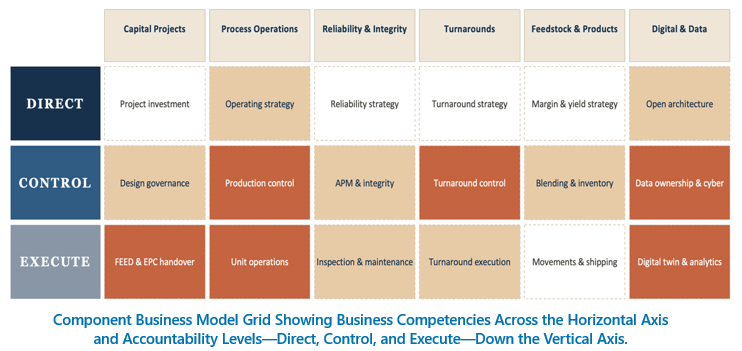
The CBM decomposes the enterprise into business components that are modular, self-contained units of capability, each with its own business purpose, activities, resources, governance model, and set of business services offered to and consumed from other components. The figure makes the model executive-readable by arranging business competencies across the horizontal axis—Strategy, Engineering, Integrated Operations, Reliability, Commercial, and Digital and accountability levels down the vertical axis as Direct, Control, and Execute, so leaders can see both what the enterprise does and how each component is directed, governed, and executed.
ARC Advisory Group clients can view the complete report at the ARC Client Portal.
Contact Us if you would like to speak with the author.
Obtain more ARC In-depth Research Market Analysis.