Representative End User Clients







Representative Automation Clients







Representative Software Clients








Software-Defined Factory at BMW Welt in Munich, Germany brought together 135 automation engineers, plant leaders, IT/OT decision-makers, and analysts. Across 16 sessions, one message stood out: manufacturers cannot overcome skills shortages, fragmented automation estates, and rising operational risk simply by adding people. They need faster, governed engineering loops built around software, shared machine state, and human-controlled AI.
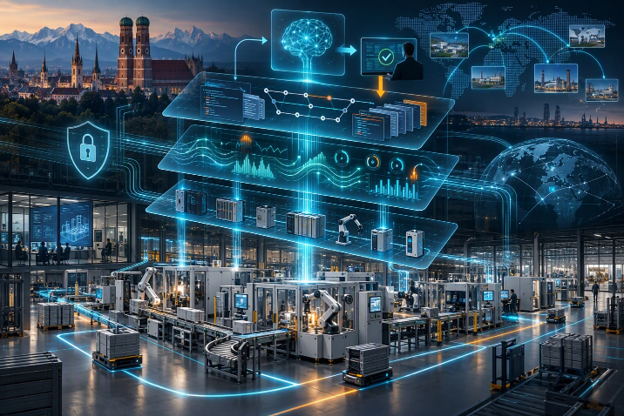
The opening theme was that “the factory is code,” although much of that code remains undocumented, unversioned, and dependent on individual experts. Host company Software Defined Automation introduced its State Layer for Physical AI as a system of record linking what machines should run with evidence of what they actually did. The goal is not unsupervised change, but a closed loop in which AI proposes improvements, engineers approve them, and every deployment and result is traceable.
Production examples moved the discussion beyond vision. BMW Group described pilots spanning facility management, electric-drive production, battery modules, and powertrain testing. Henkel showed how AI analysis of PLC code uncovered a long-hidden robot fault and how automated tag interpretation can reduce the cost of preparing machine data. Sanmina outlined a cloud-native, multi-vendor approach combining manufacturing execution, control-layer abstraction, versioning, backup, and Industrial DevOps. Clevertech showed how machine builders can preserve software-change history from engineering through production, allowing lessons from one machine to be reused across a fleet.
A live demonstration made the model tangible. Code, telemetry, and deployment history appeared in a common view, enabling an AI agent to recommend changes to throughput and energy performance. An engineer reviewed, approved, and deployed the action, then compared machine behavior with the code change. The demonstration highlighted the difficulty: variables, timestamps, and physical context must align precisely, while approval remains a logged human responsibility.
Other sessions addressed the foundations for scale. SEW-EURODRIVE framed unified data, virtualization, and orchestration as pillars of the software-defined factory. Autonomy presented OpenPLC as an open control-layer alternative, while FLECS explained how the Linux Foundation’s Margo standard can provide a consistent way to package, deploy, update, and retire edge software across vendors. Cytiva emphasized validated environments, audit trails, and governed recovery in regulated production, where restoring operations requires proving process readiness, not merely recovering a backup.
Scaling also emerged as an organizational challenge. Panelists cited weak handovers, inconsistent naming, unclear ownership, changing roles, and concentrated expertise as common reasons pilots stall. Boehringer Ingelheim similarly argued that global OT services require shared platforms, centralized capabilities, security by design, and cross-functional working practices rather than more interfaces between existing silos.
Security was treated as a prerequisite for industrial AI, not a compliance afterthought. Priorities included maintaining a live asset inventory, eliminating shared remote-access credentials, protecting communications, versioning and backing up controller software, and requiring a human gate for every change. The closing message captured the consensus: machine state can be known, engineering loops can be closed, and AI can extend scarce expertise without removing accountability. The first step is demanding but clear—establish what is actually running across the controller fleet, then manage every change from that verified baseline.