Representative End User Clients







Representative Automation Clients







Representative Software Clients








Honeywell Process Solutions recently briefed ARC Advisory Group on the company’s new document and change management offering. The solution was introduced for general release in March. Honeywell named the solution Trace.
 To document the interdependencies within their control systems, end users have normally relied on manually maintained, engineering-related databases, spreadsheets, CAD files, and Word documents. But engineering tools are too focused to provide an overarching view of all the places information must flow. Honeywell Trace automatically pulls this information together into a series of web-based dashboards for quick access and easy interpretation.
It is extremely important that information about every control element's usage throughout the control system is clearly understood and documented to help avoid process interruption should any element require maintenance or modification.
According to Honeywell, the solution:
Makes it easier for end users to document the knowledge of more experienced workers
Helps reduce the effort required to troubleshoot and assess issues by as much as 80 percent
Makes it easier for end users to comply with control system configuration change management requirements
Makes it easier to propagate best practices across the organization
 Control systems are intricate, consisting of many different software and hardware components with multiple dependencies. Typically, several different users from several different departments are responsible for maintaining, servicing, and supporting the systems. In this environment, keeping track of the multiple “moving pieces” can challenge the most disciplined of organizations. Forty years since the first DCSs came on the scene, the market continues to search for an adequate solution to manage these systems.
Most industries today also face challenges relative to retaining and managing knowledge. For any control system, it’s critical for end users to have accurate, up-to-date information about how various components interconnect, in which direction various signals/data flow, and their inter-dependencies. The documentation prepared when the control system was initially commissioned quickly becomes superseded by changes and can 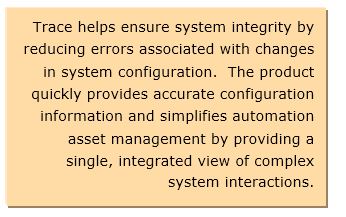 be misleading to personnel at critical times. Out-of-date documentation makes it difficult and time-consuming to troubleshoot problems. This directly impacts issue resolution times. Inaccurate documentation also increases dependency on individuals, bringing the added risk of losing this knowledge base when people retire or move on.
End users seek clear visibility into their installed systems. Engineering tools are specific to the control system pieces and do not always provide a holistic view of the system and its co-dependencies. This makes troubleshooting more difficult and can result in unintended or extended disruptions to production.
According to the company, Trace is an automated documentation and change management software for customers seeking to improve compliance, reduce configuration errors, spend less time in project planning, and minimize troubleshooting effort.
Trace automatically captures configuration data, detects engineering anomalies, and provides performance reporting. This allows end users to 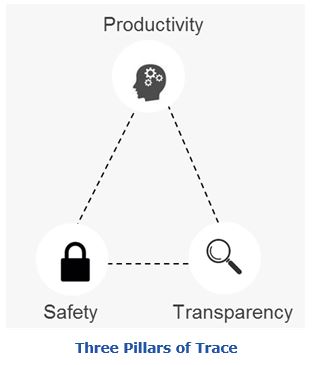 know why, when, and what actions were taken on the control system and the impact of those changes. In this manner, Trace helps ensure system integrity by reducing errors associated with configuration changes. Trace quickly provides accurate configuration information and can simplify automation asset management by providing a single integrated view of complex system interactions. The solution collects data to help improve end user’s visibility of system configuration anomalies and automates the documentation of “tribal” knowledge and actions affecting the control system.
Honeywell originally designed Trace as an internal solution for documentation and change management of its own intellectual property and system assets in response to an internal need not met by currently available products. Based on this need, it has decided to release the application commercially.
Trace supports both Honeywell and third-party systems. As of this writing, the product supports Experion PKS Process and SCADA Server, Honeywell TPN (TotalPlant Network), the combination of Experion and TPN, OSIsoft PI historian, FSC/Safety Manager, Triconex, Uniformance PHD, and InTools/SPI (Smart Plant Instrumentation).
Better System Management Means Better Reliability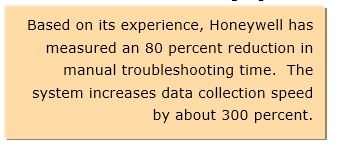
As a single platform for system management and management of change across the entire system, Trace can help increase process availability, improve plant performance, and enhance safety overall. Trace improves productivity through the ability to map configuration interdependencies visually. It also allows end users to query the application for parameters without the need to understand SQL. It also eases the effort required to manage tag references within the system and the spare I/O capacity.
Trace makes the system more transparent by making the system asset inventory readily available. It also maps out the current control system network hierarchy. Users can freely access and manage the workflows around change management and the system support user notes and attachments to ease the flow of information.

Many factors affect plant safety. Trace enhances safety by making information readily available to the end user. It detects when changes are made and allows the user to evaluate these changes through the dashboard. The application also monitors the system for anomalies that may be a violation of control philosophy, design rule, or configuration rules of that plant. This functionality aids the user in enforcing compliance to plant standards and safety standards. Because Trace offers system health and performance reporting, end users can quickly respond to problems, potentially avoiding an incident.
Trace is the culmination of Honeywell’s internal efforts with regard to its Assurance360 offerings. This allowed the company to measure the results of Trace in the real world. Based on its experience, Honeywell has measured an 80 percent reduction in manual troubleshooting time. The system increases the data collection speed by about 300 percent. On projects, it reduces quality assurance activities and FAT (field acceptance testing) by a third.
Every user expresses the importance of accurate documentation. In practice, every user has experienced the woes associated with a poorly documented system. Despite the best of intentions, paper-based systems fall short. Honeywell experienced this need first hand when the company introduced its Assurance360 performance services program. Trace is the result.
Tools, like Trace are crucial to engineering organizations. As knowledge leaves companies or even changes departments, new workers need familiar tools to quickly access information. (It’s possible that some Millennials have never even seen a physical binder.) It is vital that companies find ways to institutionalize this knowledge to avoid downtime associated with ignorance and poor access to accurate, up-to-date documentation.
Equally important, these tools are critical in system recovery situations. Should a controller need to be reloaded, this type of tool can easily point out changes between the recovered backup and the system prior to the failure.
The tool also promotes proactive and interactive support with its reporting functions, allowing personnel to focus on real issues in a timely manner instead of reacting to a problem after it manifests. This feature can also help address cybersecurity issues like careless or rogue employees/actors.
ARC Advisory Group clients can view the complete report at ARC Client Portal on Office 365 or Box.com or New Client Portal on this website
If you would like to buy this report or obtain information about how to become a client, please Contact Us
Keywords: Trace, Change Management, Documentation Management, Honeywell Process Solutions, Control System, Knowledge Retention, Unscheduled Downtime, Uptime, ARC Advisory Group.