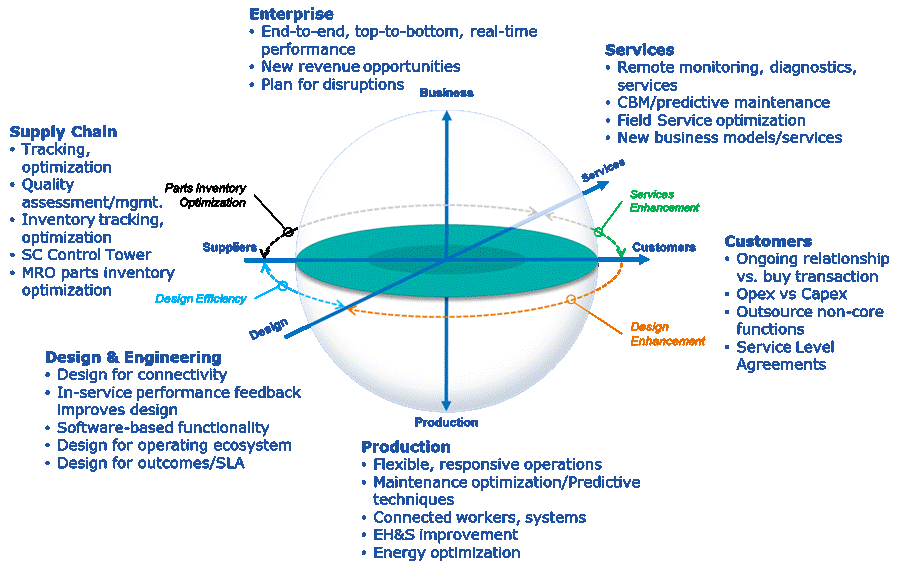
Here's a handy guide that depicts key IIoT dimensions for manufacturers. Unlike some other views that start with a technology stack, this ARC graphic portrays key transformational opportunities in terms of three core business processes, shown as three intersecting axes: Operations (Business <-> Production), Supply Chain (Suppliers <-> Customers), and Lifecycle (Design <-> Services).
Production
Manufacturers can leverage IIoT technologies (such as new sensors, communications networks, IoT platforms, machine learning, and predictive analytics) to improve optimize asset performance, production operations and maintenance management. There are additional opportunities to improve productivity by 'connecting' workers via smart watches, smartphones, or tablets. The technologies can be applied to improving EH&S as well as Energy optimization.
Supply Chain
IIoT can improve logistics tracking and optimization, inventory tracking and optimization, and indirect parts tracking and optimization. There are also opportunities to improve quality and manage end-to-end supply chain processes through the use of supply chain 'control towers'.
Services
The low-hanging fruit for IIoT is providing remote monitoring, diagnostics, and other services enabled by 'connected' products in operational use. This can include predictive maintenance services, field service optimization, and brand new services.
Customers
In many cases, there is an opportunity to fundamentally change the business model with customers, shifting from a 'one and done' transaction based model to an ongoing relationship model in which the manufacturer stays connected to key data from products in operation in the field. Customers can potentially benefit by shifting from Capex to Opex funding. They may elect to outsource non-core functions, and they may elect to 'buy outcomes instead of assets,' relying on 3rd parties or manufacturers and SLAs with teeth.
Design and Engineering
Many if not all of the potential digital transformation opportunities start in Engineering. Several new design mandates are emerging, such as design for connectivity, design for expected operating ecosystem, and design for outcomes/SLA. Real-time operating performance feedback from in-service products will enable to take product designs to the next level - quickly and efficiently. And of course, modern designs should incorporate software based functionality, to provide for the possibility of changing machine performance while in service.
Enterprise
At the business/enterprise level, it is important to leverage the emerging technologies to provide real-time, end-to-end, information-driven performance improvements. Plan for disruptions that - by definition - may not be anticipated. And to the extent possible, seek to transform key business processes before competitors do it for you.




















