Representative End User Clients







Representative Automation Clients







Representative Software Clients








Going beyond Silicon Valley, Chicago’s diverse economy remains to be the biggest strength in building a thriving tech ecosystem and a startup hub. Chicago has established itself as a strong business community for business-to-business (B-2-B) tech ecosystem for startups ranging from data science, logistics, manufacturing, retail, medicine, finance, and publishing. Recently, I was attending a briefing by Uptake, the industrial data science and IoT company, at their Chicago headquarters.
 Uptake, co-founded by Brad Keywell, in July 2014, has grown exponentially in last four-years with 750 employees and over fifty global customers across multiple industries like Railways, Wind, Energy, Oil and Gas etc. Brad states that reimagination, disruption, and value creation were three driving factors in building this successful business venture. Uptake believes that digital transformation is fundamentally changing how people do their jobs, to create value in new ways with the right analytical tools and training.
Among the many prevailing digitization and IIoT trends, the market for asset reliability software, services, and APM have emerged with asset-centric business models. Industrial AI and IIoT are rapidly reshaping how assets are managed, which is driven by the availability and machine learning technologies capable of dealing with massive amounts of data, and by the availability of modern cloud application platforms. Most asset management software vendors in the market still focus on the planned and reactive maintenance services, while the trend is drifting towards predictive maintenance.
Ganesh Bell, the president of Uptake and a former GE, SAP, and Peoplesoft executive rightly sets his vision for Uptake, “Data for every single physical environment within transportation and energy sector needs to be collected to solve every piece of the problem, and understand the value of the connected asset and a data-driven enterprise”. This vision will play a critical role in Uptake’s product and service offerings that can disrupt or transform businesses and entire industries.
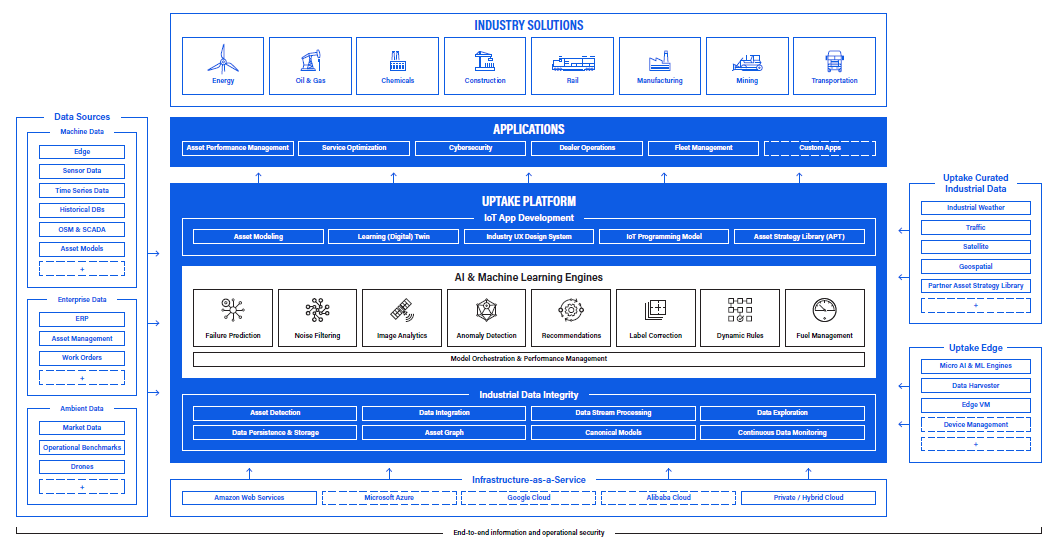 Uptake's expertise – the core APM application sits horizontally across industry verticals assists in failure prediction, fuel management and label correction around complex industrial assets like locomotives and wind turbines. Uptake’s platform is built upon cloud infrastructure from Alibaba, Amazon, and Google. The platform is built to scale, integrate edge enabled machine learning engines and open source technologies, deploy over 400-models in less than 2-minutes, and switch between models based on the industry requirements. It also generates recommendations and service report within 2-weeks once data is in uptake database/platform. Uptake platform has the capability of moving away from the process and transactional towards asset intelligence and analytics.
Regarding the vertical approach discussed by Greg Goff (Uptake’s Chief Product Officer), ARC research indicates that this is what manufacturing owner/operators prefer. They want to deal with suppliers who have expertise in the industrial processes and can provide a systems approach to optimization as opposed to standalone solutions for individual assets. It’s investment in the rail and renewable vertical should make it a key player for the next several years as they transition towards Outcome-as-a-Service.
The industry business model has been transitioning from one-time asset sales to multi-year operation and maintenance contracts. At the moment, Uptake is competing with large OEMs, APM services, and the evolving data science companies. Creating a three-way working relationship among IT-OT-ET will be the key challenge for Uptake. In addition, most of the current workforce in manufacturing sector does not understand the nuances of IT-based networks. This will be an added challenge for Uptake to educate that APM solutions deliver actionable information that can help manufacturers increase maintenance efficiency and effectiveness, avoid costly unplanned downtime, minimize the need for scheduled downtime, and maximize equipment availability, all while increasing safety.