Representative End User Clients







Representative Automation Clients







Representative Software Clients









The transition from paper to digital has been happening for a while in the industry. Digital operations are becoming the new operational reality for the industrial frontline. In the last two to three years, the industrial landscape has crossed the threshold from mere digital operations—where the focus was on digitizing paper and connecting assets—to AI-driven digital operations, where the system itself acts as a proactive collaborator.
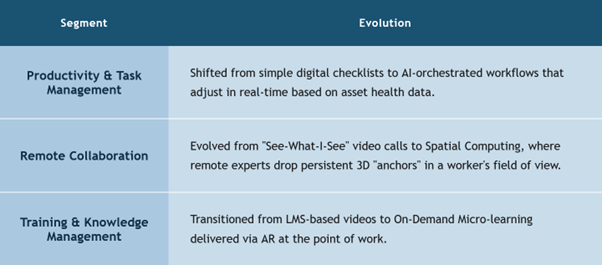
In 2026, AI-driven digital worker technologies for manufacturing have evolved from software tools into AI-driven collaborators that fundamentally re-architect frontline work. Unlike previous digital iterations that merely provided access to information, modern digital worker platforms utilize AI to reason, prioritize, and help frontline workers execute complex workflows.
Central to understanding the maturity of the digital worker technologies landscape and evolution is the ARC Advisory Group Market Research report and MarketMap, which provides the blueprint for how the suppliers in this segment as well as the related technologies are categorized and evolving.
Industrial work processes are becoming increasingly complex, high-risk, and digitally integrated. As a result, there is a growing need for advanced digital worker technologies that can provide industrial employees with essential real-time support and information to help them perform their duties more safely, efficiently, and effectively. The growing demand is highlighted by the growth observed in the digital worker technologies market. According to the recent Digital Worker Technologies Market Research report, the market is expected to post a CAGR of over 11 percent for the five-year forecast period. The growth is supported by several leading market trends.

As we are wrapping up our upcoming report, Digital Worker Technologies MarketMap, the focus has shifted from how the market will grow to how technology is shaping up today, and what the vision for the future is. ARC MarketMap is an analyst-driven evaluation framework that provides a visual representation of supplier positioning based on current capabilities and future strategic direction. For digital worker technologies, this evaluation becomes particularly critical given the convergence of several technologies impacting this space.
The most urgent driver behind the ARC MarketMap’s recent coverage is the increasing interest of end users in digital worker technologies because of the ongoing Silver Tsunami. With a significant portion of the manufacturing workforce retiring, the industry is facing a massive brain drain. Digital worker technologies are the primary tool for preserving tribal knowledge. By using AI to capture how a veteran technician listens to a pump or adjusts a valve, companies are turning individual expertise into an enterprise asset. In 2026, we are also seeing the emergence of Connected Intelligence. This is the leap from workers being "connected" to a database to workers collaborating with AI Agents. During the research process for our upcoming MarketMap, ARC has taken a closer look at the AI-driven capabilities that can help end users empower their workforce.
In the digital worker technology market, the supplier landscape is highly fragmented, with technology providers ranging from large enterprise platform vendors and niche capability specialists to emerging AI-native players. This diversity creates a significant challenge: distinguishing true capability from market positioning. ARC MarketMap addresses this by offering a consistent, research-driven view of supplier strengths and gaps. The visual positioning simplifies complex analysis, allowing stakeholders to quickly identify leaders, emerging players, and niche specialists. End users can use MarketMap insights to build shortlists and benchmark suppliers against industry expectations, rather than relying on fragmented inputs. Ultimately, ARC MarketMap enables end users to move from reactive vendor selection to proactive, strategy-led decision-making.