Representative End User Clients







Representative Automation Clients







Representative Software Clients








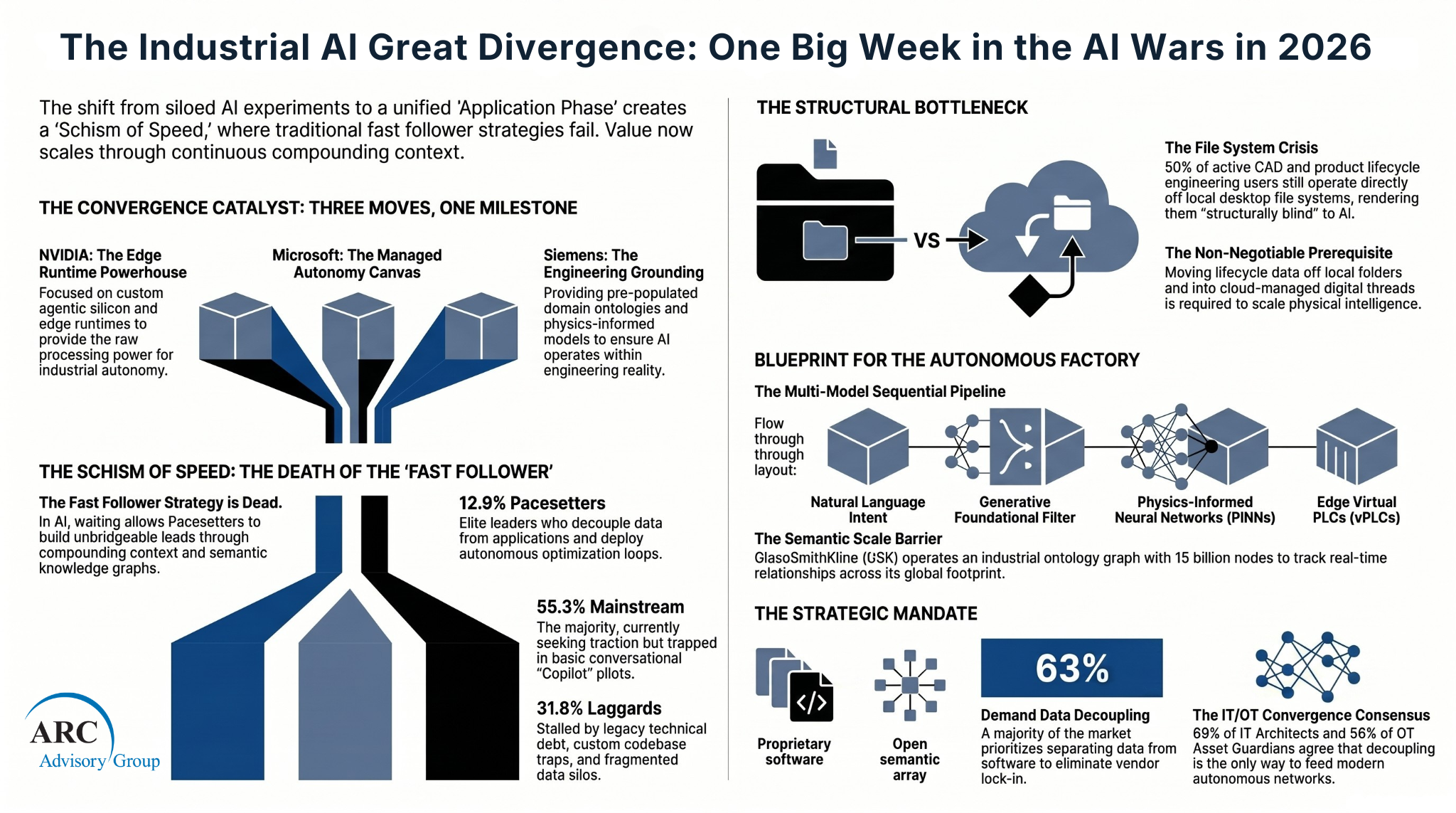
If you evaluated the major technology disclosures of the past week in isolation, you might see them as a routine series of vendor software refreshes and hardware product launches. But when you step out of individual vendor events and briefings and evaluate these consecutive developments as an assembled sequence, a far more compelling macroeconomic reality emerges. Last week represents a remarkable milestone—one we may well look back upon as the defining moment when the industrial market began transitioning out of the “Infrastructure Phase” of artificial intelligence and into the “Application Phase.”
What last week truly delivered was a powerful catalyst: a convergence of distinct capabilities where accelerated hardware, enterprise software canvases, and physical context are beginning to interact, dividing the market along a noticeable operational fault line. Over a single, hyper-accelerated week, the industrial tech landscape experienced a massive realignment across three major technological disclosures:
Taipei (COMPUTEX 2026): We analyzed NVIDIA’s custom agentic silicon and edge runtimes.
Redmond (Microsoft BUILD 2026): We unpacked how operating system primitives are constructing a more secure canvas for managed enterprise autonomy.
Detroit (Siemens Realize LIVE Americas 2026): We charted how pre-populated domain ontologies are grounding computational tokens in engineering reality.
To understand how this operational divide is playing out across actual manufacturing and process operations, we must look directly at the quantitative metrics gathered during ARC Advisory Group’s global research initiatives. In analyzing the final cuts of our Industrial AI, Energy, and Robotics Survey, the empirical data proved that the traditional “fast follower” strategy—a methodology where conservative industrial organizations could safely wait out a technology cycle before purchasing commoditized software—is effectively dead for productive AI adoption.
Waiting out the technology cycle is an operational dead end because productive AI scales through continuous, compounding context. While a fast follower hesitates, pacesetters are actively decoupling their core data to run autonomous optimization loops and building massive semantic knowledge graphs. By the time a follower attempts to buy a commoditized solution off the shelf, their underlying product models and schematics remain trapped in legacy file systems, leaving them structurally blind and permanently separated by an unbridgeable digital divide.
Our survey research shows that the global industrial market has fractured into three distinct operational cohorts:
The Pacesetters (12.9 percent): Elite industry leaders that have stopped treating AI as a siloed IT experiment, successfully decoupling their core data from software applications to deploy autonomous optimization loops across their facilities.
The Mainstream (55.3 percent): The traveling majority seeking solid operational traction, yet remaining largely trapped in basic conversational copilots and retrieval-augmented generation (RAG) document summaries that fail to deliver meaningful value.
The Laggards (31.8 percent): A trailing cohort feeling increasingly left behind, stalled by legacy technical debt, custom codebase traps, and fragmented data silos.
Moving out of pilot purgatory requires a fundamental change in corporate innovation culture. Laggards manage technology adoption through risk-averse procurement structures, targeting a zero percent codebase failure rate, which inevitably strands them on obsolete software branches. Pacesetters treat AI deployment as a continuous, high-velocity R&D campaign. They carry an intentional 50 percent project scrap rate on exponential budgets, establishing strict review windows to aggressively kill unscalable pilots early.
This operational variance highlights a critical structural bottleneck on the modern engineering desktop: The File System Crisis. As disclosed by Siemens at last week’s conference, a striking technical metric revealed that 50 percent of active CAD and product lifecycle engineering users still operate directly off standard local desktop file systems.
The Analyst's Verdict: If your engineering technology (ET) division is attempting to deploy advanced multi-agent workflows or train neural networks while your underlying product models, configuration states, and schematics are locked in unversioned local folders, your automation strategy is structurally blind. Moving critical lifecycle data off legacy desktop file systems into cloud-managed digital threads is the non-negotiable prerequisite to scale physical intelligence.
Manufacturers that resolve these data bottlenecks are unlocking a highly sophisticated software design pattern that systematically disassembles the rigid layers of the traditional Purdue Model (ISA-95). Winning industrial AI architectures reject the assumption that a single horizontal large language model can safely manage production operations. Pacesetting organizations are abandoning monolithic systems in favor of open, graph-aware data fabrics that coordinate decentralized networks of specialized, sequential multi-model pipelines:
Natural Language Operational Intent: Captured at the user interface layer to define the scope of work.
Generative Foundational Layer (Upfront Filter): Explores high-level concepts and design permutations, compressing the design space from millions of options down to a handful of high-probability candidates.
Geometric Deep Learning/Physics-Informed Neural Networks (PINNs): Runs a first-principles physics validation engine, mathematically enforcing differential equations to guarantee safety and compliance.
Edge Virtual PLCs (vPLCs): Translates verified instructions into real-time, closed-loop kinetic actuation directly on the physical machinery line.
The true competitive barrier separating these pacesetting environments from generic IT pilots is the sheer scale of the semantic context layer running behind the model. To make AI effective, you cannot rely on manual tag mapping. It requires a living knowledge graph that auto-discovers assets and contextualizes legacy operational data into relational intelligence.
This was highlighted on the Realize LIVE stage, which documented that global pharmaceutical leader GlaxoSmithKline (GSK) is currently running a live industrial ontology graph containing 15 billion nodes inside Siemens’ Intelligence Center X platform. A general-purpose cloud model understands text strings, but it cannot duplicate a 15-billion-node semantic mesh that tracks the continuous, real-time relationships between physical components, operational tolerances, and enterprise business logs across a global footprint.
The core lesson from this milestone week of technology disclosures is that individual, siloed AI applications are no longer competitive on their own. Long-term survival across this accelerating Industrial AI Revolution demands an open, accessible, and unified data foundation.
Our aggregate global survey cuts confirm that a massive 63 percent of the industrial market considers “decoupling data from software” to be a critical strategic priority. When split by job function, this consensus remains remarkably balanced—embraced by 69 percent of IT architects and 56 percent of OT asset guardians. This cross-functional consensus focuses on two clear operational goals:
Eliminating Application Lock-In: Preventing critical factory data from being held hostage by proprietary vendor legacy software.
Feeding Open Semantic Arrays: Ensuring that contextualized data fabrics are readily accessible to modern, multi-agent autonomous networks.
Siemens’ disclosures explicitly demonstrate this platform strategy, drawing a hard competitive boundary line against horizontal IT tools attempting to sweep downwards into the plant network. By owning the physical domain data, the geometry models, and the operational footprint, Siemens establishes the definitive semantic layer required to transform raw computing tokens into safe, autonomous operational workflows. Both sides of the enterprise now mutually recognize that monolithic, proprietary application architectures are a strategic dead end that permanently blocks the scaling of intelligence.
The simultaneous volleys fired across COMPUTEX, Realize LIVE, and BUILD reveal that the industrial core is rapidly splitting apart along a profound operational and economic divide.
Blog 5: “The Industrial Token Economy: Balancing OPEX Traps, Value-Based Software Tokens, and Edge CapEx Escapes.” We will transition from multi-model software blueprints into the stark financial realities facing the C-suite. We will deliver an analyst-grade procurement playbook for CFOs and CIOs, analyzing how to deploy local edge capital assets to systematically dismantle the volatile, unpredictable cost loop of cloud-metered API token consumption. Stay tuned.
The Industrial AI (R)Evolution is moving faster than ever. To dive deeper into the frameworks and data shaping the future of the industrial sector, explore my latest research:
Navigating the AI Wars and the escalating Industrial Robot Wars
Closing the Digital Divide by Embracing Industrial AI
Assembling your Industrial-Grade Data Fabric
Charting the new frontier of Physical Intelligence and transitioning to a Cyber-Physical Industrial Architecture (CPIA)
Mapping your maturity and strategy with ARC's 3-Axis Industrial AI Models Taxonomy
Take our Industrial AI Assessment to benchmark your organization's maturity, identify critical gaps in your IT/OT/ET convergence, and get actionable recommendations to accelerate your path to becoming an Industrial AI Pacesetter.
Don't guess what your global operations or prospective customers need. Use empirical data to align your stakeholders and de-hype the market with ARC Advisory Group's Voice of Market Service.
For tailored recommendations on governing and guiding major people, process, and technology decisions across the enterprise, cloud, industrial edge, and AI, please contact Colin Masson at [email protected].
Or, set up a meeting with my fellow Analysts and I at ARC Advisory Group to find out more about our Executive Insights Service for Industrial organizations and our Industrial AI Insights Service for Vendors.