Representative End User Clients







Representative Automation Clients







Representative Software Clients








If you are following our ongoing series tracking the profound technological transformations reshaping the industrial sector, welcome back. In our opening two installments, we focused on the structural foundations of the emerging autonomous ecosystem. We first dissected NVIDIA’s COMPUTEX campaign in Taipei, evaluating how the transition to token-based computing metrics is forcing a total re-evaluation of hardware performance and thermodynamic design at the extreme edge. We then traveled to Redmond for Microsoft BUILD 2026 to analyze the corporate cloud and operating system infrastructure, mapping how new operating system primitives like Windows Execution Containers are building a secure canvas for multi-agent automation.
As I noted in those initial entries, our goal as analysts is to evaluate each of these technology leaders independently within their respective domains before we synthesize these movements into a broader analysis of the macro-level “Industrial AI Wars.”
To complete this groundwork, we must now evaluate the missing link in the autonomous chain: deep engineering context and physical shop-floor execution.
Accelerated silicon and generalized platform canvases represent the raw computational muscle and data plumbing of the modern enterprise, but they are functionally blind without first-principles engineering truth, physics-informed asset models, and headless control loops.
To examine how these pieces are integrated into production-grade systems, we look at the portfolio updates emerging from Siemens Realize LIVE Americas 2026 in Detroit.
The proceedings in Detroit made it clear that Siemens is positioning its Siemens Xcelerator portfolio to dominate the contextual execution layer of the industrial value chain. While horizontal cloud and database providers attempt to sweep downward into the plant network with general-purpose tools, Siemens commands a highly resilient foundation built on decades of physical data gravity, asset lifecycle management, and automation footprints.
For information, operational, and engineering technology executives, the core takeaway from Realize LIVE is that a generalized large language model understands sentences, but it has no native grasp of thermodynamics, kinematics, or manufacturing geometry. By anchoring neural networks within the strict boundaries of physical sciences, Siemens is attempting to operationalize the digital twin, transforming it from a passive system of record into an active, governed foundry for human-agent collaboration.
This philosophy was clearly detailed during the opening keynote address by Tony Hemmelgarn, President and CEO of Siemens Digital Industries Software. Hemmelgarn outlined an operational framework where generative architectures are utilized as high-velocity upfront acceleration filters. Rather than forcing engineers to spend weeks manually testing infinite permutations in a design space, generative models are deployed to compress and narrow down the design boundaries from millions of options to a handful of high-probability candidates. These candidates are then immediately handed off to high-fidelity, deterministic physical simulation models for absolute validation. The generative brain creates the concept, but the deterministic twin enforces physical reality.
A premier real-world example of this active digital twin paradigm was showcased on stage by keynote customer PepsiCo. Following up on the operational blueprints presented at our own ARC Industry Leadership Forum 2026 (see our full analysis in The PepsiCo Blueprint: What an Industrial AI Pacesetter Looks Like in 2026), PepsiCo’s presence in Detroit highlighted a continuous, virtual-first design strategy. While a different executive speaker took the stage in Detroit, the use cases remained identical: leveraging the Siemens digital twin ecosystem to reconfigure manufacturing lines, simulate layouts, and optimize brownfield facility constraints, successfully compressing development cycles by 20 percent to 40 percent before streaming any real-world atoms.
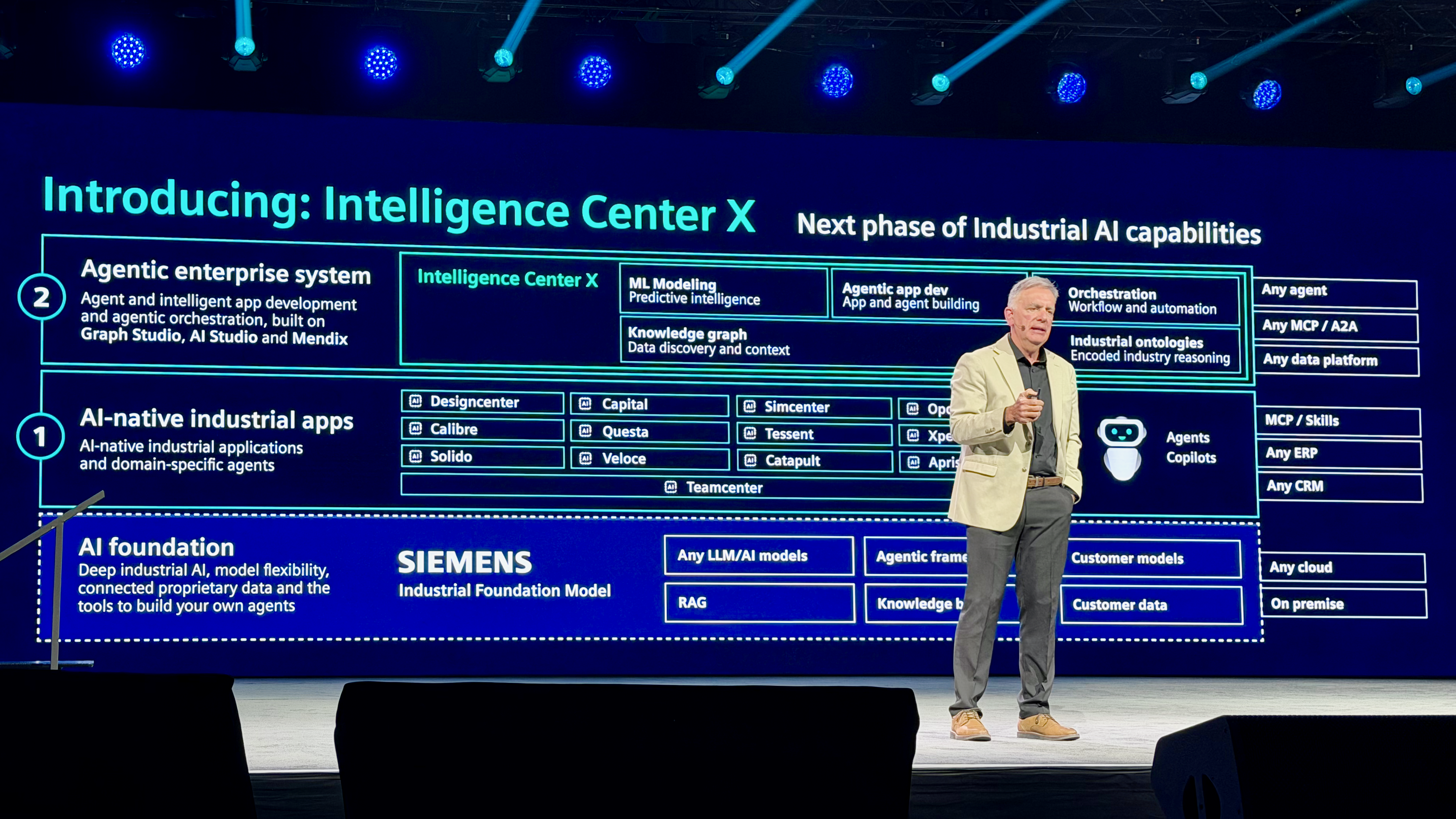
The central product development of the event was the official introduction of Siemens Intelligence Center X, a software orchestration environment that maps directly to Archetype 6 (The AI Platform) within the ARC Advisory Group 3-Axis Industrial AI Models Taxonomy. Intelligence Center X does not operate as an isolated, standalone application; rather, it serves as a semantic middleware layer designed to sit directly on top of existing enterprise and operational data infrastructure to manage multi-agent workflows. The platform achieves this cross-functional orchestration by unifying three core elements of the Siemens Xcelerator portfolio into a single workspace: Mendix for low-code application development and agent state coordination, Graph Studio for automated semantic data discovery, and AI Studio (RapidMiner) for deep statistical machine learning.
For an enterprise IT or data science executive, the single highest cost factor in any advanced industrial data initiative is the manual data engineering tax—the tedious, repetitive process of extracting tag streams from disparate plant historians and manually mapping them to asset descriptions. Siemens Graph Studio targets this bottleneck by operating as an automated knowledge graph generation engine. Instead of forcing engineers to write custom code to map every new physical component, Graph Studio automatically structures ingestion feeds into shared lifecycle intelligence.
The primary breakthrough here is Siemens’ introduction of Pre-Populated Industrial Ontologies built directly into the core platform. Because Siemens owns the data schemas for both the engineering suite and the execution portfolio, Intelligence Center X deploys out-of-the-box data models that natively understand industrial logic:
Designcenter X and Teamcenter X Ontologies: Natively pre-populated with engineering lifecycle semantics, understanding the precise relational attributes between 3D CAD topologies, parts lists, geometric configurations, material data sheets, and engineering bills of materials (EBOMs).
Opcenter X Ontologies: Natively pre-populated with manufacturing operations semantics, mapping real-time station routings, production logs, quality tolerances, machine toolpaths, and standardized equipment downtime fault signatures.
The immediate operational benefit for manufacturers is profound. Because these ontologies are pre-coded with industrial context, incoming autonomous execution agents do not have to spend cycles trying to “learn” how a factory data model is organized. They connect to a pre-structured representation of physical reality, allowing an agent to immediately cross-reference a real-time edge telemetry anomaly directly back to the original CAD design specification or materials log without human data engineering intervention.
Siemens validated this enterprise scale by highlighting that global pharmaceutical innovator GlaxoSmithKline (GSK) is currently running a live industrial ontology graph encompassing 15 billion nodes inside Intelligence Center X to synchronize real-time process visibility and regulatory compliance context across its global facility footprint.
During the various roundtable sessions, we confronted a common narrative currently echoing through the Silicon Valley hype cycle:
“Now that advanced, autonomous coding agents like Anthropic’s Claude Code or Claude Cowork can automatically generate raw scripts, build microservices, and configure databases from natural language prompts, traditional low-code/no-code platforms have become obsolete.”
Siemens’ executive team provided a vital, defensive reality check to this belief, revealing a profound misunderstanding of how software governance actually functions in a high-stakes industrial environment.
In an office productivity setting, you can allow a probabilistic AI agent to write and execute code on the fly. On a manufacturing plant floor or inside a chemical process network, you cannot allow an AI model to push unvetted code scripts directly to operational databases, SCADA networks, or edge controllers. Mendix has been systematically repositioned by Siemens not merely as a drag-and-drop tool to help business users avoid typing code syntax, but as the mandatory structural body, application state coordinator, and deterministic governance container for autonomous AI agents.
The architectural division of labor must be framed clearly for cross-functional executives: The foundational AI model operates as the brain, but Mendix operates as the physical body and the legal boundary. Claude can generate a specialized data-transformation microflow or a localized calculation script in seconds, but Mendix provides the rigid, visual logic blocks, the enterprise application integration (EAI) safety rails, the state validation engines, and the mandatory human-in-the-loop (HITL) review canvases that govern that execution. The agent operates inside the Mendix container, ensuring that all automated code outputs are sandboxed, audited, and structurally barred from crossing safe operational parameters.
Siemens grounded this architecture in the field by highlighting the landmark deployment metrics achieved by Vivix Vidros Planos. As Brazil’s leading flat glass manufacturer, Vivix constructed a highly coordinated architecture consisting of nearly 30 distinct Mendix applications that bridge data layers across their SAP S/4HANA ERP enterprise core, Siemens Industrial Edge nodes, and a centralized Snowflake data warehouse.
When it stood up its AI-powered Virtual Assistant (leveraging Intelligence Center X, Amazon Bedrock, and Claude), it did not bypass its low-code platform. Instead, they utilized Mendix as the secure application interface to govern the agent’s actions. This governed agentic loop drove an 85 percent reduction in production issue resolution latency while successfully capturing 6,000 hours of manual labor in a single operational year.
To maximize the commercial value of these intelligence deployments, data science and engineering technology (ET) executives must look past unified marketing definitions to identify a sharp technical bifurcation in Siemens' codebase. Realize LIVE demonstrated that Siemens is advancing along two entirely distinct, parallel algorithmic tracks: Customer-Specific Geometric Deep Learning Surrogates designed for high-speed physics approximation, and a macro Industrial Foundation Model (IFM) initiative engineered for cross-domain lifecycle orchestration.
The staggering 500 times to 1,000 times simulation acceleration metrics showcased in Detroit within Simcenter PhysicsAI are driven entirely by Customer-Specific Deep Learning Surrogates. This is the capability that transforms the passive CAD/PLM repository inside Designcenter X into an active predictive twin environment.
The Data Structure: This track does not rely on an out-of-the-box, generalized foundation model. It is trained strictly on a specific customer’s own historical simulation data assets. To build a functional surrogate, an enterprise must feed Graph Neural Networks (GNNs) thousands of its own historical, high-fidelity CAE runs (e.g., past NX Nastran or STAR-CCM+ meshes for a highly specific product architecture, such as an electric vehicle chassis or an aerospace wing component).
The Algorithmic Value: The network acts as a localized neural shortcut, implicitly learning the complex geometric and boundary-condition relationships of that specific corporate design space. By mapping the geometric topology directly onto the neural network’s weights, it completely cuts mathematical mesh generation and traditional, iterative differential equation solving out of the upfront design loop.
The Operational Reality: Designcenter X returns an accurate physics approximation surrogate in seconds, allowing design teams to dynamically explore thousands of shape and performance variations in real time before committing the final candidate to heavy, deterministic solvers for absolute mathematical verification.
Entirely separate from these localized design surrogates is Siemens’ multi-year campaign to construct the Industrial Foundation Model (IFM)—the sector’s true Design-to-Manufacturing Frontier Model.
The Ingestion Strategy: This is where the global 150-petabyte ecosystem dataset comes into play. Siemens is leveraging this data to train a multi-modal, cross-domain foundation model capable of interpreting generalized engineering intent, relational product structures, and generative assembly rules.
The Lifecycle Loop: The objective of the IFM isn't to calculate localized mechanical stress. It is built to bridge the gap between engineering design (ET) and production execution (IT/OT). It is trained to interpret a 3D CAD model, understand its component dependencies, and programmatically generate the corresponding manufacturing bills of materials (MBOMs), factory floor routing rules, and manufacturing execution system (MES) configuration states required to build the physical asset.
This structural bifurcation explains why The File System Crisis is an immediate roadblock to digital transformation. Siemens dropped the sobering benchmark that 50 percent of active CAD and product design users still operate entirely off standard local file systems. If an enterprise carries out half of its design work on isolated local desktop folder trees, both algorithmic tracks are paralyzed:
Local deep learning surrogates cannot scale because the historical simulation data required to train the GNNs is uncontextualized, unversioned, and scattered across individual local machines.
The macro Industrial Foundation Model cannot orchestrate the lifecycle because it lacks a centralized, clean digital thread to map engineering intent down to shop-floor execution blocks.
The deployment of Intelligence Center X on the shop floor introduces a highly strategic solution to a painful architectural roadblock that has held back the Manufacturing Execution System (MES) market since its inception: Custom Code Hell.
Historically, manufacturing enterprises had to write site-specific, hard-coded software customizations directly into core MES applications to handle localized plant routing exceptions, site-specific quality checks, or custom machinery logic. This custom code permanently locked the enterprise into a specific software version, making application upgrades impossible and leaving global facilities stranded on obsolete software branches.
The integration of Intelligence Center X directly resolves this deadlock by introducing a governed, managed customization and extensibility abstraction layer on top of core Opcenter X microservices.
Under this architecture, instead of tampering with core MES application source code, plant engineering teams and autonomous agents deploy plant-specific extensions within the managed Mendix sandbox container. AI agents read the pre-populated manufacturing ontologies via Graph Studio to understand local constraints, and autonomously inject plant-level routing exceptions or logic updates into the extended application layer.
This cleanly decouples the standardized, multi-tenant core product from localized, site-specific configurations. For the C-suite, it finally resolves the 30-year upgrade deadlock, allowing corporate IT to push unified software updates across global fleets while granting local OT teams the managed flexibility to adapt operations dynamically.
To complete this standalone assessment, we must restore a critical technical nuance regarding open connectivity frameworks, specifically evaluating the role of the Model Context Protocol (MCP). For information technology and data science teams, MCP represents a profound advancement for Axis 1 (Data Integration) within the ARC taxonomy. It operates as an open-standard semantic routing and information discovery engine across multi-vendor enterprise software estates. It allows an intelligent agent sitting inside Siemens Teamcenter to seamlessly query, locate, and retrieve context from an asset file locked inside an external ERP or a third-party database without requiring a customized, proprietary API connector. It effectively bridges the multi-vendor information gap.
However, an analytical hard stop must be drawn regarding control architectures. While MCP is an exceptional tool for cross-system querying, it remains an asynchronous information protocol. It natively lacks the deterministic, sub-millisecond capability required to control a spinning kinetic asset safely.
Hard shop-floor control loop optimization can never run via an open internet query framework. It demands edge-native orchestration, utilizing containerized virtual PLCs (vPLCs) and ruggedized edge hardware acting directly next to the machine, entirely insulated from high-level enterprise agent traffic.
The technical architectures unveiled at Realize LIVE 2026 establish clear operational imperatives for cross-functional industrial leaders. To help your enterprise navigate the “intelligence divide” without getting trapped in unscalable pilots, here is the condensed set of tactical milestones that your executive team must prepare to execute:
Eradicate Legacy File Systems (The Non-Negotiable Step): Pacesetting companies must make cloud-connected digital thread adoption a board-level KPI. If 50 percent of your product geometry is still trapped on local engineering desktops, you cannot scale deep physics surrogates or lifecycle automation. Curing this technical debt is your top priority.
Transition to Localized Silicon for Unmetered Reasoning: To operationalize real-time engineering twins without blowing out your operational expenditure budget, you must prepare to shift inference entirely to the edge. Running always-on diagnostic loops through cloud-native public APIs creates an unpredictable OpEx trap.
Enforce Safe Change Control through Low-Code Containers: Reject the fallacy that autonomous coding agents render custom application layers obsolete. Foundational models operate as the algorithmic brain, but secure low-code frameworks like Mendix are required to serve as the mandatory governance container, risk sandbox, and human-in-the-loop validation layer for safe field execution.
Isolate Your Semantic Graphs from Deterministic Control Lines: Enterprise architectures must aggressively adopt semantic standards like MCP and i3X to enable multi-vendor information discovery. However, your OT groups must draw a hard boundary line isolating these asynchronous routing systems from sub-millisecond edge networks running virtualized PLCs.
Siemens’ Realize LIVE disclosures demonstrate an explicit platform strategy: The company is drawing a hard, competitive boundary line against horizontal IT tools attempting to sweep downward into the plant network. As stated directly from the Huntington Place stage:
“When we say Copilot, that's not a Microsoft Copilot; that's a Siemens Copilot.”
Siemens possesses the physical domain data, the geometry models, and the operational footprint that horizontal tech providers cannot duplicate.
Now that our three independent event deep dives have established the accelerated hardware primitives (NVIDIA), the enterprise platform canvas (Microsoft), and the industrial engineering context (Siemens), our groundwork is complete. It is time to step out of individual vendor rooms to consider the broader Industrial AI ecosystem ramifications of last week’s market shake-up, and why these developments indicate a significant milestone in the Industrial AI (R)Evolution.
Up Next in the Series, Blog 4: "Bits, Atoms, and Autonomy: Unpacking the 2026 Industrial AI Realignment" We will dive directly into the empirical benchmarks of ARC’s global manufacturing surveys to show how a small vanguard of pacesetters is disassembling the traditional Purdue Model, breaking out of pilot purgatory, and proving why a “fast follower” strategy is a recipe for permanent operational obsolescence. Stay tuned.
The Industrial AI (R)Evolution is moving faster than ever. To dive deeper into the frameworks and data shaping the future of the industrial sector, explore my latest research:
Navigating the AI Wars and the escalating Industrial Robot Wars
Closing the Digital Divide by Embracing Industrial AI
Assembling your Industrial-Grade Data Fabric
Charting the new frontier of Physical Intelligence and transitioning to a Cyber-Physical Industrial Architecture (CPIA)
Mapping your maturity and strategy with ARC's 3-Axis Industrial AI Models Taxonomy
Take our Industrial AI Assessment to benchmark your organization's maturity, identify critical gaps in your IT/OT/ET convergence, and get actionable recommendations to accelerate your path to becoming an Industrial AI Pacesetter.
Don't guess what your global operations or prospective customers need. Use empirical data to align your stakeholders and de-hype the market with ARC Advisory Group's Voice of Market Service.
For tailored recommendations on governing and guiding major people, process, and technology decisions across the enterprise, cloud, industrial edge, and AI, please contact Colin Masson at [email protected].
Or, set up a meeting with my fellow Analysts and I at ARC Advisory Group to find out more about our Executive Insights Service for Industrial organizations and our Industrial AI Insights Service for Vendors.