Representative End User Clients







Representative Automation Clients







Representative Software Clients








You've heard the story: The Industrial Internet of Things can reduce unplanned downtime and improve operating performance. For industrial companies using large machines in their production operations - especially rotating equipment - this idea can be compelling. It is the primary reason that Asset Performance Management is a hot topic across the industrial landscape today.
But there is another important dimension to consider. The other side of the IIoT coin is the opportunity afforded to manufacturers of industrial machines and equipment. These manufacturers can potentially grow their revenues by using the Industrial internet of Things / Industrie 4.0 concepts and technologies to develop or expand their service business.
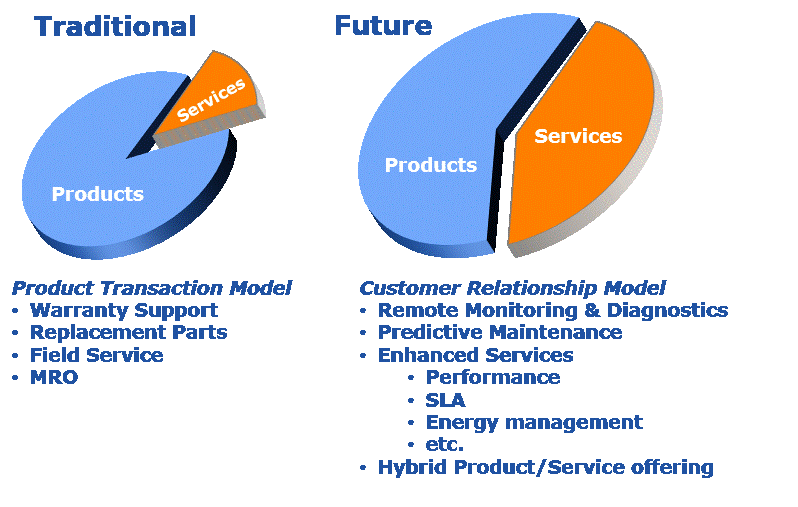 Conventionally, many industrial product companies used a variant of simple, transaction-based business model: The machine (product) was exchanged for money, then parts and services were offered for machines needing maintenance or repair. In this model, the customer engages with the machine manufacturer only during the initial transaction, and when something breaks.
With the Industrial Internet of Things, new business models become possible, potentially benefitting both the industrial customer and the machine manufacturer. Instead of reacting to a customer call when something has gone wrong, manufacturers can establish dynamic relationships with customers. They can offer better maintenance service, ensure optimal machine performance, and in some cases, guarantee machine outputs. They can offer new services such as monitoring for excessive energy consumption, identifying usage patterns that potentially impact machine health and service life, detecting operating conditions outside of design range, or recommending new settings or parameters to fine tune individual machine performance.
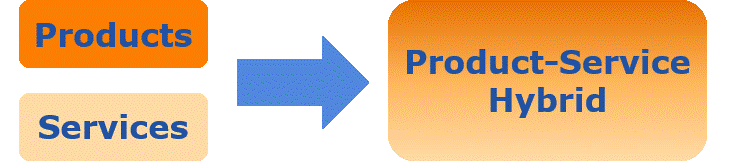 Over time, industrial companies will shift their machine buying and asset performance management protocols to take advantage of the new capabilities made possible by digitized machines and enhanced service offerings. Instead of making capital expenditures to buy machines, then contracting to support them, in certain cases they may choose to enter into service level agreements guaranteeing the outputs of machines, similar to the 'power by the hour' jet engine market model. To make this viable, machine manufacturers will need to support new product hardware and software requirements, and develop expertise in managing a data and information intensive operation. They will need new service delivery metrics and models, and will have to develop new competencies and expertise, including a new way of selling.
In order to position the company to offer new services, manufacturers need to put several pieces in place:
Machinery manufacturers have the opportunity to grow their service business beyond providing maintenance, and many are already moving along this path. There are challenges, but the requirements are well within the capabilities of industrial machinery manufacturers, who have a great deal of related technical and business expertise and experience to draw upon. The marketplace is changing, so the real question is, which companies will adapt and thrive by growing their service business - and which will not.
Posted in IIoT and I4.0 Viewpoints