Representative End User Clients







Representative Automation Clients







Representative Software Clients








Process simulation and optimization (PSO) software remains a core tool for designing, validating, and improving industrial processes. In a recent briefing, Datacor discussed its positioning of CHEMCAD as an integrated simulation platform intended to support a wide range of process manufacturing organizations.
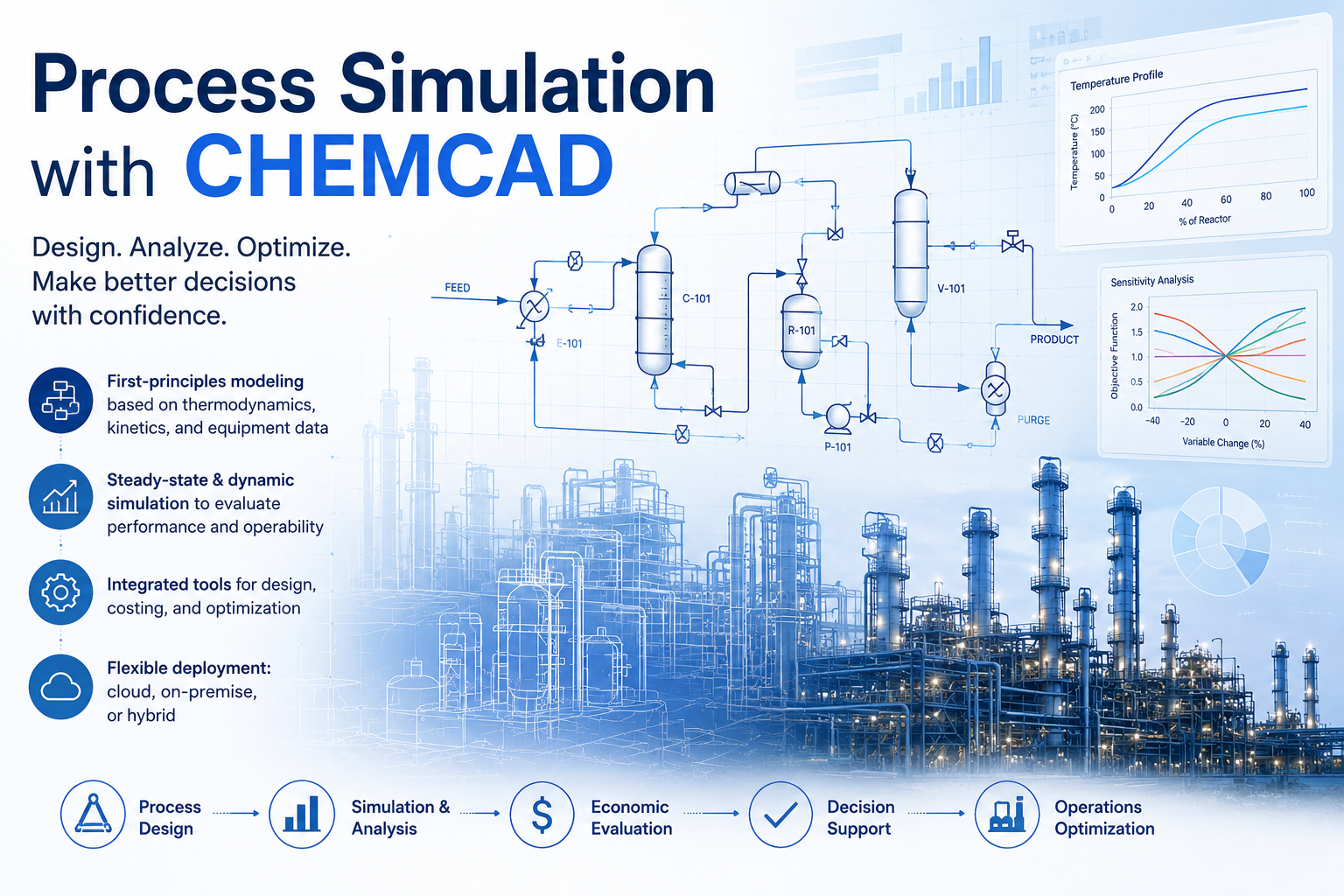
CHEMCAD is a first-principles simulation platform that models chemical processes using thermodynamics, kinetics, and equipment-level representations. It supports both steady-state and dynamic modeling, allowing engineers to evaluate operating conditions and analyze variables such as energy consumption, yield, and cost. These capabilities enable users to assess process designs and operational scenarios before making changes in a production environment.
The platform is structured as a single environment that includes capabilities such as heat exchanger design, process costing, and dynamic modeling. This approach allows users to work across multiple engineering workflows without relying on separate tools or modules.
CHEMCAD can be deployed in cloud, on-premise, or hybrid environments. This range of deployment options allows organizations to align simulation tools with existing IT strategies and infrastructure. Datacor also pointed to efforts to simplify implementation and reduce the effort associated with maintaining simulation environments.
Usability was another area highlighted during the discussion. The platform includes pre-built model libraries and training resources intended to support onboarding and day-to-day use. This reflects a broader effort to make simulation tools more usable for organizations that may not have extensive simulation expertise or dedicated teams.
These characteristics are consistent with broader shifts in the PSO market. Many organizations are looking for tools that balance modeling capability with usability and flexible deployment. At the same time, adoption of process simulation is expanding beyond traditional large-scale applications into industries such as specialty chemicals, pharmaceuticals, and biofuels, where users may have different levels of simulation experience.
Process simulation tools continue to be used to support efficiency improvements, risk reduction, and investment planning. Typical use cases include evaluating trade-offs between capital and operating costs, optimizing throughput and energy use, and validating process designs prior to implementation.
Datacor also discussed potential areas of development related to artificial intelligence. In this context, AI is positioned as a way to assist with model setup, automate elements of workflow, and improve user interaction, rather than replace first-principles modeling. The company also noted ongoing integration across its broader portfolio, including ERP, MES, and LIMS, which could allow simulation to be more closely connected to operational and laboratory data.
Datacor’s direction reflects a broader industry trend toward making process simulation tools more accessible and better integrated with other systems used in manufacturing environments. As adoption continues to expand across a wider range of industries and user types, usability, deployment flexibility, and system integration are likely to remain key considerations in how these platforms evolve.