Representative End User Clients







Representative Automation Clients







Representative Software Clients








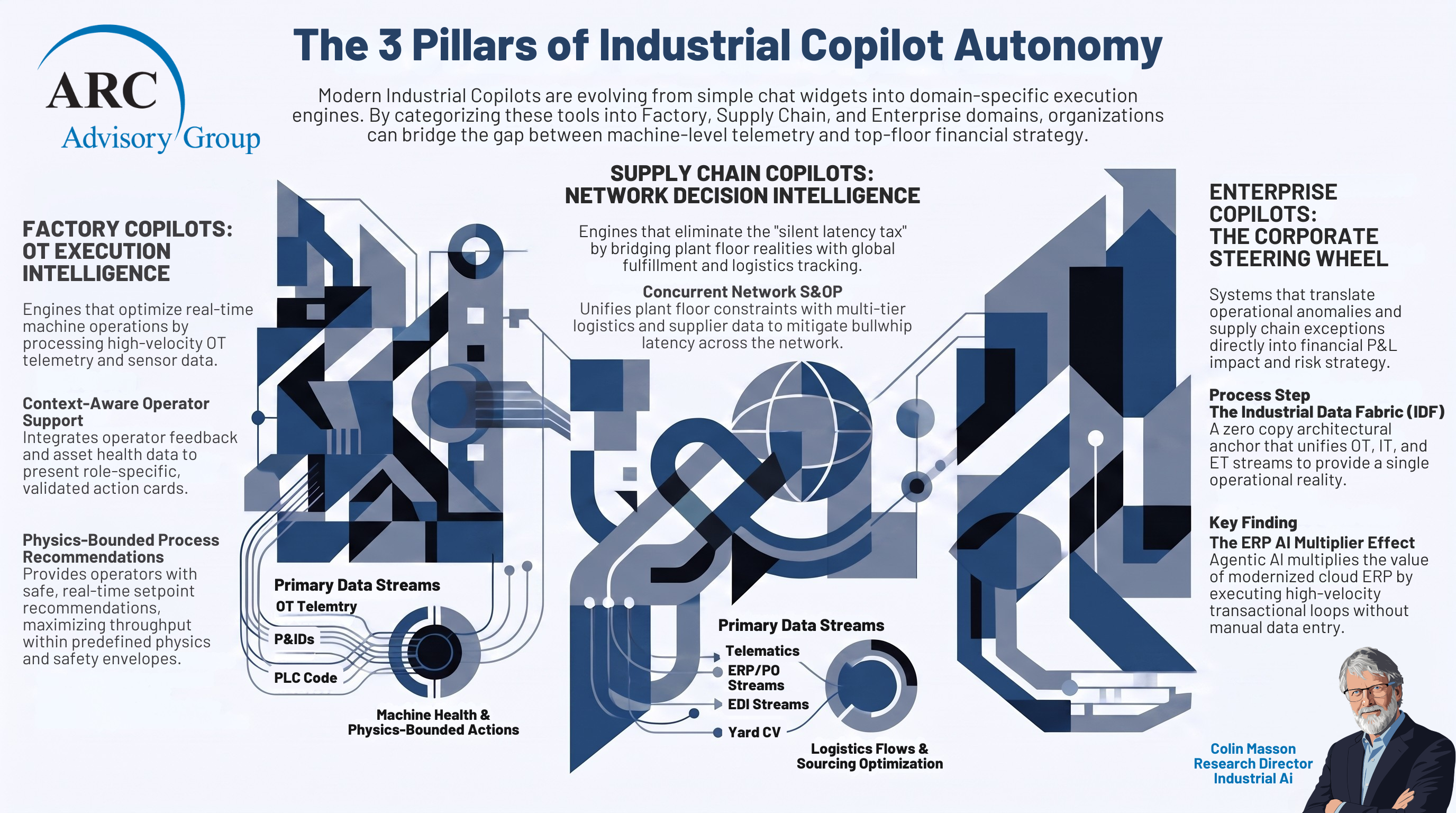
Evaluating Supply Chain Copilots through a narrow plant-floor OT lens severely distorts their enterprise value. When operational telemetry is correctly expanded to encompass logistics tracking, telematics, yard computer vision, and EDI streams, Supply Chain Copilots emerge as autonomous decision engines that bridge factory realities ("Make") with global fulfillment networks ("Source & Deliver").
In Blog 2, we introduced the power of Agent-to-Agent (A2A) protocols—highlighting how platforms like Aera Technology and FourKites allow logistics agents to negotiate trade-offs directly with enterprise decision engines. Blog 4 expands this network perspective, demonstrating why Supply Chain Copilots represent an entirely new category of Real-Time Operational Decision Intelligence (RODI).
For decades, heavy industries have paid a "silent latency tax." When a critical feed pump trips in a high-consequence operational zone, downstream logistics planning systems remain completely blind to the schedule shift for days. Conversely, when a raw material container ship is delayed at sea, the plant floor operates blind across the logistics frontline, producing inventory that cannot be shipped or running assets at suboptimal throughput.
Supply Chain Copilots eliminate this latency tax by unifying transactional ERP records with real-time physical execution streams.
| Operational Theater | Primary Operational Data Streams | Real-Time Orchestration Role (Supply Chain Copilot) |
| Plant Floor Reality ("Make") | • Live OPC UA telemetry
• Equipment breakdown events
• Batch yield deviations | Plant Outage Exception: Detects equipment failure → Auto adjusts downstream shipment windows and carrier appointments via a zero-copy knowledge graph.
|
| Global Logistics Network ("Deliver") | • Container telematics and GPS
• Port gate computer vision
• Yard Management Systems (YMS) | Port Delay/Supply Exception: Detects shipment delay at sea → Auto-reschedules plant batch grade mix and production line sequencing before a stockout occurs. |
A key taxonomy decision in ARC's MarketMap research is distinguishing between pure-play multi-enterprise networks (Supply Chain Copilots) and integrated ERP suites that contain supply chain modules (Enterprise Copilots).
Pure-play SCM platforms specialize in multi-echelon, real-time decision intelligence across complex, external, multi-vendor networks (carrier tracking, ocean exceptions, direct spend CAD/BOM parsing, and concurrent planning). In contrast, enterprise ERP platforms excel at managing core internal transactional systems of record (financial P&Ls, order-to-cash, and corporate asset ledgers). ERP vendors that deliver sophisticated supply chain capabilities rely heavily on platform-native integration across their own suites (e.g., SAP S/4HANA and SAP Digital Manufacturing, Infor OS, and Oracle Fusion) rather than open, inter-agent protocols across third-party networks.
By grouping pure-play network visibility and concurrent planning under Supply Chain Copilots, ARC highlights the decision intelligence engines bridging multi-enterprise operations. As we will demonstrate in Blog 5, this classification by no means diminishes ERP systems; rather, it sets the stage for exploring how modern cloud ERP platforms can act as the master transactional anchor for agentic AI.
| Real-Time Logistics & Execution | Enterprise Decision Intelligence & Planning | Procurement & Spend Orchestration |
| FourKites (Tracy, Alan, Sam) | o9 Solutions (APEX Agents) | Coupa (Navi Agents) |
| Project44 (Ocean Exceptions Agent) | Kinaxis (Maestro & Agent Studio) | Tacto (AI Procurement OS) |
| Manhattan Associates (WES/Labor) | Blue Yonder (Orchestrator AI) | |
| Aera Technology (Aera Decision Cloud) |
FourKites: Features an autonomous digital workforce operating within its Intelligent Control Tower: Tracy (track-and-trace exception manager), Alan (autonomous appointment scheduler), Sam (supplier collaboration manager), and YardWorks AI (gate computer vision). FourKites automates the "white space" between supply chain functions, reducing detention fees by 15 percent and cutting integration costs by 75 percent.
Project44: Operates as a specialized Movement Decision Intelligence engine, featuring the Ocean Exceptions Agent to automate maritime freight rerouting.
Manhattan Associates: A premier Warehouse Execution System (WES) and labor orchestration copilot that optimizes distribution center workflows in real time.
o9 Solutions: Features APEX Agents running on its patented Enterprise Knowledge Graph (EKG). o9's composite agents combine neural networks with symbolic mathematical solvers to detect value leakage, running real-time S&OP/S&OE scenarios that bridge top-floor financial targets with plant-floor capacity.
Kinaxis: Powered by the Maestro concurrent planning engine, Kinaxis deploys multi-agent studios paired with zero-copy data fabrics (Databricks, Snowflake) to execute instant demand-supply trade-off simulations.
Blue Yonder: Features Orchestrator AI and Luminate Ops Agents, fine-tuned on decades of supply chain IP to cut empty transit miles and optimize warehouse labor allocation.
Aera Technology: An Enterprise Decision Intelligence leader running on the Aera Decision Cloud, utilizing prepackaged "Aera Skills," Decision Ledgers, and policy-driven Policy Studio controls. In real-world enterprise deployments (such as Hershey's global supply chain orchestration), Aera's decision intelligence agents deliver $2.7 million in savings in 11 weeks and cut excess POs by 14 times.
Coupa: Features Navi AI Agents embedded in its Business Spend Management platform. Led by an Orchestrator Agent, Coupa combines conversational LLM interfaces with deterministic Llamasoft mathematical algorithms to optimize direct spend across an $8 trillion global dataset.
Tacto: Positioned as a premier mid-market AI Procurement Operating System. Tacto automatically parses complex 2D/3D CAD drawings and technical engineering BOMs to execute should-cost modeling and automated supplier RFQs for heavy manufacturing.
When evaluating candidate Supply Chain Copilots, use these six essential diagnostic inquiries during vendor RFI reviews:
Zero-Copy SCM/OT Data Ingestion: Does your copilot connect directly to live operational data warehouses (Databricks, Snowflake, Fabric) via zero-copy data sharing, or does it require copying datasets into secondary silos?
Multi-Echelon Constraint Awareness: When recommending schedule shifts or supplier expedites, does your engine cross-reference live plant-floor machine capacity and thermal limits before committing to changes?
Autonomous Exception Remediation: Can your digital workforce (track-and-trace, appointment scheduling, and ocean exception agents) execute multi-step carrier updates under human-in-the-loop policy guardrails?
Value-Stream Trade-Off Simulation: Does your platform simulate real-time S&OP/S&OE trade-offs across Source, Make, and Deliver, presenting pre-validated cost/service choices before bottlenecks occur?
Direct Spend CAD/BOM Parsing: Can your procurement agents automatically parse complex 2D/3D CAD drawings and engineering BOMs to execute automated should-cost modeling and supplier RFQs?
Open Inter-Agent (A2A) Protocols: Does your platform support open inter-agent protocols (MCP/A2A) to negotiate trade-offs natively with third-party ERP and MES platforms?
Having evaluated the network decision intelligence of Supply Chain Copilots, we now turn to the corporate steering wheel.
In our next installment, "Deep-Dive Category: Enterprise Copilots—Aligning Top-Floor Financial Strategy with Shop-Floor Execution," we examine how ERP, EAM, and hyperscaler platforms translate operational events into P&L impact. Stay tuned.
The Industrial AI (R)Evolution is moving faster than ever. To dive deeper into the frameworks and data shaping the future of the industrial sector, explore my latest research:
Navigating the AI Wars and the escalating Industrial Robot Wars
Closing the Digital Divide by Embracing Industrial AI
Assembling your Industrial-Grade Data Fabric
Charting the new frontier of Physical Intelligence and transitioning to a Cyber-Physical Industrial Architecture (CPIA)
Mapping your maturity and strategy with ARC's 3-Axis Industrial AI Models Taxonomy
Surviving the SaaSpocalypse and Taming the Tokenpocalypse by Mastering Multi-Agent Industrial Governance
Organizational Design and the Future of Industrial Work in the era of Agentic AI
Take our Industrial AI Assessment to benchmark your organization's maturity, identify critical gaps in your IT/OT/ET convergence, and get actionable recommendations to accelerate your path to becoming an Industrial AI Pacesetter (and download the 2026 Report). If you think you’re already a Pacesetter, nominate your team for the ARC Industrial Pacesetters Awards!
Don't guess what your global operations or prospective customers need. Use empirical data to align your stakeholders and de-hype the market with ARC Advisory Group's Voice of Market Service.
For tailored recommendations on governing and guiding major people, process, and technology decisions across the enterprise, cloud, industrial edge, and AI, please contact Colin Masson at [email protected].
Or, set up a meeting with my fellow Analysts and I at ARC Advisory Group to find out more about our Executive Insights Service for Industrial organizations and our Industrial AI Insights Service for Vendors.