Representative End User Clients







Representative Automation Clients







Representative Software Clients








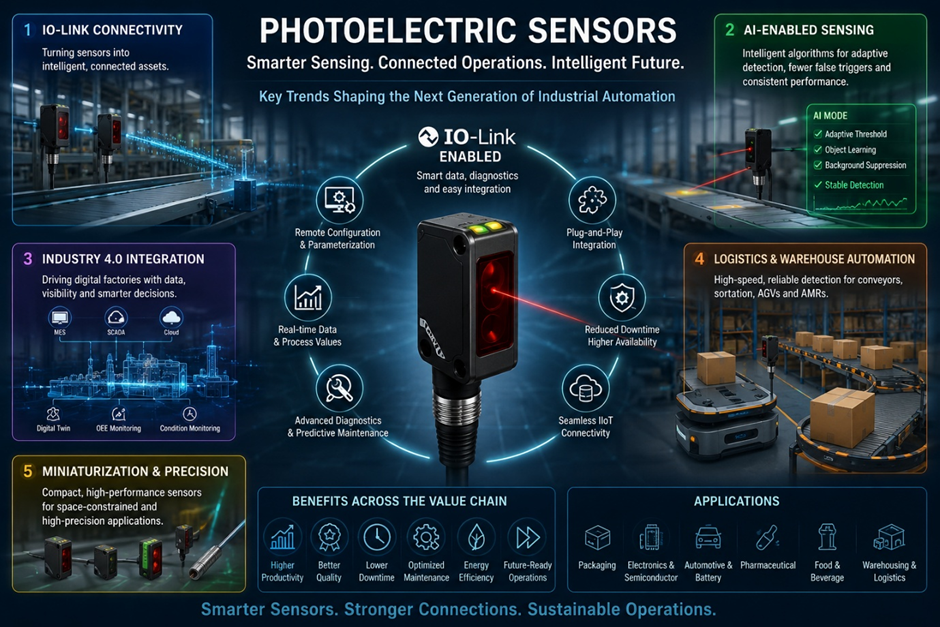
Photoelectric sensors have long served as the “eyes” of industrial automation, enabling reliable object detection, counting, positioning, and presence verification across manufacturing, packaging, logistics, and assembly environments. Their role, however, is expanding rapidly.
Today, the role of the photoelectric sensor is undergoing a fundamental transformation.
Driven by Industry 4.0, Industrial IoT, predictive maintenance, and the demand for greater operational visibility, photoelectric sensors are shifting from simple switching devices to intelligent, connected assets that generate useful machine and process data.
Recent developments from leading suppliers indicate a clear direction: the market is moving from basic detection toward smart sensing platforms that combine connectivity, diagnostics, and analytics-ready data.
ARC Advisory Group identifies five key technology trends shaping the next generation of industrial photoelectric sensors:
IO-Link-enabled smart sensing.
AI-assisted sensing and adaptive detection.
Robotics redefining proximity sensor form factors.
Wireless proximity sensing.
Miniaturization.
These trends are redefining both supplier strategies and end-user expectations.
IO-Link is becoming a baseline requirement for smart photoelectric sensors. It enables bidirectional communication, remote configuration, device diagnostics, and faster replacement through automatic parameter download.
This changes the sensor’s role from a passive field device to an active source of operational intelligence. Users gain better visibility into signal strength, contamination, alignment, and device health, supporting faster troubleshooting and reduced downtime.
Industrial environments are becoming more variable and complex. To improve reliability, suppliers are adding advanced signal processing, adaptive sensitivity, automatic threshold optimization, and environmental compensation to photoelectric sensors.
These capabilities improve detection of transparent, reflective, small, or fast-moving objects while reducing false triggers. This is especially important in semiconductor manufacturing, electronics assembly, EV battery production, pharmaceutical packaging, and high-speed logistics.
As Industry 4.0 programs mature, sensor data is moving beyond machine-level control loops into broader digital architectures. Connected photoelectric sensors can support condition monitoring, digital twins, predictive maintenance, OEE improvement, and operational analytics.
This evolution reflects a broader convergence of sensing, connectivity, and analytics. Increasingly, value is created not only by sensing performance, but also by the quality, accessibility, and usability of sensor-generated data.
E-commerce, warehouse automation, and parcel sortation are creating strong demand for compact, accurate, and connected photoelectric sensors. These sensors are critical in conveyors, automated storage and retrieval systems, AMRs, AGVs, and high-speed sortation equipment.
Logistics applications require high throughput, continuous operation, precise detection, easy maintenance, and sensing technologies that can withstand demanding operating requirements. As a result, logistics and warehouse automation remain among the most important growth areas for advanced photoelectric sensors.
Miniaturization remains another important innovation path. Compact housings, fiber-optic sensing, laser-based detection, and longer sensing ranges in smaller form factors are enabling new applications in electronics, semiconductor manufacturing, robotics, and compact machine designs.
End users should look beyond basic detection when selecting photoelectric sensors. Important criteria include IO-Link support, diagnostics, ease of integration, data accessibility, scalability, and alignment with broader digital transformation objectives.
Organizations that continue to treat sensors as commodity devices may miss opportunities to improve uptime, reduce maintenance effort, and enhance operational visibility. Smart photoelectric sensors are becoming an important building block for connected, data-driven industrial operations.
For Buyer and Supplier Strategy: Read ARC’s MarketMap blog for strategic insights on supplier positioning, buyer evaluation, and competitive differentiation in the photoelectric sensor market.
For Market Size, Forecast, and Technology Trends: Visit ARC’s photoelectric sensors market analysis page for market sizing, five-year forecasts, smart sensing trends, and sensor-to-cloud developments.
https://www.arcweb.com/market-analysis/photoelectric-sensors
For MarketMap: See ARC’s MarketMap research announcement for the study scope, market context, and supplier evaluation focus for photoelectric sensors.
https://www.arcweb.com/blog/arc-initiates-marketmap-research-photoelectric-sensors